

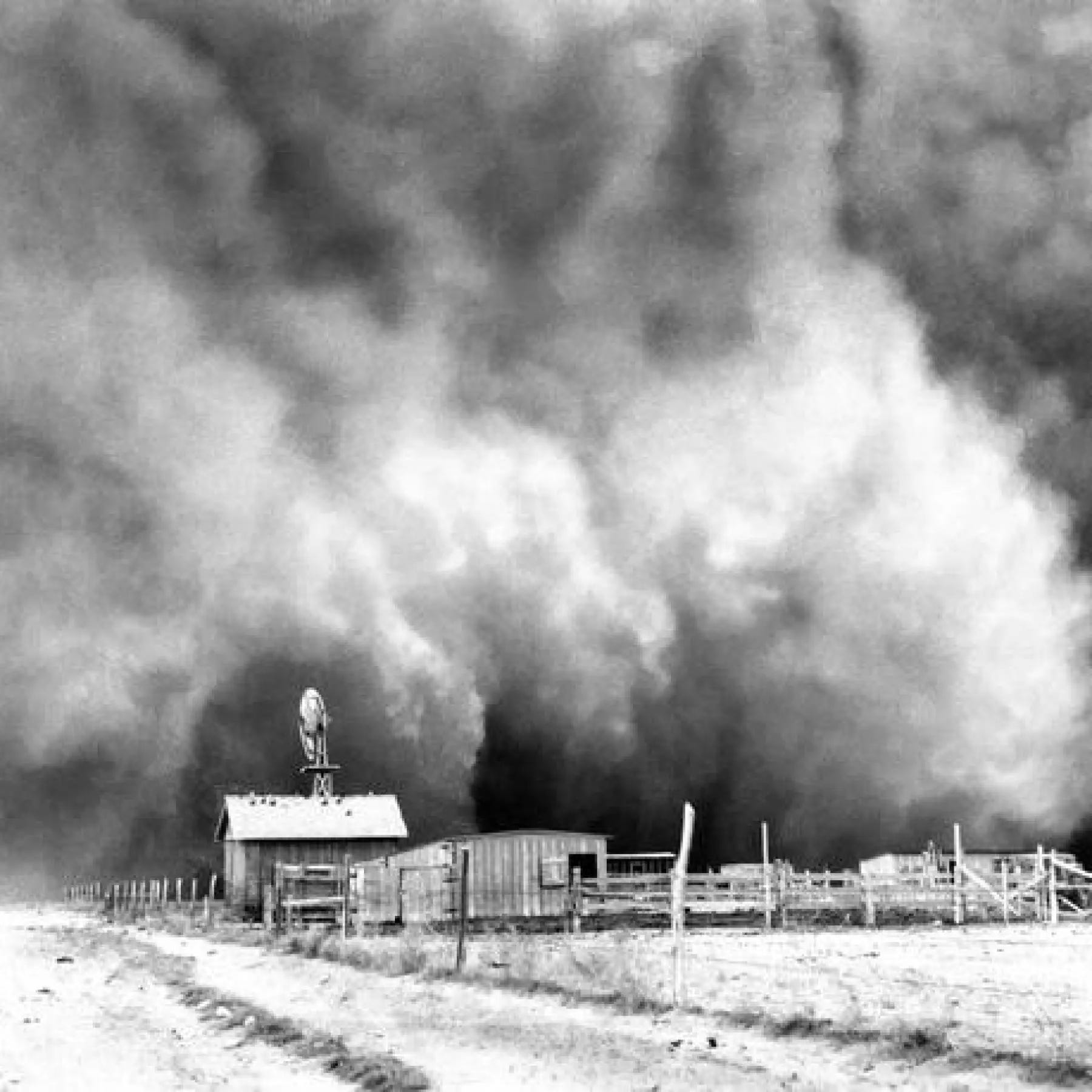
The story of the Dust Bowl can give some insight into the Bible story of Creation and the Fall. What we commonly refer to as the Breadbasket of America became a land of devastation. The rich land of the prairies was stripped bare by farmers and was over-farmed to meet the needs for wheat during World War I. A multi-year drought beginning in 1931 turned the top layer into fine dust.
By 1935, storms in the region would create black blizzards. The dust clouds choked livestock and ruined machinery. The dust got into people’s lungs as well, causing dust pneumonia. The years of bounty had given way to some very lean years. The region’s economic ruin coincided with the larger phenomenon of the Great Depression, forcing family farms into foreclosure.
Mass migration resulted. Nearly 2.5 million people moved away from Oklahoma, Texas, Kansas, and Colorado, many to California. I remember stories of my grandparents leaving their family farm in South Dakota at this time and moving out to California, employed as migrant farm workers. It also evokes the impressive Steinbeck volume, The Grapes of Wrath.
A well-known story
Bounty and destruction is a trope that shows up in the Biblical story as well, first off in the very story of Creation and the Fall. God created Adam and Eve and entrusted them with the rest of the Creation. They were stewards of the Garden. They listened to the insidious lies of the Tempter and chose to rebel against God. Through their sin of disobedience, they damaged their relationship with God and were forced to leave the Garden.
We still deal with the effects of Original Sin. G.K. Chesterton noted that Original Sin is the only dogma that you don’t need faith to believe. We have evidence every day just walking around.
Not my fault
Original Sin is distinct from personal sin.
Although it is proper to each individual, original sin does not have the character of a personal fault in any of Adam’s descendants. It is a deprivation of original holiness and justice, but human nature has not been corrupted (Catechism of the Catholic Church, 405).
So, we didn’t do anything wrong personally, but we suffer the effects of the sin committed by our First Parents. It means that we are no longer primed for paradise. We do not have original holiness and justice. We do not go so far, however, as to say that human nature is corrupt.
Wounded, but not dead
Although we are not corrupt, the effects of original sin weigh heavily on us. Our human nature:
Is wounded in the natural powers proper to it; subject to ignorance, suffering, and the dominion of death; and inclined to sin - an inclination to evil that is called “concupiscence” (Catechism of the Catholic Church, 405).
Before original sin, Adam and Eve were more attuned to God’s will through the gift of preternatural integrity, ordering their appetites toward reason and God. God still speaks to us through our conscience, but we feel it is harder to hear him. Our communication with God cannot compare with the cool evening walks in the Garden described in the Book of Genesis.
Sometimes, our conscience can be like the black blizzard clouds of the Dust Bowl. It can be hard to see clearly. As much as we try to comprehend a situation, we cannot always get to the center of the matter because our judgment has been clouded by selfishness, ignorance, and our familiarity with sin.
Good News
The good news is that this is not our definitive state. We receive from the Ancient Church the concept of felix culpa, the happy fault that won for us so great a Savior. Because man fell into sin, God sent his Son to redeem us from our sin and save us from death.
Through the Sacrifice of the Cross, Jesus merited for us the grace of Baptism. Through the pouring of the waters and saying of the words, we become adopted sons and daughters of God, and all the stain of original sin is removed from our souls. Our sin does not determine who we ultimately are. Indeed, we are called to spiritual battle, to stand up for the rights of God.
The Dust Bowl gives us an image that is helpful to understand the Fall and how it affects our humanity. The land was still good land; it had just been debilitated. The farmers were still able to work and use their ingenuity. Eventually, the land was recovered. We too should never give up in the face of sin. The Fall did not have the last word. Christ does.