

May 1st is a holiday with a lot of meanings. There is the maypole in Germany, which seems to have pagan origins. Communists took the day to celebrate the working proletariat. In the years that I have lived in countries celebrating May 1st as the day of the worker, I have always made sure to go to work, wanting to honor St. Joseph through work. Since 1955, as Catholics, we celebrate this day as the feast of St. Joseph the Worker. He shows us through his testimony the value of human work.
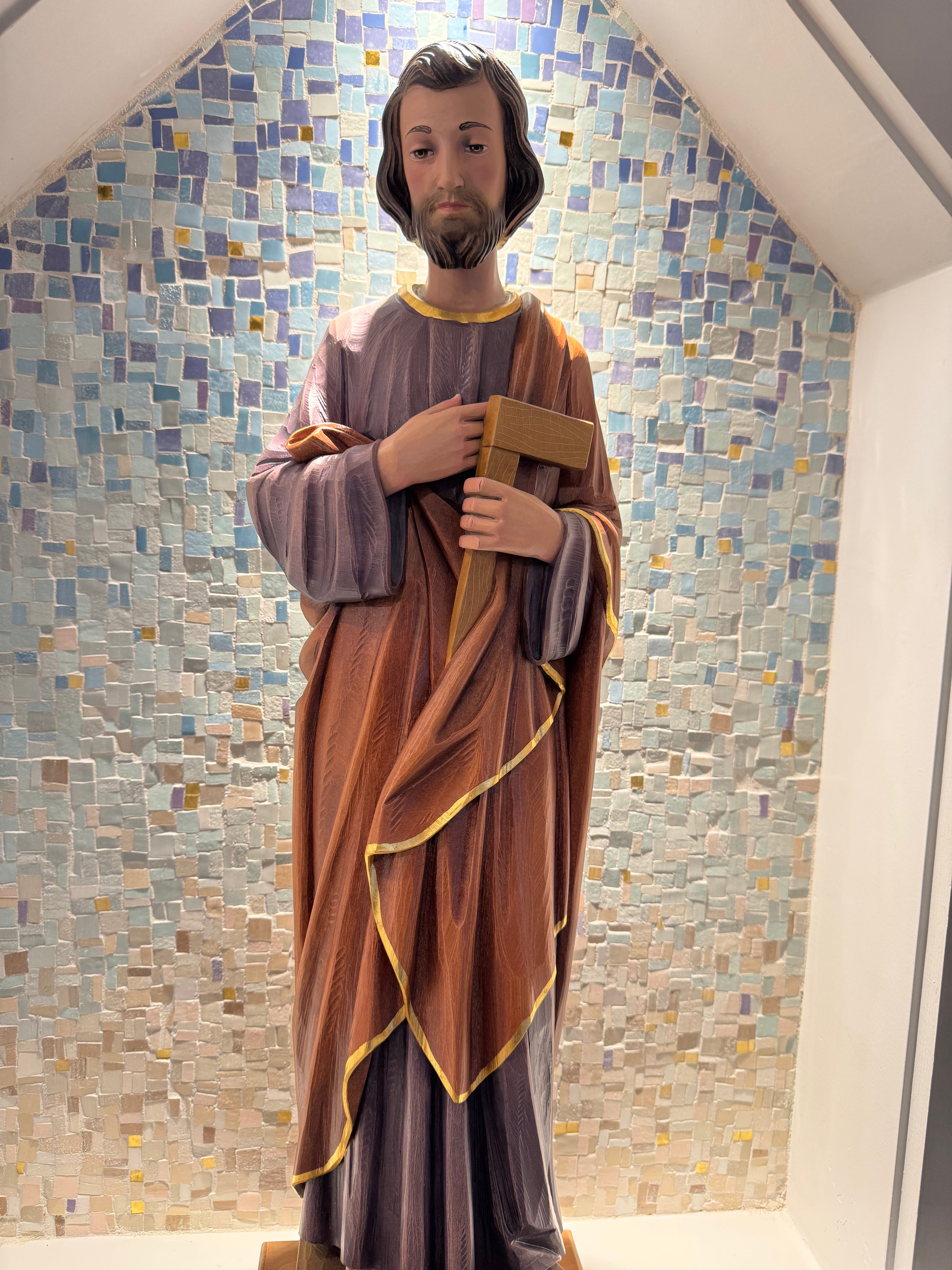
St. Joseph the Worker reminds us of our fundamental vocation. With Pope John Paul II, we can remember the original state of man in the Garden of Eden. Although there was no toil, there was certainly work. Throughout all of human history, work has been part of the human condition, although since the fall, with the unpalatable aspect of toil.
As part of our human condition, we are all called to work, expressing our participation in God’s creation. St. Josemaria Escriva spoke much of this aspect of Christian spirituality, exhorting Christians to live out their work as a path to holiness.
Work is man’s original vocation. It is a blessing from God, and those who consider it a punishment are sadly mistaken (St. Josemaria Escriva, The Furrow, 482).
Joseph didn’t just work for God. He worked with God in his carpenter’s shop. By participating in the humble work of shaping wood into tables and chairs, Jesus himself furthered the work of creation and showed us that work can be holy and sanctifying. This contrasts with much of the image of work as experienced during the Industrial Revolution.
With the social upheaval of the 19th century, the nature of work was transformed. Agrarian societies weakened as the masses congregated in cities to provide workers for factories, whose numbers were ever-growing. As individuals and families suffered abuse, groups sprouted up to defend the rights of workers. The suffering of the time lent sympathy to socialist ideas.
Even before the appearance of the Communist Manifesto in 1848, Popes have warned about the dangers of Atheistic Communism. Pope Leo XIII noted how Communism is a poisonous doctrine and responded with his monumental document Rerum Novarum, giving a Christian reading key to the new reality brought about by the Industrial Revolution.
In 1955, Pope Pius XII instituted the feast day of St. Joseph the Worker on May 1, as a competition to the Communist holiday of the Worker, seeking to drive division and social unrest.
More recently, Pope Francis reminded us of the quiet strength of St. Joseph.
Each of us can discover in Joseph – the man who goes unnoticed, a daily, discreet and hidden presence – an intercessor, a support and a guide in times of trouble. Saint Joseph reminds us that those who appear hidden or in the shadows can play an incomparable role in the history of salvation. A word of recognition and of gratitude is due to them all (Pope Francis, Patris Corde).
Rather than interpreting human work as the faceless mass of the proletariat, Christians are called to see the dignity of each human being and make sure that work is a participation in God’s own work of creation. We face a particular challenge as our work moves further away from the physical crafting and shaping of materials. Yet even our intellectual work can participate specially in God’s divine plan for humanity. Our work can bring us closer to God, just as it did for St. Joseph, who worked side by side in his carpenter’s shop with the Son of God. Your work is not just something you do, but rather a place to encounter God.
Great article, Father! The topic of work reminded me of something Caryll Houselander talks about in "The Reed of God":
"We could scrub the floor for a tired friend, or dress a wound for a patient in a hospital, or leave the table and wash up for the family; but we shall not do it in a martyr spirit or with that worse spirit of self-congratulation, of feeling that we are making ourselves more perfect, more unselfish, more positively kind.
We shall do it just for one thing, that our hands make Christ's hands in our life, that our service may let Christ serve through us, that our patience may bring Christ's patience back to the world.
By His own will Christ was dependent on Mary during Advent: He was absolutely helpless; He could go nowhere but where she chose to take Him; He could not speak; her breathing was His breath; His heartbeat in the beating of her heart.
To-day Christ is dependent upon men. In the Host He is literally put into a man's hands. A man must carry Him to the dying, must take Him into the prisons, workhouses, and hospitals, must carry Him in a tiny pyx over the heart onto the field of battle, must give Him to little children and "lay Him by" in His "leaflight" house of gold.
The modern world's feverish struggle for unbridled, often unlicensed, freedom is answered by the bound, enclosed helplessness and dependence of Christ — Christ in the womb, Christ in the Host, Christ in the tomb.
This dependence of Christ lays a great trust upon us. During this tender time of Advent we must carry Him in our hearts to wherever He wants to go, and there are many places to which He may never go unless we take Him to them"