

Few twentieth-century figures understood the power of truth better than Karol Wojtyła. He spent his youth under two totalitarian regimes that depended upon lies to survive. As a young man, he witnessed the German invasion of Poland. The Nazis controlled society and severely restricted every aspect of daily life. He joined the Rhapsodic Theater as a form of cultural resistance. By proclaiming Polish literature aloud, he and his friends made sure to continue seeking truth in a world full of lies. As his friends discussed the possibility of taking up arms, Karol was wrestling with the question of whether he should become a priest.
Eventually, the vocational pull grew too strong, and he decided to join the seminary. This meant abandoning his government-ordered job to disappear from the world in his pursuit of the priesthood. To avoid detection, Archbishop Sapieha required clandestine formation, with seminarians living and studying at the bishop’s palace under conditions of strict secrecy. The Nazis were right to fear the formation of future priests. Truth ultimately outlasts totalitarianism.
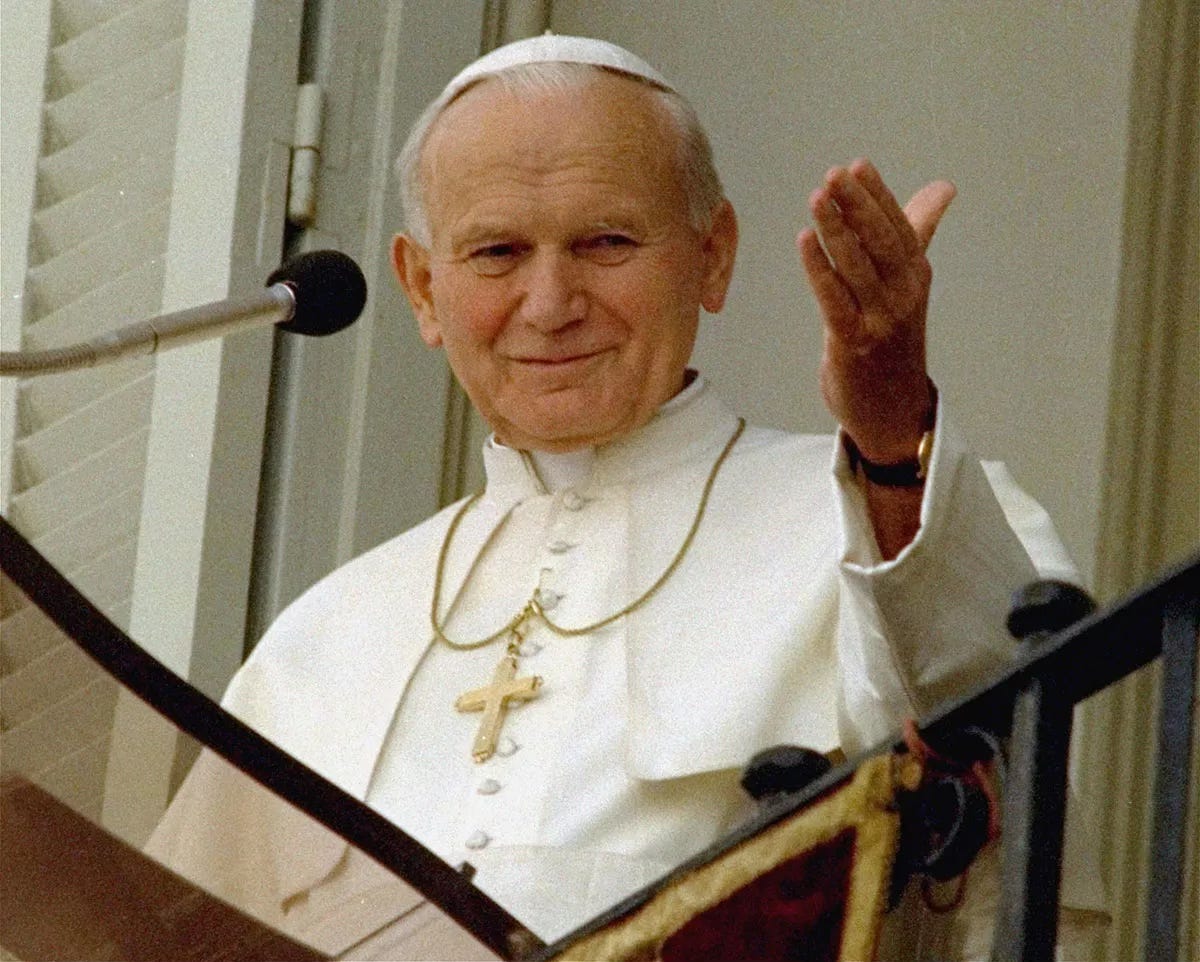
Struggle Against Totalitarianism
The close of the war meant simply exchanging one sort of oppression for another for the Poles. The Soviets replaced the Nazis, establishing Poland as a puppet state. Lies ruled once again. Wojtyła’s priesthood and episcopacy would be marked by playing a deadly game of cat and mouse with the new regime. His strong philosophical and theological background ensured that he would not cave to their desires to obfuscate the truth. Rather, it hardened his conviction to seek the truth above all else.
As a philosophy professor at Jagellonian University, he helped young people reflect on truth. As a pastor, he proclaimed the Gospel from the pulpit. Yet, as a priest living under communist rule, he constantly had to sift through propaganda and deception to discern what was really happening.
The Soviets famously manipulated information and tried to rewrite history. After the Bolshevik Revolution of 1917, history itself “became an area of strict political control. It was supposed to serve the current political interests of those in power and the Soviet Empire” (Anna Zofia Cichocka, “Historical Fallacies in Communist Propaganda”).
Every totalitarian regime depends on a series of lies and deceptions. Karol Wojtyła knew from his own experience that totalitarianism cannot survive the truth. His own life would become a sustained witness to reality against ideology. His thought on the subject would also span the question of the relationship between faith and reason.
Theological Reflection
He wrote extensively on the topic in his 1998 encyclical, Fides et Ratio, “On Faith and Reason.” The first lines of the encyclical are some of the most poignant of all his years of the pontificate.
Faith and reason are like two wings on which the human spirit rises to the contemplation of truth; and God has placed in the human heart a desire to know the truth – in a word, to know himself – so that, by knowing and loving God, men and women may also come to the fullness of truth about themselves (Pope St. John Paul II, Fides et Ratio, 1).
He had already reflected on truth regarding moral theology in Veritatis Splendor, “The Splendor of Truth.” However, his opening to Fides et Ratio always strikes me as a veritable homage to truth. Veritatis Splendor focuses on truth in moral action, while in Fides et Ratio, Pope John Paul II focuses on truth in intellectual knowing. God himself has placed in the human heart the desire for truth. Knowledge of self and others, leading ultimately to knowledge of God, is a recurring theme in the thought of Karol Wojtyla.
Philosophical Grounding
Wojtyla’s commitment to truth was not merely political or pastoral. It was grounded in a philosophical vision of the human person and our capacity to know reality. A realist epistemology recognizes the existence of objective truth, at the same time that it admits that this objective truth can be difficult to attain. Truth is objective, but our access to it is personal. Each of us approaches reality through our own experiences, knowledge, and limitations. My experience, my past knowledge, and even my emotions can color the data that I perceive from the outside world.
This does not imply any opposition or contradiction between faith and reason. Both modes of knowing can be modes of arriving at the truth, and they even build on one another.
The human spirit is called to rise to the contemplation of truth. This imagery reminds us that truth is a good to be pursued. There is a fundamental relationship, even between what is true and what is good. The transcendentals remind us that truth and goodness belong together. To pursue the good fully, we must also seek the truth about it.
Wojtyła’s engagement with phenomenology, especially through the work of Max Scheler, deepened his appreciation for the world of human experience and value. Value is inherently related to good. Value arises when a good is recognized and freely affirmed by a person. Increasingly, narrative, not truth, becomes the organizing principle of public discourse.
Looking to Today
Rather than truth-telling, much of our public discourse seems to become marketing. Social media rewards attention, not necessarily accuracy. Political discourse rewards loyalty to tribes more than fidelity to reality. In such an environment, Wojtyła’s insistence on seeking truth together becomes increasingly relevant.
Karol Wojtyła understood the value of truth his entire life. Being subjected to totalitarian regimes sharpened his awareness of the danger of lies. If we are going to be truly disciples of truth, we need to learn to question the narratives that whirl around us and go to the heart of the matter. Not only will this help us have a firmer grasp on reality, but it will also make possible a civilization of love. Totalitarian regimes fear the truth because the truth exposes reality. Free societies need the truth because only truth can sustain genuine freedom. For Wojtyła, truth was not an abstraction to defend but a reality to live. Without it, neither freedom nor love can endure.