

The occupation of Poland, first by the Nazis and then by the Soviets, taught Karol Wojtyła that attacks on freedom begin with attacks on truth. Throughout his philosophical and papal writings, he would argue that freedom detached from truth inevitably becomes either license or tyranny.
Bringing Polish Experience to the World Stage
Upon being elected Pope in 1978, Karol Wojtyła faced the challenge of bringing his experience of Poland to the universal Church. He had developed a strong voice demanding freedom. He had long supported the aspirations that would later find expression in the Solidarity Movement. He had advocated for building a church in the fully socialist city of Nowa Huta. He felt the hand of God, however, in the votes of his fellow cardinals and took up the papal mantle in an attitude of obedience.
He witnessed firsthand how Communist authorities controlled the press, censored publications, and restricted public discourse. His own appointment as bishop had been a miscalculation by Soviet authorities trying to place an innocuous candidate as auxiliary bishop of Krakow in 1958. He would end up being a great champion of truth and oppose the Communist authorities with every fiber of his being.
Although he had to leave Poland behind, his observation of his home country continued from the Apostolic Palace in Rome. Upon witnessing the breakup of the Soviet Union, he celebrated the newfound freedom of Poland. He did lament, however, certain corruptions of freedom he perceived in his homeland.
Freedom in Catholic Social Doctrine
1991 marked one hundred years since the publication of Rerum Novarum, Pope Leo XIII’s groundbreaking document articulating Catholic Social Doctrine in the face of the Industrial Revolution. Several Popes of the 20th century had written encyclicals building upon Rerum Novarum, responding to the social ills of their own days. Pope John Paul II had already written about the value of work in Laborem Exercens. He had responded to other social problems in Sollicitudo Rei Socialis.
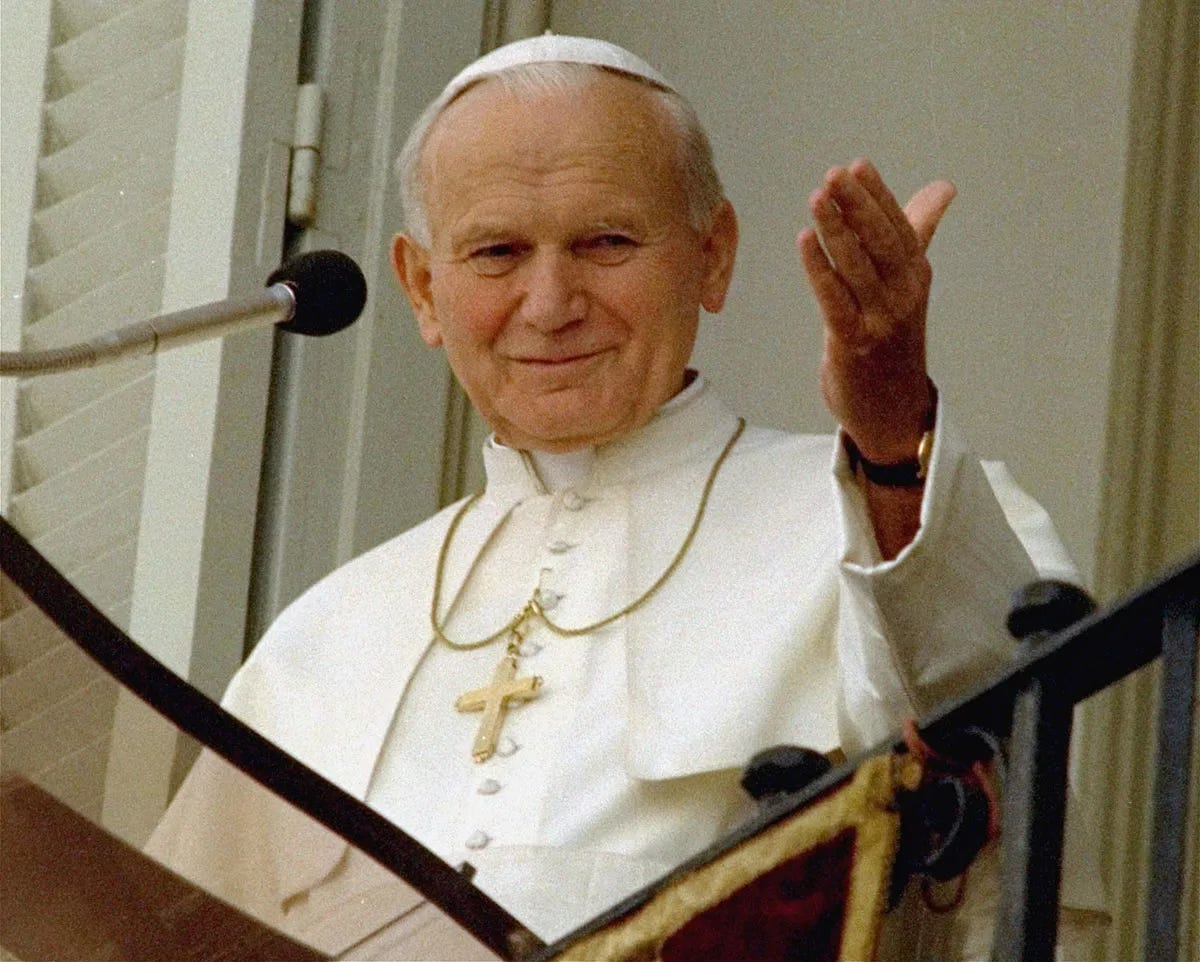
In Centesimus Annus, he spoke out about freedom and truth once again, but sobered by some of the negative tendencies from the West flooding the former Soviet republics, particularly Poland. Instead of true freedom, license was spreading in the formerly oppressed places. John Paul II believed that both totalitarianism and license ultimately stem from a rejection of truth. In his encyclical, he reminded the world of the
essential bond between human freedom and truth, so that freedom which refused to be bound to the truth would fall into arbitrariness and end up submitting itself to the vilest of passions, to the point of self-destruction (Pope St. John Paul II, Centesimus Annus, 4).
Truth over Tyranny
It can be hard for us to understand, as we are so inundated with the idea that absolute freedom is a basic value. However, even when standing up to totalitarianism and rejecting the claims of Marxist socialism, Karol Wojtyła recognized that the greatest evil was not the overt oppression of freedom but rather the suppression and manipulation of truth. Truth exposes the lies upon which totalitarian systems depend.
Pope John Paul II witnessed it from afar when the Solidarity Movement achieved a peaceful revolution in the Gdansk shipyard. Lech Wałęsa led the independent trade union and pressured the authorities to concede real freedom. The union would grow to have 10 million members and played a pivotal role in the eventual downfall of Communist rule in Poland. Freedom flourishes when society acknowledges reality rather than ideology.
Value of Christian Anthropology
Because the defense of truth requires a correct understanding of the human person, Karol Wojtyła devoted much of his philosophical work to Christian anthropology. Knowing who we are as human beings helps to determine so many other questions of life. It is true that
from the Christian vision of the human person there necessarily follows a correct picture of society (Pope St. John Paul II, Centesimus Annus, 14).
Through Christian anthropology, we know that man is naturally social. He is called to support the Common Good. These anthropological principles help us build a society that promotes authentic human flourishing and development.
Relation of Anthropology to Ethics
Ethics “has occupied itself very earnestly with the act and with man” (Karol Wojtyła, Person and Act, p. 104). All of ethics is primarily the study of acts that imply the person as agent. Man’s acts determine his moral character. Our human nature invites us to know truth and to do good. By recognizing this, we are able to build up the society that will be most effective at promoting true human development and flourishing.
The Catechism of the Catholic Church, one of Pope John Paul II’s masterpieces, describes freedom in the following way.
Freedom is the power, rooted in reason and will, to act or not to act, to do this or that, and so to perform deliberate actions on one’s own responsibility (Catechism of the Catholic Church, 1731).
This ability to act or not to act is inseparable from moral responsibility because every human action proceeds from a person who freely chooses. Here Wojtyła’s understanding of action differs sharply from Marxist approaches that emphasize historical processes and collective force over personal agency.
Refutation of Marxism
Marxist thought tends to evaluate actions primarily according to their historical or economic effects rather than the moral responsibility of the acting person. Wojtyła objected that every action originates in a person who remains morally accountable for what he chooses. By removing the person from the moral calculation, there is a risk in such thought to detach from truth and to judge all actions as morally neutral. When truth about the human person is obscured, power can replace morality as the measure of action. The result is often some form of totalitarianism.
Realism helps us to see that
man, who was created for freedom, bears within himself the wound of original sin, which constantly draws him towards evil and puts him in need of redemption (Pope St. John Paul II, Centesimus Annus, 25).
Thus, it is not surprising when human beings use their freedom to commit evil deeds. We all bear the wound of original sin. When evaluating the freedom afforded to its population by a society, there should be consideration for the moral character of the people. They should be using their freedom to choose what is good, not what is evil. Freedom does not survive by casting off all limits. It endures only when it remains rooted in the truth about God, man, and the moral order. Detached from truth, freedom becomes license. United to truth, freedom becomes the path to authentic human flourishing.
Faith and Reason Series
Faith and Reason: Two Ways of Knowing