

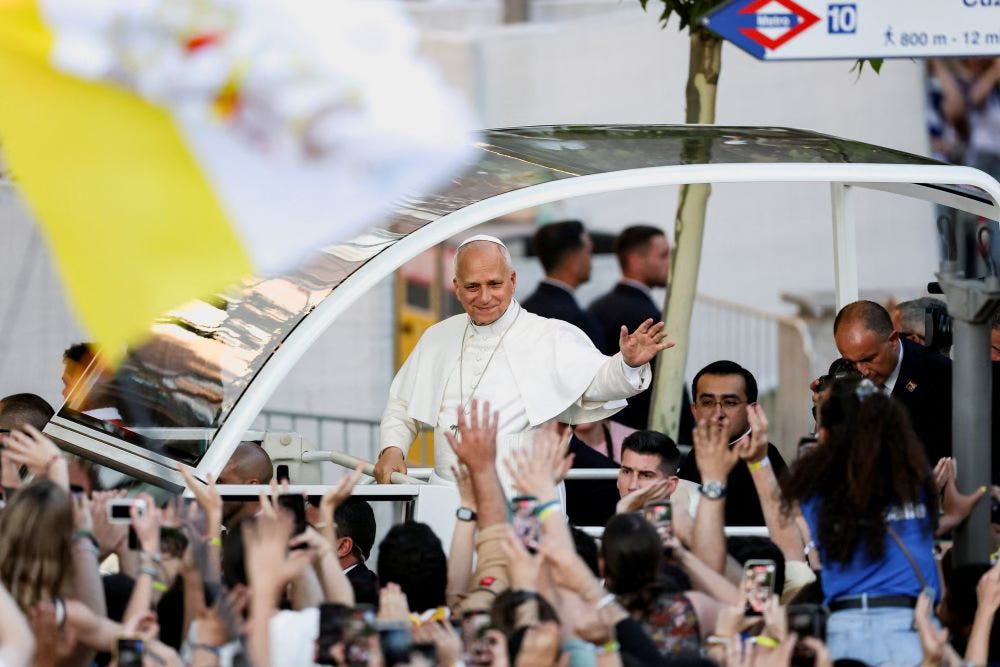
Pope Leo XIV’s recent pastoral visit to Spain inspired hundreds of thousands of people. Many came away moved by his words and witness, sensing a desire to take their faith more seriously. Inspiration is a gift, but it naturally leads to a question: “What do I do now? Where do I start?”
It’s a great question, and one we should be able to answer. If I had to recommend one realistic starting point for most young adults, it would be this: commit to thirty minutes of daily prayer, participate faithfully in Sunday Mass, and go to confession regularly.
The goal is not to do everything at once. The goal is consistency. A simple prayer routine practiced faithfully over months and years will bear far more fruit than an ambitious plan abandoned after a few weeks.
Daily Mass
Daily Mass seems to be one of the most effective ways to grow deeper in our faith. It guarantees contact with Sacred Scripture, and if we are in a state of grace, we can receive Communion. Hopefully, the words the priest shares in the homily edify, encourage, and nourish us spiritually. Arriving a few minutes early and staying a few minutes afterward helps us to receive more spiritual fruit from the experience. I like it because even when we are distracted, we are sure to be growing.
Rosary
This is an example of vocal prayer – praying with our lips with pre-fabricated prayers – that has a deep tradition within Christianity. The Rosary invites us to meditate on the mysteries of Christ’s life, so it serves as a constant anchoring of our spiritual lives in the Word of God. It invites Mary to accompany us on the path of holiness. St. Bernard of Clairvaux coined the phrase, de Maria numquam satis (you can never get enough of Mary), and I am inclined to agree.
Lectio Divina
Taking Sacred Scripture in hand each day and praying with it opens a powerful path to transformation. By reading, meditating on, and applying God’s word to our lives, we gradually learn to think with God’s mind and conform our lives to his will. Down through the centuries, this has been a preferred mode of prayer for the saints.
Adoration
“Eucharistic adoration” refers to spending time in front of the consecrated host. Jesus is truly there, either in the tabernacle or solemnly exposed in the monstrance. Spending time in front of the Eucharistic Lord always bears fruit, even when we do not immediately perceive it. Pope John Paul II would speak frequently of his experience of the Eucharist. He tried to communicate some of his own devotion to the faithful in his Encyclical Letter, Ecclesia de Eucharistia.
It is pleasant to spend time with him, to lie close to his breast like the Beloved Disciple (cf. Jn 13:25) and to feel the infinite love present in his heart. If in our time Christians must be distinguished above all by the “art of prayer”,48 how can we not feel a renewed need to spend time in spiritual converse, in silent adoration, in heartfelt love before Christ present in the Most Holy Sacrament? (Pope Saint John Paul II, Ecclesia de Eucharistia, 25).
Our time in front of the Blessed Sacrament can be flexible. We might apply some of the other spiritual practices, such as lectio divina or praying the rosary. We may also simply rest in silence before the Lord, pouring out our hearts before him and leaving silent spaces for him to speak to us.
Examination of Conscience
Before we go to confession, we try to examine our consciences to see how we have failed to correspond to God’s love. We repent of the evil we have committed, and we go before God’s representative to ask for pardon and peace. The practice of examination of conscience can be fruitful in other moments as well. I like to examine my conscience every day. It helps me to see what is going on in my life, hopefully before I go too far off the rails.
Getting Started
All of these practices have borne fruit in the lives of countless saints and ordinary Christians. Of them, daily Mass has had the greatest impact on my own spiritual life. If I wanted to start tomorrow, I would look for how many daily Masses I can fit into my weekly schedule, then assign the other spiritual practices to the remaining days.
There are obviously many more things we could do to jumpstart our spiritual lives. Some people would suggest that we need to spend much more than 30 minutes a day. I suggest starting with 30 minutes, and then talking to a mentor in the spiritual life before increasing the daily commitment. I have seen too many people try to take on longer commitments, only to fail and end up doing nothing to take care of their spiritual lives. 30 minutes might not seem like much, but over the course of a year it adds up to over 180 hours. If that is 180 hours more than last year, you can be sure it is going to affect your spiritual life.
The important thing is to start and persevere. God does not ask us to become saints overnight. He simply asks us to meet him each day. Thirty minutes may not seem like much, but over time those small daily encounters can transform an entire life.