

Sometimes, you see people going through really difficult times. The other day, I was speaking to a friend, obviously frustrated and overwhelmed about her future. How do you juggle finishing your education, finding and marrying a spouse, raising children, and having a successful career? It can get to the point that you are not sure what life is all about. This happens to us especially when we take our eyes off of what is most important. This life gains meaning and purpose to the extent that we put Jesus Christ at the center. The problem may not be that we have too many things to do or that life seems too complex. Rather, maybe we are trying to make all of those things carry a weight they were never meant to carry.
Karol Wojtyła had moments to consider his own future rather grimly. He had lost his brother and both of his parents. The Nazi occupiers were replaced by Soviets who controlled the government of the country he loved so much. Even from a young age, he possessed what we might characterize as the “folly of the saints” and it came out clearly in his first encyclical, Redemptor Hominis, proclaiming Christ to be the Redeemer of Man.
While others look to the Second Vatican Council as an abandonment or at least a departure from traditional Catholic living, Wojtyła saw it as a necessary step in the ongoing mission of the Church. Only by opening the windows of the Church to the world, as Pope St. John XXIII envisioned the historic meeting of bishops in Rome, could the Church hope to dialogue with a world that had changed so radically in countless ways. Wojtyła didn’t see engagement with the world as abandoning Christ. He saw it as a way of bringing Christ into the modern world.
In the Steps of Paul VI
Cardinal Wojtyla saw the former Archbishop of Milan as a prophetic voice. Cardinal Montini was going to inherit a curious situation when he took the reins of the Church as Pope Paul VI upon the death of Good Pope John. In the Church of Pope Pius XII and Humani Generis, Archbishop Roncalli, Monsignor Montini, and Fr. Wojtyła looked ahead 50 years to the dawn of the third millennium. Aware of the problems of their times, with the risk of nuclear proliferation and worries about tremendous change in society, they were nevertheless more excited about the fact that Jesus was going to influence the third millennium.
In the encyclical, Pope St. John Paul II saw himself in continuity with Pope St. Paul VI even to the point that he continued some of the same self-questioning about the direction of the Church. To be Pope is an amazing thing because the man can do a lot to steer the rudder of the Barque of Peter, but he is mandated to listen closely to the whisperings of the Holy Spirit. He felt a strong calling to foster a new advent in the Church while serving as a good shepherd, called to care for the sheep.
Learning from Architecture
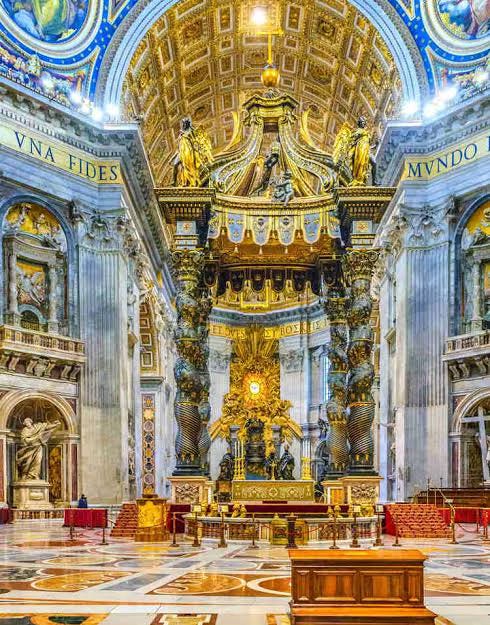
In the Basilica of St. Peter’s in Rome, the words of Jesus and Peter adorn a banner going around the church. When one turns toward the center of the church from the image of Our Lady of Good Help, he sees the words, strengthen your brethren. In addition to feeding the sheep, Peter was called to strengthen his brethren once he turned back from his betrayal of Jesus. The words are emblazoned there to remind all successors of St. Peter that they are called to strengthen their brethren, first their brother bishops and through them the entire Church.
Walking through the Basilica and reflecting on the various encounters of Jesus with Peter is always striking. How much deeper must the experience be for the Pontiffs wandering through when all the pilgrims are absent? I loved visiting St. Peter’s early in the morning, with barely anyone inside. You felt like you were locked in a museum, but something with greater significance than a museum. For the Popes, it is almost like a time machine, transporting them to the time of Jesus, and they take their marching orders from him. This is not in the sense that they physically hear the voice of Christ, but their habits of prayer help them to make a deep experience. At least, that’s the way I imagine it. The Pope, too, has to remember that he is not the center. Pope John Paul II expresses this beautifully in his poem, “The Floor.” Just like Peter, the Pope is there to strengthen his brethren by pointing them toward Christ.
Walking Toward Jesus
From the first days of his pontificate, and throughout the more than quarter century that followed, John Paul II was always walking toward Christ and inviting the Church to follow.
Our spirit is set in one direction; the only direction for our intellect, will, and heart is towards Christ our Redeemer, towards Christ the Redeemer of man. We wish to look towards him because there is salvation in no one else but him, the Son of God (Pope St. John Paul II, Redemptor Hominis, 7).
In the recent note from three dicasteries in the Vatican, the Church reminds us again today that Jesus is the one savior of mankind. While there is a shared heritage between Christians and Jews, Christians cannot look to Judaism as a parallel path of salvation (cf. Dicastery for the Doctrine of the Faith, Dicastery for Promoting Christian Unity, Dicastery for Interreligious Dialogue, “Note. A Journey of Hope. Sixty Years of Interreligious Dialogue and Fraternity in the Light of the Conciliar Declaration Nostra Aetate”). Remembering the Congregation for the Doctrine of the Faith’s Declaration Dominus Iesus (2000), there is a consistent insistence on Jesus as the unique savior of mankind. This insistence is due, in large part, to the pontificate of Pope John Paul II.
The Church has always been aware, and the Council developed the need to see Christ as the head through whom we exist. He is the way, the truth, and the life, and the resurrection and the life. Because of Christ, the Church is a “kind of sacrament or sign and means of intimate union with God, and the unity of all mankind” (Pope St. John Paul II, Redemptor Hominis, 7). In the first part of the 20th century, much theological reflection had revolved around the sacraments and the need for a renewed life of the Church. We can look at the efforts of the Council Fathers as a deep dive into this renewed theology and a presentation of the same perennial truths to the modern world. Wojtyła always admired the work of the Council and did his best to promote its work throughout his pontificate.
Need for Return
John Paul II recognized the need of the Church to return constantly to Christ. With Peter, the Church recognizes the unique role of Jesus Christ. Being God, he speaks to man also as man. This is part of what gives Christ such an incisive insight into the meaning and purpose of the life of every human being.
We may experience suffering and abandonment. In Jesus, we find the God-man who also suffered physical pain and abandonment. In the Eucharist, the Church finds her “‘fountain of life and holiness,’ the efficacious sign of grace and reconciliation with God, and the pledge of eternal life” (Pope St. John Paul II, Redemptor Hominis, 7). So much of what the Church is a source of grace and redemption to others, as her mission is an extension of Christ’s mission. This is how she “stays within the sphere of the mystery of the Redemption, which has become the fundamental principle of her life and mission” (Pope St. John Paul II, Redemptor Hominis, 7).
When we are going through difficult times, we need to turn to Jesus and his Church, remembering that we receive the sacraments of salvation so that we can be happy with him forever in Heaven. We don’t begin by managing our lives. We begin with Christ.