

Is the “Spirit of Assisi” a spirit of heresy? During the pontificate of Pope St. John Paul II, some people criticized the “Spirit of Assisi” that arose following his 1986 World Day of Prayer for Peace in Assisi. World religious leaders gathered in the Italian hometown of St. Francis to pray for peace, each according to his own religious tradition. Was this a departure from orthodoxy for John Paul II? Was he possibly falling into the indifferentism that he had warned about in his first encyclical? John Paul II did not enter into dialogue because he believed all religions were equally true. Since he took Christ seriously, he could not treat others indifferently.
Champion of Ecumenism
Because of his faith in Jesus as the Savior, Pope St. John Paul II championed ecumenism. This raised more than a few eyebrows and drew criticism from many. His zeal for ecumenical dialogue was evident from the first encyclical of his pontificate, Redemptor Hominis, “The Redeemer of Man,” and its focus on the person of Jesus Christ. He laid out the
problem of Christian unity with evangelical clarity as a simple consequence of the will of Jesus Christ himself, our Master, the will that Jesus stated on several occasions but to which he gave expression in a special way in his prayer in the Upper Room the night before he died: “I pray... Father... that they may all be one” (Pope St. John Paul II, Redemptor Hominis, 6).
If Jesus himself is calling for unity with practically his dying breath, John Paul II saw it as his mission to respond to that call. What is amazing in Pope John Paul II’s first encyclical is that it truly outlines the program of his pontificate. He introduces themes in his first writing to the whole Church that he will end up developing over the next twenty-five years of his pontificate. Throughout his papacy, he reflected on the relationship between Christian unity, religious dialogue, and the Church’s universal mission.
Being a man deeply imbued with the spirit of the documents of the Second Vatican Council, he reflected deeply on the reframing of the Church’s relationship with the world proposed by Nostra Aetate. The Church recognizes what is true within other religions and recognizes that they may seek answers to fundamental human questions. Nevertheless, the Church continues to proclaim Christ as the one Savior of mankind.
Ecumenism and Interreligious Dialogue
Ecumenism refers to the dialogue between Christian traditions, while interreligious dialogue refers to dialogue with non-Christian religions. John Paul II never missed an opportunity to further ecumenism and interreligious dialogue through his teaching. His enthusiasm did not stem from the false doctrine of universalism: the belief that all people are going to Heaven and that all religions are the same. Nor does it stem from indifferentism, which he condemns in the same breath as he speaks about ecumenism in this first encyclical.
Some even express the opinion that these efforts are harmful to the cause of the Gospel, are leading to a further rupture in the Church, are causing confusion of ideas in questions of faith and morals and are ending up with a specific indifferentism. It is perhaps a good thing that the spokesmen for these opinions should express their fears. However, in this respect also, correct limits must be maintained (Pope St. John Paul II, Redemptor Hominis, 6).
Dialogue is not hindered by truth. Rather, truth makes genuine dialogue possible. Believing that truth is real, I can listen to a person I disagree with and take this person seriously without pretending to assent to all of his or her beliefs.
Universal Mission, Not Universalism
He speaks about the universal mission of the Church, which is not the same thing as declaring that all are saved with no consideration for their own faith and life decisions. The mission of the Church is universal in the same way that Christ’s mission is universal. The Second Person of the Trinity takes on flesh and becomes man to suffer and die for all, even if not all choose to receive this salvation.
For John Paul II, ecumenism is not a concession to modernity, but an answer to Christ’s call for unity. Looking at the modern world in which cultures and religious traditions were increasingly encountering one another, sometimes peacefully and sometimes clashing, he recognized the importance of unity among Christians for the purpose of giving credible witness to the rest of the world. This spirit animated both his defense of the faith and his dialogue with others. He would be able to approach other religious traditions respectfully, without ever sacrificing his fidelity to Gospel truth.
Spirit of Assisi
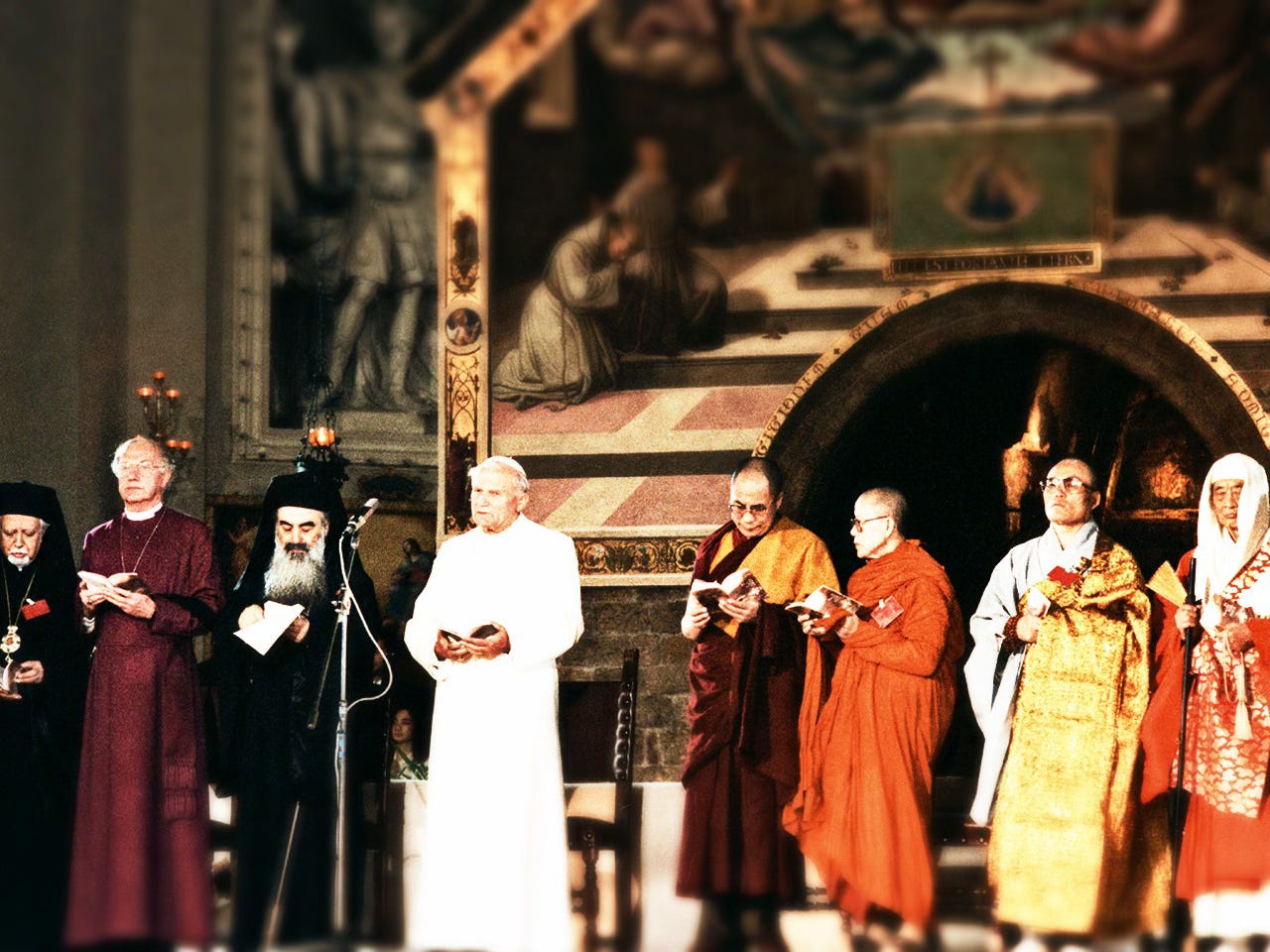
In 1986, Pope John Paul II invited religious leaders from around the world to Assisi to pray for peace. Some people were confused by the gesture, equating it with a statement that all religions are the same. Cardinal Etchegaray explained that it was not a promotion of religious pluralism.
Assisi was the symbol, the staging of what the Church must do by virtue of her proper vocation before a world in a state of flagrant religious pluralism: to profess the unity of the mystery of salvation in Jesus Christ (Card. Etchegaray, “The Spirit of Assisi”).
When they came together to pray for peace, it was not a moment of unity of religious belief. Each one continued in his or her own tradition. They shared the common purpose of peace, while maintaining the integrity of their own traditions. They were not asked to create a common religious prayer. They were invited to come together to appeal for peace, while praying according to their own traditions.
That year at Christmas, Pope John Paul II would address the Curia to explain some of his motives and how he saw religious dialogue. He had not come up with the idea of unity. Rather, his deep contemplation of the Word in Sacred Scripture had moved him to call for this day of prayer.
The fact that we came together in Assisi to pray, to fast and to walk in silence—and this, in support of the peace which is always fragile and threatened, perhaps today more than ever—has been, as it were, a clear sign of the profound unity of those who seek in religion spiritual and transcendent values that respond to the great questions of the human heart, despite the concrete divisions (cf. Nostra Aetate, 1) (Pope St. John Paul II, “Address to the Roman Curia”, 22 December 1986).
Why was it appropriate to come together in the first place? John Paul II understood the world along the lines of the Second Vatican Council document on the joys and hopes of the world. In the pastoral constitution Gaudium et Spes. This document describes dialogue with other religions as one of the signs of the times. As communication has made international boundaries more relative in some sense, mutual knowledge and learning are not only optional, but necessary. The hopes and joys of the modern world are dependent on becoming increasingly aware of the world community. The Dogmatic Constitution on the Church, Lumen Gentium, exhorts us to recognize the “relationship between the very identity and the mission of the Church on the one hand, and the human race on the other” (Pope St. John Paul II, “Address to the Roman Curia”, 22 December 1986).
Drawing on his philosophical training, Karol Wojtyła was at ease discussing topics with people of different intellectual convictions. This did not mean that he was giving in to intellectual, much less moral relativism. Rather, he was convinced that he was always searching for the truth, a truth he found ultimately in the person of Jesus Christ. For Pope John Paul II, ecumenism and interreligious dialogue were always intimately linked to the missionary vocation of the Church.
Mission of the Redeemer
He would revisit the topic of religious indifferentism in his encyclical on missionary work, Redemptoris Missio (1990). He noted that:
great obstacles to the Church’s missionary work include past and present divisions among Christians, dechristianization within Christian countries, the decrease of vocations to the apostolate, and the counterwitness of believers and Christian communities failing to follow the model of Christ in their lives. But one of the most serious reasons for the lack of interest in the missionary task is a widespread indifferentism, which, sad to say, is found also among Christians (Pope St. John Paul II, Redemptoris Missio, 36).
To think with the Church (sentire cum Ecclesia) is to recognize her missionary mandate, including the necessity to speak with those of other religious traditions. Critics thought that dialogue would lead to indifferentism, which would lead to a loss of missionary zeal. The Pope believed that indifferentism had diminished zeal, but he looked for another solution. For him, authentic dialogue leads to encounter and witness, meaning a new zeal for the mission. For Karol Wojtyła, this is a necessity laid upon the heart of every Christian, just as it was on the heart of St. Paul.
The mission of Christ the Redeemer, which is entrusted to the Church, is still very far from completion. As the second millennium after Christ’s coming draws to an end, an overall view of the human race shows that this mission is still only beginning and that we must commit ourselves wholeheartedly to its service. It is the Spirit who impels us to proclaim the great works of God: “For if I preach the Gospel, that gives me no ground for boasting. For necessity is laid upon me. Woe to me if I do not preach the Gospel!” (1 Cor 9: 16) (Pope St. John Paul II, Redemptoris Missio, 36).
Some critics have interpreted his approach as an abandonment of objective truth and of the Church’s missionary tradition. John Paul II was always centered on the person of Jesus Christ, even in and perhaps especially, his moments of dialogue with men and women who thought differently. Put simply, for Karol Wojtyła, “the redeemer of man, Jesus Christ, is the center of the universe and of history” (Pope St. John Paul II, Redemptor Hominis, 1). Was John Paul II abandoning orthodoxy at Assisi? No. If anything, the meeting at Assisi makes sense only when we understand how radically Christ-centered Wojtyła remained until the end.