

You pay God a compliment when you ask great things of him (St. Teresa of Avila).
Blessed Stanley Rother was a diocesan priest from Oklahoma. Studies did not come easy to him, but perseverance paid off and he was ordained a priest in 1963. A few years later, in 1968 he volunteered to go as a missionary priest to Guatemala. Facing a tense political situation, his life was constantly in danger, as he ministered to the Mayan people of his parish.
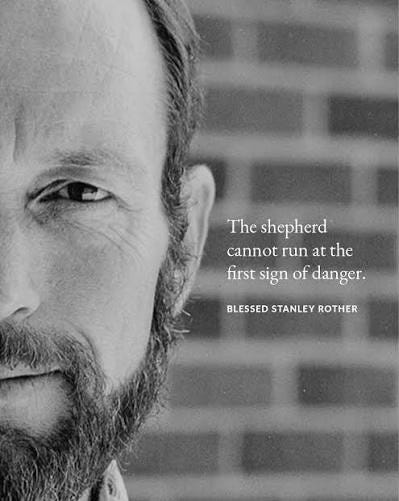
When his name eventually appeared on a right-wing death list, he obeyed his bishop, who ordered him home. However, it was not long before he was begging to go back to Guatemala, saying famously that “the shepherd cannot run at the first sign of danger.”
Living Out the Gospel
It is one thing to read the Gospel, and another thing to live it out. Jesus said, “Fear no one” (cf. Mt. 10:26). It is hard to live without the shadows of fear overpowering our lives. Blessed Stanley was able to do this because he trusted completely in God. We learn to trust God by learning and living in his divine providence. We get a clue about his concern for each one of us when Jesus talks about his Father with great love.
Are not two sparrows sold for a small coin? Yet not one of them falls to the ground without your Father’s knowledge (Mt. 10:29).
God is not merely watching us from afar. He continually sustains us in existence and guides all things through his providence.
Our Goodness Comes from God
Like all created things, we are good simply because God created us (cf. St. Thomas Aquinas, Summa Theologiae, I.22.1c.) Yet we are also made for a purpose, and God guides us toward the fulfillment for which he created us. We discover part of the purpose he gives to us through the natural law that is inscribed on all of our hearts (cf. Rm. 2:14-16). Because God is the author of all creation, everything ultimately falls under his providential care (cf. St. Thomas Aquinas, Summa Theologiae, I.22.2.) You and I make plans and use various means to accomplish them. We use the virtue of prudence to do this. He is leading us to something great. Jesus knows this and uses the example of the sparrows to show that God loves each one of us individually.
What does it mean to live according to divine providence when I am worried about my future? I need to learn to see how God works through the circumstances of my life.
How God’s Providence Works
God’s providence works ordinarily through establishing the nature of things. (cf. St. Thomas Aquinas, Summa Theologiae, I.22.3). We can distinguish between God’s positive will and his permissive will. He never positively wills evil or suffering, but he does permit these things as part of the way the world functions. So, some sparrows will die, and this does not mean that God doesn’t care or can’t do anything about it. But he typically rules the world through the natural laws that exist. We can ask ourselves why things are able to die if we all depend on God’s providence. However, he is the final cause of all things that exist. Material things are not meant to last forever in this world. Their fragility reminds us that our ultimate destiny is not found here, but in God.
We worry about grades, medical conditions, finances, or vocational decisions. Yet Jesus reminds us that the Father who knows every sparrow also knows every detail of our lives.
Finding Our Purpose
When we realize that we live for a greater purpose, peace flows into our hearts. We become more concerned about the mission of our life, and are less likely to engage in selfish pursuits of pleasure and honor. Peace is one of the greatest gifts we can receive, and does not depend on getting our way. Blessed Stanley Rother surely did not desire to die at the hands of three assassins. Yet, when the moment came, he even tried to go quietly so as to avoid causing danger for the people of his congregation.
We need to learn to have a daring confidence in God. St. Teresa of Avila said that we pay God a compliment when we ask great things of him. Nothing is too big for God, yet often we are afraid to ask. Really, we are afraid that we and our problems are insignificant to God. This is never the case. Blessed Stanley asked for big things, such as the salvation of his people. The shepherd cannot run at the first sign of danger because he knows that his life, his mission, and even his death rest securely in the hands of God. The question remains: Do we trust God’s providence enough to follow him wherever he leads?