

The Galileo controversy symbolized much of what Pope John Paul II wanted to fix about the relationship between the Church and modern science. He feared that the manner in which the 17th-century scientist was treated damaged the Church’s credibility. In 1992, he addressed the controversy directly, recognizing errors of scriptural interpretation that had contributed to the controversy.
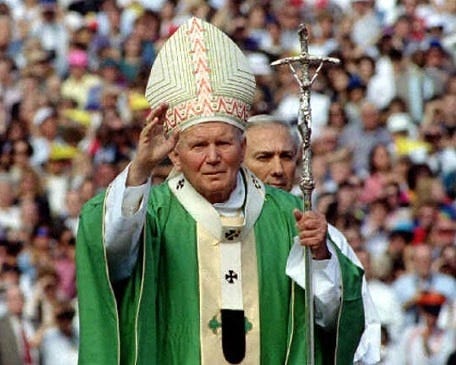
Six years later, his encyclical letter Fides et Ratio, published in 1998, offered a reflection on the relationship of faith and reason in the Christian thought tradition. John Paul II’s understanding of the relationship between faith and reason comes from the Christian understanding of the human person. Faith does not ignore the value of human reason but rather helps reason reach its full dignity and potential. This comes out clearly in the very first paragraph of the encyclical.
Faith and reason are like two wings on which the human spirit rises to the contemplation of truth; and God has placed in the human heart a desire to know the truth—in a word, to know himself—so that, by knowing and loving God, men and women may also come to the fullness of truth about themselves (Pope St. John Paul II, Fides et Ratio, 1).
The Church has always had a great interest in philosophy. The Pastoral Constitution Gaudium et Spes, offers a compendium of biblical anthropology that can help to inspire philosophy. It stresses how the human person is created in the image of God. This establishes the dignity and superiority of the human person over the rest of creation. Human reason transcends other realities.
John Paul II returns to the text that he analyzed in his first encyclical, Redemptor Hominis, which is the text from the Council that would most influence his own magisterium.
The truth is that only in the mystery of the Incarnate Word does the mystery of man take on light. For Adam, the first man, was a type of him who was to come, Christ, the Lord. Christ, the new Adam, in the very revelation of the mystery of the Father and of his love, fully reveals man to himself and brings to light his most high calling (Gaudium et Spes, 22; quoted in Pope St. John Paul II, Fides et Ratio, 60).
The different aspects highlighted in Fides et Ratio 60 become evident once again in this seminal paragraph.
Compendium of Biblical Anthropology
When John Paul II spoke of his theology of the body, he would stress the importance of a return to the beginning. By mentioning Adam, the first man, the Pastoral Constitution Gaudium et Spes makes mention of this beginning. By looking at Adam, we come to understand more about Jesus Christ. St. Paul references this idea in his first letter to the Corinthians.
The first, man, Adam, became a living being, the last Adam a life-giving spirit (1 Cor. 15:45).
The Conciliar text mentions Adam three times in the very number that Karol Wojtyła would cite so frequently. The return to the origin would mark the teaching of Pope St. John Paul II throughout his pontificate. He emphasized the importance of understanding biblical anthropology as the basis of understanding modern man.
Created in the Image of God
The philosophy proposed by the Council stresses the value of the human person created in the image of God. The entire chapter 1 is dedicated to the dignity of the human person. This dignity is founded in his creation according to God’s own image. The biblical text serves as the foundation of the human dignity of every human being.
When God created man, he “saw that it was very good” (cf. Gn. 1:31). God’s creation is good and because of this we can be confident that we as a human race are good and called to goodness. While a part of creation, man is also called to rule over creation.
Human Dignity and the Created Order
While many modern ideologies try to place man as simply “one more” entity on earth, the Bible places man above the rest of material creation. It is only in this understanding that we are able to give man his place within creation. Created in God’s image, he
is capable of knowing and loving his Creator, and was appointed by Him as master of all earthly creatures that he might subdue them and use them to God’s glory (Gaudium et Spes, 12).
He is set apart from the rest of creation because only he can judge the value of the rest of creation. This subduing of creation does not give man the right to use nature without concern for further effects. Rather, it is the very basis of all of his efforts to protect the environment. Man is put in charge of the material world, but precisely as a steward, not as an absolute lord over creation.
However, modern ideologies that seek to downplay the importance of man within the order of creation are mistaken. Man is not called to be merely one more piece of the creation story, but rather its end and destination.
Transcendent Capacity of Human Reason
This ability to transcend creation comes from man’s rational nature. He sees himself as a part of the material world, but not only. Man becomes a sort of horizon between the material and spiritual world. With a material body and a spiritual soul, he bridges the gap between these two worlds. The philosophers speak of man as “capax Dei,” being capable of God, at least in a limited way.
The human being is the only material being who can communicate with God appropriately, because he is made in the image and likeness of this same God. The human capacity to know and love God presupposes the freedom to reject him. Human beings are not compelled to enter into a relationship with their Creator. Freedom to love God or reject him leads to what we see in the various forms of atheism.
Atheism and Human Dignity
Pope John Paul II underlines the threat that atheism poses to human dignity and freedom.
The word atheism is applied to phenomena which are quite distinct from one another. For while God is expressly denied by some, others believe that man can assert absolutely nothing about Him. Still others use such a method to scrutinize the question of God as to make it seem devoid of meaning (Gaudium et Spes, 19).
While atheism may take on different forms, it is united in denying some basic truths about man. Somehow, what we believe about God has a lot to do with what we believe about man.
The Church holds that the recognition of God is in no way hostile to man’s dignity, since this dignity is rooted and perfected in God. For man was made an intelligent and free member of society by God Who created him, but even more important, he is called as a son to commune with God and share in His happiness (Gaudium et Spes, 21).
By going back repeatedly to the documents of the Second Vatican Council, especially Gaudium et Spes 22, Pope John Paul II ensures that his papal teaching stays Christ-centered, while dealing with the existential problems plaguing modern man.
This comes back again in his encyclical Fides et Ratio because of his desire to harmonize faith and reason, effectively overcoming the perceived opposition symbolized by the Galileo case. Faith and reason are two wings of the human spirit, and we come to know this human spirit more deeply by contemplating the mystery of the Incarnate Word.