

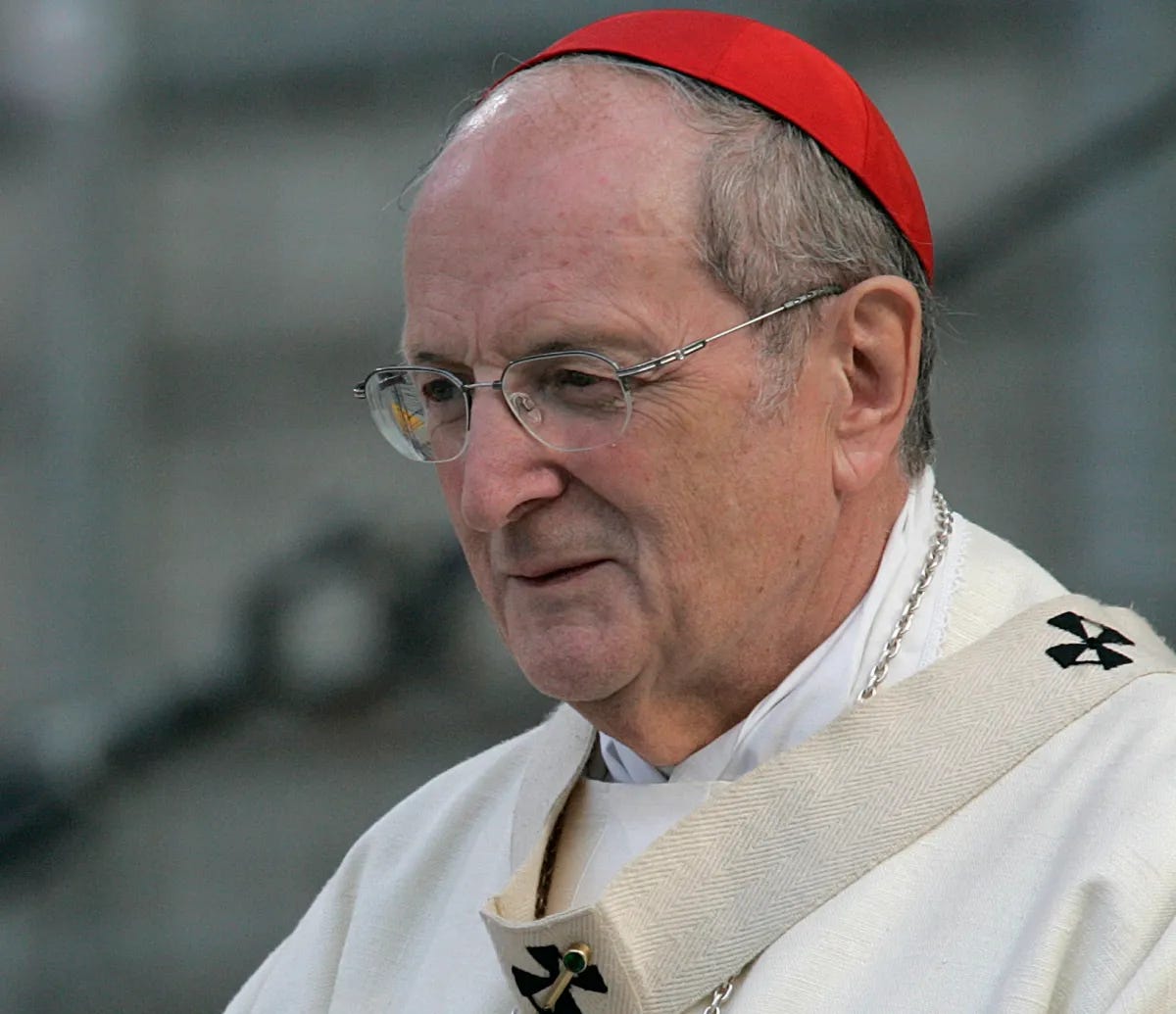
When I was a novice in Germany, we visited Cardinal Meisner at his residence in Cologne. We visited his private chapel, and we saw an interesting piece of artwork. There was a hand reaching through a wall. Novices are famously curious, not to say nosy, and one of my brothers asked the Cardinal about the piece of art. He explained that he had been working in Berlin, a city still divided between East and West.
When John Paul II spoke to him about going to Cologne, he felt a deep hesitation because he would be leaving his faithful behind. He felt especially troubled for the East Germans who were under severe restrictions because of the Communist rule. Pope John Paul II looked into his eyes and said, “They will follow you. Don’t worry.” Meisner went to Cologne, and a few months later, the Berlin Wall came crashing down. Effectively, his flock was free to follow the shepherd.
John Paul II could speak with such freedom because of his deep faith and confidence in the saving power of Jesus Christ. He knew that the Church did not depend ultimately on his ability to control events. History belonged to Christ. This confidence shines forth in his first encyclical, Redemptor Hominis, On the Redeemer of Man.
Inheritance
For Karol Wojtyła, it’s always best to start at the beginning. He often returned to the Story of Creation because it helps us to recover a fundamental understanding of who we are and who God is. Before considering suffering, death, and sin, we need to consider God’s original plan. Even something that seems like a screw-up, like Original Sin, ultimately serves God’s glory and our good because God is good at writing straight with crooked lines. Before considering sin, suffering, or redemption, we need to remember that God created us in his image and likeness.
One way the liturgy summarizes the mystery of redemption is “O happy fault… which gained us so great a Redeemer.” The state of humanity after redemption is higher and greater than what it was before the Fall. So, even though the Fall of our first parents is the greatest tragedy of human history, it is not definitive because of the sacrifice of Christ on the Cross. The central moment of human history is the Incarnation of the Son of God.
God entered the history of humanity and, as a man, became an actor in that history, one of the thousands of millions of human beings but at the same time Unique (Pope St. John Paul II, Redemptor Hominis, 1).
This is one of the great claims of Christianity. God does not save humanity from a distance, without getting his hands dirty. He enters our history and takes on human nature. Hunger, friendship, rejection, suffering and even death… none of this is strange to Jesus Christ.
God in the drama of human history
God did not wish to stay removed from the drama of human history. Rather, he enters into history to be born as a small child. He is raised as a common Jew in Palestine, before taking on his messianic mission and calling the disciples as his followers. Teaching the people about the Kingdom of God, he comes into the crosshairs of the rulers of his time and is condemned to the death of a criminal. His suffering and death on the cross become the revelation of God’s redeeming love.
Through the Incarnation, God gave human life the dimension that he intended man to have from his first beginning; he has granted that dimension definitively-in the way that is peculiar to him alone, in keeping with his eternal love and mercy, with the full freedom of God-and he has granted it also with the bounty that enables us, in considering the original sin and the whole history of the sins of humanity (Pope St. John Paul II, Redemptor Hominis, 1).
The Christian mystery and solution to the problem of evil and suffering is so profound, yet also fragmented by the anti-testimony of the Christian Church’s splintering. Our inheritance is harmed by our disunity. Christ entered history to reconcile God and man. John Paul II laments the divisions among Christians that contradict the very mystery we proclaim.
We must therefore seek unity without being discouraged at the difficulties that can appear or accumulate along that road; otherwise we would be unfaithful to the word of Christ, we would fail to accomplish his testament (Pope St. John Paul II, Redemptor Hominis, 6).
Christ’s desire to reconcile God and man is his principal mission. He also wants to reconcile us. This brings up the question: “How will we respond to the mystery of redemption?”
Mystery of Redemption
For John Paul II, looking to the Mystery of Christ and Redemption was to look at his own mission as Supreme Pontiff and pastor of souls. What does it mean to shepherd a Church? It very much means to lead the entire Church towards Christ.
Our spirit is set in one direction; the only direction for our intellect, will and heart is towards Christ our Redeemer, towards Christ, the Redeemer of man (Pope St. John Paul II, Redemptor Hominis, 6).
Throughout his entire pontificate, Pope St. John Paul II looked forward to the year 2000 as a fundamental moment of history, one that could remind people of the Incarnation. Even the way we measure time is marked by the birth of Christ. John Paul II was committed to proclaiming this truth always and everywhere.
Redemption has divine and human elements, and John Paul II reminds us that man cannot live without love. The sacrifice of Christ on the cross is the greatest witness to love.
Man cannot live without love. He remains a being that is incomprehensible for himself, his life is senseless, if love is not revealed to him, if he does not encounter love, if he does not experience it and make it his own, if he does not participate intimately in it (Pope St. John Paul II, Redemptor Hominis, 10).
Understanding Christ to understand ourselves
His callback to Gaudium et Spes 22 is one of many he will make throughout his papacy. Wojtyła holds this as a central element of his thinking. This is an important aspect of Christian anthropology. We can only understand man fully to the extent that we understand Jesus Christ.
Our understanding of Jesus Christ and his unique mission to the world also calls us to be witnesses to the world in our own right.
Jesus Christ is the stable principle and fixed center of the mission that God himself has entrusted to man. We must all share in this mission and concentrate all our forces on it, since it is more necessary than ever for modern mankind (Pope St. John Paul II, Redemptor Hominis, 11).
Church’s mission related to freedom
The Church’s mission is also related to human freedom. Christ came into the world to give us true freedom: freedom from sin.
In the course of so many centuries, of so many generations, from the time of the Apostles on, is it not often Jesus Christ himself that has made an appearance at the side of people judged for the sake of the truth? (Pope St. John Paul II, Redemptor Hominis, 12).
The Church is called to proclaim the truth about God and the truth about man. The two truths often become intertwined, which is why the Church often stands up for religious freedom, even for other religions. This is not a form of doubting her own truth, but rather a reflection of how important human freedom is to what it means to be human.
Cardinal Meisner’s hesitation came from his sense of pastoral responsibility. He loved his flock. John Paul II’s vision of freedom was similarly pastoral. No one should be abandoned to slavery, be that political, ideological, or spiritual. The Church has the mission to proclaim the truth that makes freedom possible. That truth ultimately has a face: Jesus Christ.
This is why John Paul II was able to approach the modern world so confidently. He did not begin with a theory or political program, but with the person of Jesus Christ. Since Christ came to set humanity free, the Church cannot keep this truth to herself. She must proclaim it to the world.