

The First Thanksgiving happened in Florida. Growing up, I remember re-enacting the First Thanksgiving in kindergarten. It was fun dressing up, and we had a lot of fun. Like much of the history that we learn in Elementary School, however, the truth is more complex. The First Thanksgiving happened in Florida. More precisely, it happened at the conclusion of a Catholic Mass.
Now, perhaps it can be argued that since our history is more linearly connected to the Puritan settlers at Plymouth Rock than it is with the Spanish Conquistadors who landed at St. Augustine, Florida, we should still honor them as the first settlers. This may be, but I think it is also amazing that a Catholic Mass accompanied the first Thanksgiving that happened in territory that would eventually become part of the United States.
Celebration with the Natives
Pedro Menéndez de Avilés was the leader of the expedition, landing at St. Augustine on September 8, 1565, the Feast of the Birth of Mary. Along with 800 Spanish settlers, he founded the city of St. Augustine in what the Spaniards called La Florida. He invited the local indigenous Seloy tribe members to participate in a feast. They also had a celebration of the Mass, presided over by Fr. Francisco López de Mendoza Grajales. Although obviously unfamiliar with the liturgical rites, it seems that the Seloy natives participated in the service, imitating what they observed.
It is especially fitting that the celebration was capped by a Mass. The very word “Eucharist” means “Thanksgiving” in Greek, so every Eucharistic Celebration is essentially a moment of thanksgiving.
The Eucharist, the sacrament of our salvation accomplished by Christ on the cross, is also a sacrifice of praise in thanksgiving for the work of creation. In the Eucharistic sacrifice the whole of creation loved by God is presented to the Father through the death and the Resurrection of Christ. Through Christ the Church can offer the sacrifice of praise in thanksgiving for all that God has made good, beautiful, and just in creation and in humanity (Catechism of the Catholic Church, 1359).
The Eucharist doesn’t merely give Christians another reason to be thankful. It teaches us the essence of thanksgiving. We receive the goodness of creation as a gift and recognize the Giver. We return the gift to the Father through Jesus Christ.
The First Mass
The first Mass in what would eventually become the United States took place at what is now the Mission of Nombre de Dios, and the site is marked by a 250-foot-high cross. The Spaniards brought Christ to the territory which would eventually become the United States long before the nation was founded. It would take a while for the Catholic religion to be accepted within its confines. The growth of Spanish America happened rather independently of English America.
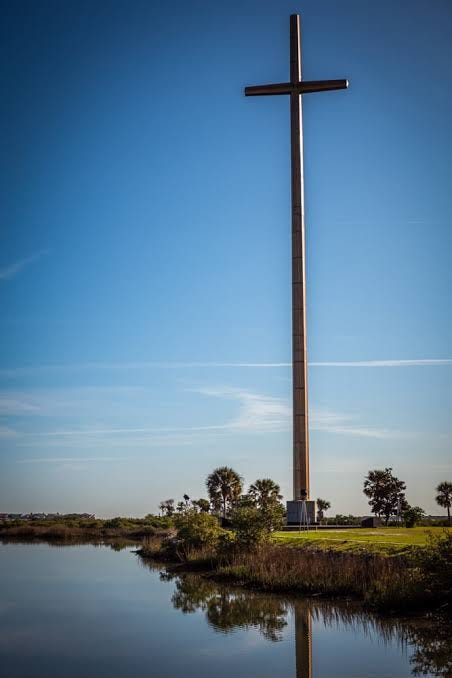
The Thanksgiving at St. Augustine occurred 56 years before the Puritan Pilgrim Thanksgiving at Plymouth Plantation. Plymouth remains etched into the social memory of Americans. It is, however, good to remember that the celebration has deeper, and more Catholic roots as well. While the nation as a whole celebrates Thanksgiving especially once a year, on the fourth Thursday of November, Catholics celebrate thanksgiving – Eucharist – every day of the year, whenever we gather for Mass.
The Spanish influence waned significantly, especially after its loss of the colonies. There is a resurgence now, however, with the spread of Catholicism and the increased practice of the faith. As Catholics, we have a special role to help every American grow in a sense of gratitude for what we have received.
Relational Aspect of Gratitude
Thanksgiving can sometimes get a little confusing when celebrated in a purely secular way. I am always curious when I hear people talk about gratitude without naming a reference point. We are grateful “to” someone, not just in general. Yet often, popular, secular presentations of Thanksgiving have people offer thanksgiving, but without a person to whom they are offering it. Gratitude is inherently relational.
As Catholics, our thanksgiving is always linked to the Paschal sacrifice of Christ. At each Mass, we experience Christ’s one sacrifice as sacramentally present on the altar. Every act of thanksgiving reminds us of our need to give thanks to him for the great gift of redemption.
I had no idea that the first Thanksgiving occurred in St. Augustine 56 years before the Puritan Pilgrim Thanksgiving at Plymouth on Sept 8th, 1565, the feast of Mary's birthday. Is there any connection of this first Thanksgiving to the Spanish being aware of the apparitions of Our Lady in 1531, to Juan Diego at Tepeyac?