

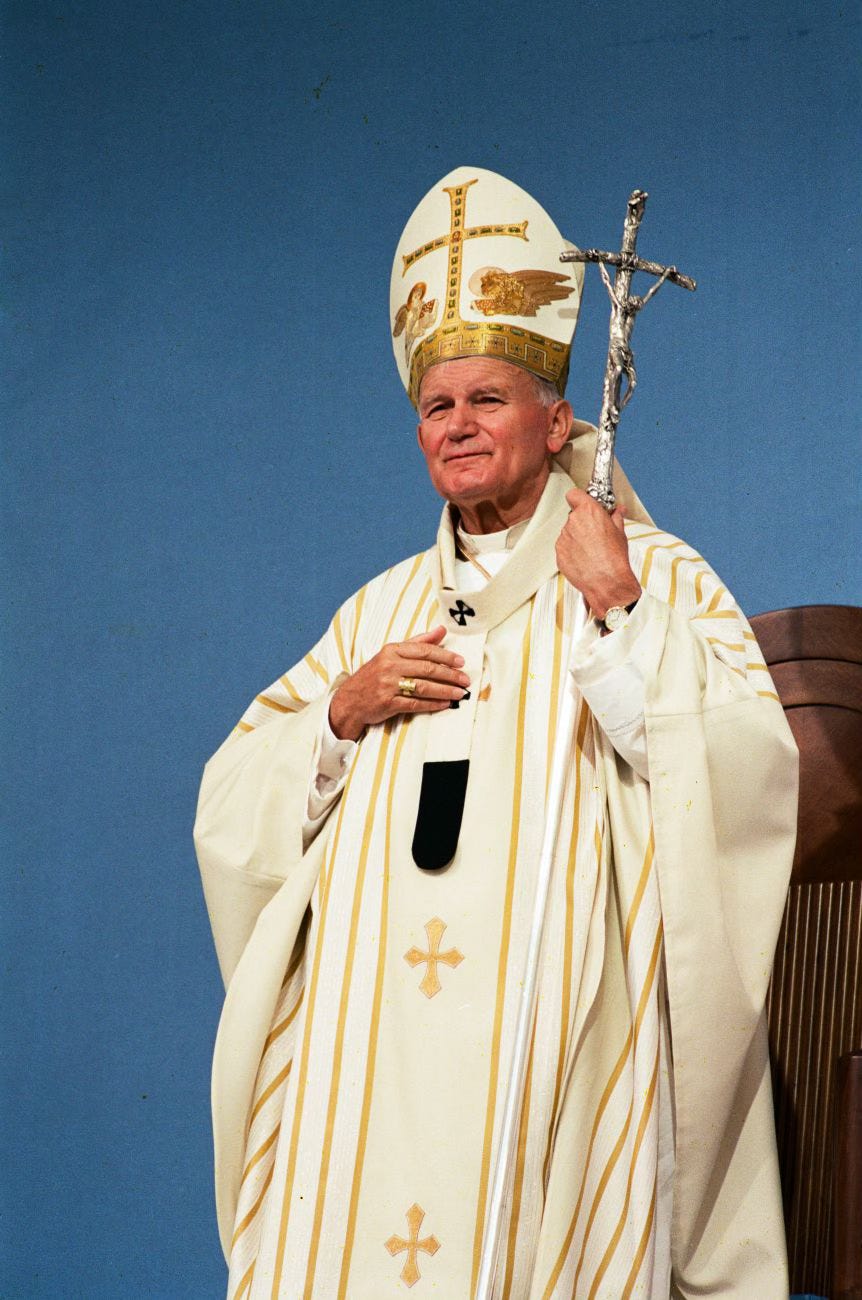
The collapse of the Soviet Union in 1991 is often attributed to chronic economic stagnation, the financial strain of the arms race, and costly foreign conflicts like the Afghan war. The political system that claimed to champion the worker ultimately collapsed under the weight of centralized planning and the suppression of personal economic initiative. While always placing Jesus Christ at the center of his analysis, Pope John Paul II saw a deeper problem: the denial of the human person’s dignity and freedom. For him, economic freedom was not merely a matter of efficiency but an important expression of human creativity, responsibility, and participation in society.
For John Paul II, communism failed not simply because it was economically inefficient, but because it rested on a false understanding of truth, human dignity, and freedom. Once truth is denied, freedom loses its direction. Once freedom is distorted, human dignity is threatened. Economic and political systems ultimately collapse when human dignity is threatened.
Truth
Communist regimes frequently subordinated truth to ideology. News and information were often manipulated to preserve the image of the state and advance the goals of the party. Marxist thought inherited from Hegel the conviction that history unfolds according to an intelligible process. Marx transformed this idealist framework into a materialist one but retained the tendency to interpret reality through a predetermined theory of historical development. Ideology is imposed upon society rather than tested against reality. In his social encyclical Centesimus Annus, John Paul II said that
Obedience to the truth about God and man is the first condition of freedom, making it possible for a person to order his needs and desires and to choose the means of satisfying them according to a correct scale of values, so that the ownership of things may become an occasion of growth for him (Pope St. John Paul II, Centesimus Annus, 41).
Because Soviet Communism was explicitly atheistic, it rejected any public consideration of the truth about God. Yet it also distorted the truth about man. In its emphasis on praxis and production, the human person was often viewed primarily as a worker contributing to the historical project of building socialism. Human beings were valued less for who they were than for their role in transforming society.
Human Dignity
When truth is subordinated to ideology, human dignity is inevitably endangered. Karol Wojtyła had seen in his experience as a priest and bishop that the authorities were more than ready to trample human rights to achieve their own goals. From his classes at the Jagiellonian University to his walks and outings with the students, Wojtyla loved to affirm the dignity of every human person. His conversations and musings took form as doctrine, building on truths expressed in the Pastoral Constitution of the Church, Gaudium et Spes.
In constantly reaffirming the transcendent dignity of the person, the Church’s method is always that of respect for freedom (Pope St. John Paul II, Centesimus Annus, 46).
Karol Wojtyła had a deep respect for the truth and a clear vision of what he believed to be true. This never pushed him to be dogmatic with others, however. He was always happy to engage in religious dialogue and was fascinated by people who did not agree with him. He believed firmly in Jesus Christ, and precisely because of that faith, he believed just as firmly in the inviolable dignity of every human being.
Respect for human dignity naturally led Wojtyla to reflect on the meaning of freedom. If the person possesses an inviolable dignity, then society must create conditions in which that dignity can be exercised through authentic freedom.
Freedom
Having lived under both Nazi occupation and Soviet domination, Karol Wojtyla understood firsthand how political systems can suppress authentic freedom. These experiences convinced him that freedom cannot mean solely the ability to choose. Freedom must be directed toward what is true and good. Although he recognized the economic shortcomings of communism, he believed that the deeper problem was anthropological: freedom detached from truth ultimately destroys itself.
Although John Paul II regarded democratic institutions and the free economy more favorably than communist systems, he never viewed them as self-sufficient. Freedom detached from truth could corrupt capitalism just as ideology had corrupted communism.
Both capitalism and communism require a foundation in truth if they are to respect the freedom that characterizes the human person. While ultimately judging the free market to be more conducive to human flourishing, he also recognized the corrupting effects of unbridled capitalism.
But freedom attains its full development only by accepting the truth. In a world without truth, freedom loses its foundation and man is exposed to the violence of passion and to manipulation, both open and hidden. The Christian upholds freedom and serves it, constantly offering to others the truth which he has known (cf. Jn 8:31-32), in accordance with the missionary nature of his vocation (Pope St. John Paul II, Centesimus Annus, 46).
To understand the value of any system, it is important to analyze whether it lends itself to manipulation, and thus to corruption. Corrupt systems never serve the truth, human dignity, or freedom. Karol Wojtyla was convinced that there is a stable human nature and that social structures must be built according to that reality. When these structures are well-built, they foster the flourishing of all the individuals involved. The truth sets us free, and Christians are called to proclaim this good news to others.
For much of the twentieth century, Soviet communism seemed to be a permanent fixture on the world stage. Pope John Paul II remained convinced that a system built upon false assumptions about God, man, and freedom could not endure indefinitely. It would crumble under the weight of its own false presuppositions.
As human beings, we long for the truth about God, the world, and ourselves. Truth safeguards human dignity, and dignity demands authentic freedom. Freedom, in turn, must be directed toward what is good and lived according to the truth. When we do so, we help to build a civilization of love, with freedom for all.
2. Faith and Reason: Two Ways of Knowing