

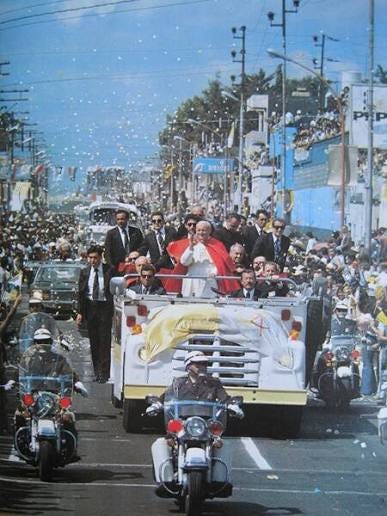
Poland and Mexico were remarkably similar in 1979. The populations were profoundly Catholic, while the governments were strikingly anti-clerical. Pope John Paul II would visit Mexico for his first international journey, in a pontificate marked by international travel. To this day, Mexicans are proud that the Polish Pope visited them on his first apostolic journey. He would visit Mexico five times throughout his papacy, and each visit was in some way a homecoming.
While Marxism was a scourge in Eastern Europe through the heavy-handed influence of the Soviet Union, it arrived in Latin America through the Cuban revolution in 1959. It made greater inroads in 1968 through the Medellín Conference. Fr. Gustavo Gutierrez, OP, was a leading theologian who combined themes from the Second Vatican Council, Marxist thought, and pastoral theology to come up with his book, Towards a Theology of Liberation. The Latin American Bishops’ Conference (CELAM) met to discuss the Church’s needs in its home countries. Liberation theology would play a pivotal role in the way that the Latin American Church understood itself, going forward.
Rise of Marxist Reading of Theology
Throughout Latin America, priests were using revolutionary rhetoric, and sometimes even taking up arms, trying to defend the poor against the domination of the rich landowners in their countries. The “preferential option for the poor” could sometimes even spill over into violence. While the clergy in the Eastern bloc was known for resisting the government’s Marxist policies, in Latin America, priests were often the first collaborators of the revolutionaries seeking to upset the status quo.
Karol Wojtyła read the Vatican documents differently from Gustavo Gutierrez. He was deeply concerned about the Marxist influence on theological and pastoral thought in Latin America. He would take advantage of the 1979 CELAM Conference in Puebla, Mexico, to stem the tide of Marxism. Just as he was fighting Marxism by supporting the Solidarity Movement in Poland, he would face off against liberation theology several times throughout the first half of his pontificate.
At Puebla, he was able to address the bishops directly, going back to the seminal text of Vatican II, Gaudium et Spes, 22.
Only in the mystery of the Incarnate Word does the mystery of man take on light (Gaudium et Spes, 22, quoted in Address to CELAM, 28 January 1979).
He applied the quote to the crisis of contemporary humanism. To understand the appeal of Marxism, both in its Soviet Communist manifestations in Eastern Europe and in its influence on liberation theology in Latin America, it is important to recognize that it was trying to answer a real problem. Contemporary humanism was trying to respond to the needs of humanity, but without looking at the Person of Christ. Wojtyła tried to correct that, especially in the context of Christian theology.
Contemporary civilization suffers from an inadequate understanding of the human person. While the great thinkers may be able to diagnose the problem, they are unable to propose a solution if their understanding of the meaning of the human person is faulty. For this reason, Pope St. John Paul II was able to speak profoundly to the heart of man. This is the paradox of modern atheistic humanism: humanity speaks constantly about itself while increasingly losing sight of its identity and destiny.
Purity of Doctrine
Pope John Paul II emphasized the importance of purity of doctrine to the Latin American Bishops. They could not hope to achieve their goals without being rooted deeply in the truth. It is not enough to desire a wonderful outcome. As a Church, the first priority has to be proclaiming the truth revealed by Jesus Christ.
This purity of doctrine will always be a reflection of a healthy Christology. When other ideologies are trying to reinterpret Jesus Christ to further their own agendas, the Church has to stay strong in proclaiming the Christ of the Gospels, the Christ of the Church.
It is from a solid Christology that there must come light on so many doctrinal and pastoral themes and questions that you intend to study in these coming days (Pope St. John Paul II, Address to CELAM, 28 January 1979, I.2).
By knowing and proclaiming Jesus Christ, they could help their people avoid falling into the confusion of competing sects. At the same time that they were building up a realistic image of Jesus Christ, it was important to remember the true place of the Church in the whole discourse.
Love for the Church must be composed of fidelity and trust (Pope St. John Paul II, Address to CELAM, 28 January 1979, I.2).
Renewed Vision of the Church
Pope St. John Paul II was dedicated to a renewal of ecclesiology, theology’s understanding of the Church, from his first days as Pope. His reading and meditation on the Dogmatic Constitution Lumen Gentium informed his renewed vision of the role of the Church in the modern world. Evangelizing activity unrooted in a well-founded ecclesiology risks faltering fatally.
The first reason is that evangelization is the essential mission, the distinctive vocation, and the deepest identity of the Church, which has in turn been evangelized (Pope St. John Paul II, Address to CELAM, 28 January 1979, I.7).
The Church cannot survive without evangelization. This cannot be reduced to mere proselytism. The idea is not to gain members but to share the beauty of the Gospel in such a way that others feel compelled to seek the treasure that we have found.
The mission of the Church is to bring this message to all people. The vocation of the Church is to be holy, as expressed in Lumen Gentium. The identity of the Church is to be the sacrament of salvation instituted by Christ to continue his mission in the world.
Unity Among Bishops For the Good of the People
In a time that could be characterized by varying pastoral visions, the Pope reminded the bishops of the importance of unity among themselves. A Church united is a Church that is able to preach the Gospel effectively. He recalled the great Church Father Saint Cyprian, a bishop who fought for unity in a time of great confusion in the Church of his own time.
The unity of Bishops comes not from human calculations and strategy but from on high: from serving one Lord, from being animated by one Spirit, and from loving one and the same Church (Pope St. John Paul II, Address to CELAM, 28 January 1979, II.1).
This unity would allow them to work effectively to improve also the material situation of their flock. While their primary concern would always be for the spiritual well-being of their people, they must be concerned with their material well-being.
Hence the Church’s constant preoccupation with the delicate question of property. A proof of this is the writings of the Fathers of the Church through the first thousand years of Christianity (cf. St Ambrose, De Nabuthae, c. 12, n. 53: PL 14,747). It is clearly shown by the vigorous teaching of Saint Thomas Aquinas, repeated so many times. In our own times, the Church has appealed to the same principles in such far-reaching documents as the social Encyclicals of the recent Popes (Pope St. John Paul II, Address to CELAM, 28 January 1979, III.4).
The economic concerns were real, but could not justify any action whatsoever in supposed benefit of the poor.
As he closed out his discourse, Pope St. John Paul II entrusted three things especially to the bishops as they would continue their meetings: the family, priestly and religious vocations, and the youth. In any age, these seem like worthy objects of a pastor’s loving concern. John Paul II would never give into the pressures of Marxism, but this did not come from a lack of concern for the common man. Rather, his deep concern for all led him to return over and over again to Gaudium et Spes 22 and recall that only Christ can reveal to man what his life truly means.
“The economic concerns were real, but could not justify any action whatsoever in supposed benefit of the poor.”
🤷♂️
The church could do nothing? Not even support labor unions as Leo XIII said?
St Oscar Romero stood up for his people.
When JPII proclaimed that man "is the way of the Church"(Redemptor Hominis) it startled a lot of people who thought it detracted from a Christocentric theology. He was proposing an ecclesiology that could combat materialist philosophies that had dominated in 18th and 19th century and that were supplanting a proper theological anthropology. It all sounds a little esoteric, but how people identify and understand themselves determines how they live, love, work and rest. In no way was he displacing Christ. Rather he proposed a Church that was so profoundly united to Christ that it intimately and practically shared Christ's mission of calling out to and chasing down each human being and urging him to receive his Savior, so that through this saving union, God would be glorified.