

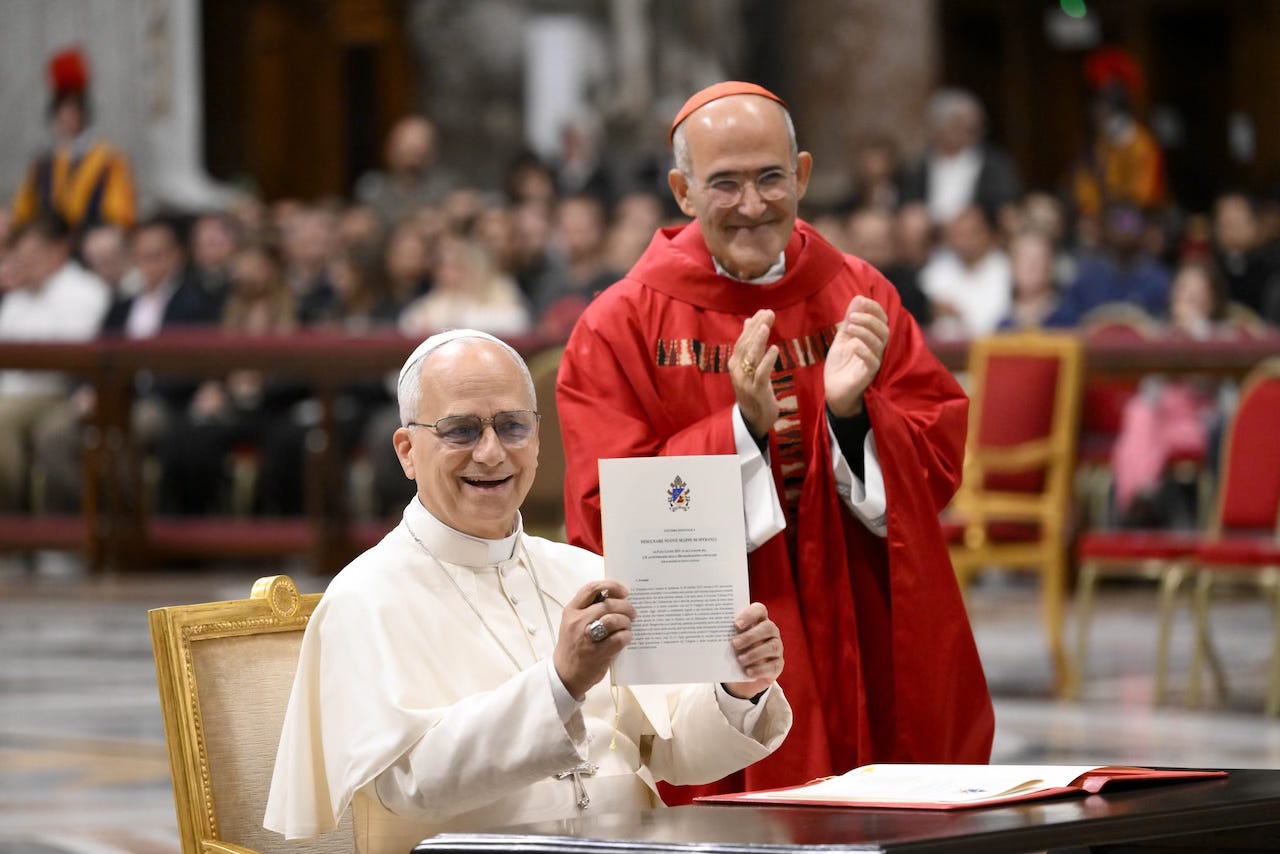
Pope Leo XIV published his Apostolic Letter New Maps of Hope on the topic of Catholic education. This comes in the context of the 60th anniversary of Gravissimum Educationis, the document from the Second Vatican Council that focused on the nature of Catholic education. It is intriguing to see how Catholic education in the United States has evolved in the last 60 years.
There has been a marked movement away from religious sisters and priests in the classroom, particularly because of a tremendous decline in the number of religious vocations. While 60 years ago, Catholic schools provided an important means of upward social mobility for minority ethnic groups, they have become increasingly difficult to maintain as education costs rise and the once-abundant service of religious sisters and priests has become rarer.
Pope Leo XIV underlines that Catholic education shows the work of the Holy Spirit in the life of the Church, who is Mother and Teacher, following the social teaching of Pope John XXIII in his encyclical Mater et Magistra. As he wrote in his encyclical:
Mother and Teacher of all nations—such is the Catholic Church in the mind of her Founder, Jesus Christ; to hold the world in an embrace of love, that men, in every age, should find in her their own completeness in a higher order of living, and their ultimate salvation. She is “the pillar and ground of the truth.” (Pope John XXIII, Mater et Magistra, 1).
The American Pope from the South Side of Chicago places his reflections on Catholic education firmly within the Church’s universal tradition. He gives special attention to the morphing of Catholic education in the United States. He reminds us that educational styles change over time, while always respecting the truth that man, made in the image of God, is called to goodness and truth. This value stays supreme even when a variety of methods may fulfil the basic requirements of education. Educational charisms can never be rigid or confined to a single historical context; they must continually be renewed.
From the early ascetic wisdom of the Desert Fathers, the Church’s understanding of education matured into institutional forms. They remind us that caring for our speech and our heart help us discover a pedagogy that knows to look for God everywhere in creation. The most important role of the educator is to inspire a desire for the truth, as St. Augustine insisted.
The rise of the universities, nourished by the Mendicant Orders, especially the Dominicans and Franciscans, brought faith and reason into fruitful dialogue. Religious congregations have always played a special role in expanding education and developing the very methods of education itself.
While Jesuits helped to continue developing new intellectual pursuits, the rise of new religious congregations were often motivated by the desire to expand the reach of education to the poorer classes within society. St. Jean-Baptiste de la Salle and the Christian Brothers get special mention because of their dedication to providing education across the various social classes, with a particular concern for the poor. St. John Bosco became famous for his pedagogical system that rescued boys from the streets of Turin and made them into good Christians and valued citizens.
Pope Leo XIV invites us to reflect once again on his first Apostolic Letter and his formulation that:
For the Christian faith, the education of the poor is not a favor but a duty (Pope Leo XIV, Dilexi te, 72).
The particular application of this has become more complicated in recent years. This is especially true in dioceses where many Catholics schools are located in poor areas and serve ethnic groups that are not predominantly Catholic. How much should the Catholic Church invest in educating the poor, when this mission seems increasingly disconnected from evangelization?
Pope Leo XIV reminds us that educating the poor should be one of our goals, at the same time that he brings to light the importance of evangelization with Catholic education as a vehicle to bring the Gospel to the modern world. This will continue to be one of the main challenges of Catholic education in modern times. How do we make sure to preach the Gospel if our schools end up being in places that are serving populations where Catholics form very much a minority? This will present certain challenges to creating and maintaining Catholic identity as well.
The vibrant retelling of Catholic education’s history gives us reason to hope. It calls us us to renew the Catholic identity of our schools – not merely to make them competitive, but to make them places where faith and truth meet in service of the Gospel.
What do you think? How does Catholic education influence society? How does it influence your life?