

Why did medieval Catholics make up the doctrine of Purgatory? This question pops up pretty frequently for other Christians who are thinking about becoming Catholic. It is one that I get to discuss often, and not one that particularly frightens me. Sometimes, it comes across as a gotcha question, and I want to explain to you “how to not get got.”
Where is that in the Bible?
Growing up, I had many conversations about the faith with my friends. I remember grad night pretty vividly (so no, I was not drinking). At about 2 in the morning, some of us gathered at one of the picnic benches outside the auditorium where the party was going on. We each started talking about our own experience of faith. Here we were, finishing High School, but thinking about the eternal truths. The friends with me were not particularly devout, but it helped me to see that people have more interest in truth and eternity than they often let on.
I remember other conversations that were more polemical and almost took the form of a debate. Predictably, my Evangelical and Baptist friends would inevitably ask at some point in the conversation, “Where is that in the Bible?” Over time, I learned that in a debate, you need to make sure you do not mistakenly accept your opponent’s presuppositions. And here, I think the most important thing is to refuse to take the Bible as the only possible source of information. Of course, the Bible is important. But before searching for Purgatory in the Bible, let’s look for where the Bible teaches that it is the only criterion of truth. The early Church did not do this, and I do not need to do so either.
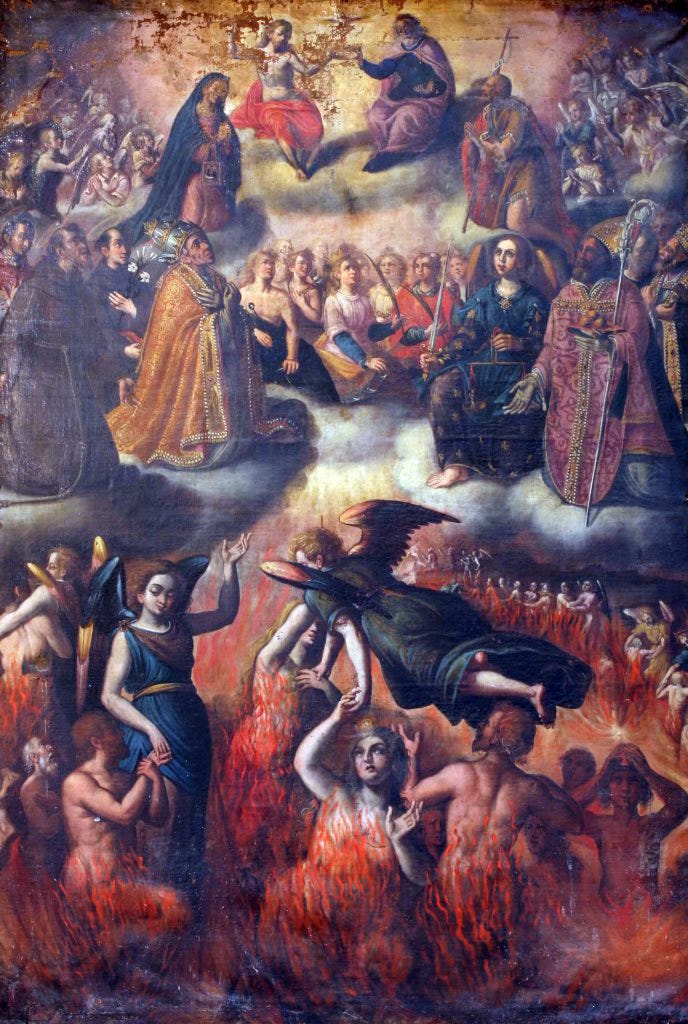
Typically, the Biblical discourse on Purgatory revolves around a story from 2 Maccabees (cf. 2 Maccabees 12:43-46), a deuterocanonical book that Protestants typically refuse to accept as inspired Scripture. When Judas and his troops found the fallen soldiers wearing amulets honoring the false gods of Jamnia, they prayed for the dead. They took up a collection to offer an expiatory sacrifice on their behalf.
Thus he made atonement for the dead that they might be absolved for their sin (2 Maccabees 12:46).
Accepting the passage as canonical, it provides a strong argument that the Jews at the time of Jesus believed in the possibility of some type of purification after death and before entering Heaven. So, often, the discussion turns to a debate about the canon of Scripture. Which books should be included and why? However, a different objection pops up more commonly.
Are the Sufferings of Christ insufficient?
Are not the sufferings of Christ sufficient for our salvation? Does the temporal suffering of Purgatory somehow complete the work of salvation begun by Christ, echoing the words of St. Paul?
Now I rejoice in my sufferings for your sake, and in my flesh I am filling up what is lacking in the afflictions of Christ on behalf of his body, which is the church (Col. 1:24).
The sacrifice of Jesus on the cross was complete. Jesus said as much from the cross.
It is finished (Jn. 19:30)
The challenge comes in the distinction between salvation and ongoing growth in holiness. Jesus gains for us our salvation. He saves us, and he invites us to progress in holiness. His death on the cross releases us from sin and death. However, our process of salvation does not mean that all of our behavior immediately and irrevocably changes from the moment we enter the Kingdom of God.
I would propose that another passage from the Bible offers a much better image for the doctrine of Purgatory.
A Different Bible Passage to Explain Purgatory
Growing in Christian life comes down to loving more. We will be judged by the love we have in our hearts. Do we want to love Christ much, or do we want to love him just a little? We are sinful creatures, even after baptism and at the beginning of our journey of faith. We sin. (I had a Protestant neighbor growing up who insisted that he never sinned. We got into this conversation while he was attacking the Catholic practice of confession. I was flabbergasted by his claim. I knew I sinned. And seeing him every day for 10 years, I was pretty sure that my neighbor sinned too.)
When we go to Heaven, do we want to love God perfectly, or do we want to still be attached to so many worldly things? I think we want to be perfect and directed completely towards God. It makes me think of the parable of the wedding garment (Mt. 22:1-14).
Jesus tells the story about a man who invites people to his wedding. When the original guests fail to materialize, he brings in other people from all around. They would not normally have been the guests at such an event. Then something happens that used to bother me. One man is found at the celebration without a wedding garment.
It always felt unfair to me. If he just came in from the road, of course he does not have a wedding garment. Why is he being treated so cruelly? “Gnashing of teeth” is the phrase that always got me. Then, one day, I heard that the host would have given them the wedding garments. The man found without had refused the wedding garment that had been provided. He wanted to go to the party, but refused to dress accordingly.
I feel like it is the perfect image to understand Purgatory. I love Jesus, but I know that I fall short so many ways. When I die, I hope to be more perfect than I am today, but there may still be something lacking.
There is nothing lacking to the sufferings of Christ, but I am lacking.
I hope he gives me the chance, the help, the obligatory help, to get perfectly clean and ready for the real wedding feast: Heaven.
Now, all of a sudden, I see Purgatory in a different way. It is the antechamber where I get ready for the party. Of course, I want to participate because I want to be worthy of the one who has waited for me.
Lovely article. After reading this, I no longer fear going to purgatory for purification. I read that souls in Purgatory seek Padre Pio's intercession, longing for his prayers, sacrifices, and suffering to find peace and be released. Let us remember to pray for the poor souls daily, especially those without anyone to pray for them. 🙏
Nice article. I think you nail the animating principle of the parable of the wedding garment.
To me, purgatory is an example of the Church's faith illuminating and extending our capacity to reason about Christ's love after we die. We Catholics did not make up purgatory. We understand the Church has three parts: The Church militant (those of us in the fight here on earth), The Church suffering (purgatory), and The Church triumphant (heaven). I found purgatory difficult to understand but the following analogy inspired by Scripture made it easier to grasp. Purgatory is like the rehabilitation of a person who has already been rescued from a fire. Christ is the rescuer. Purgatory is like emergency treatment and rehabilitation after rescue: the person belongs to the rescuer and will live, but must still be healed. Hell is not rehabilitation after rescue; it reflects the person who refuses the hand of the rescuer and remains outside the life Christ offers.
The frightening and deceptive reality is that, during earthly life our intellect and will remain capable of conversion: we can turn from sin. We can experience a change of heart toward God and must do so right to the end. But after death we cannot change our orientation. The will is either fixed in love of God or fixed in a disordered self-love that seeks an unreachable happiness apart from God—as though the self were its own god.
I like Pope Benedict XVI's description of purgatory as a “blessed pain” in which Christ’s love burns away what is false and makes the person fully of God. He says the soul experiences at least three things:
- A profound awareness of God’s goodness and beauty.
- A painful recognition of its remaining imperfection and attachment to sin.
- An intense longing to be completely united with God.
The soul is alive in Christ’s love, yet suffers because it is delayed from possessing the Beloved fully.
Pope Benedict XVI also cites these passages:
- “Each person’s work will be revealed. The Day will disclose it, because it will be revealed with fire, and the fire will test the quality of each one’s work. If the work is burned up, that person will suffer loss; the person will be saved, but only as through fire...” ~ 1 Corinthians 3:13–15.
- "Nothing unclean will enter” the heavenly Jerusalem. ~ Revelation 21:27.