

It began with one woman losing her job. It ended with an empire collapsing. When the workers of the Gdansk Shipyard walked off the job in August 1980, they weren’t just demanding justice for a fellow worker. They were starting a revolution.
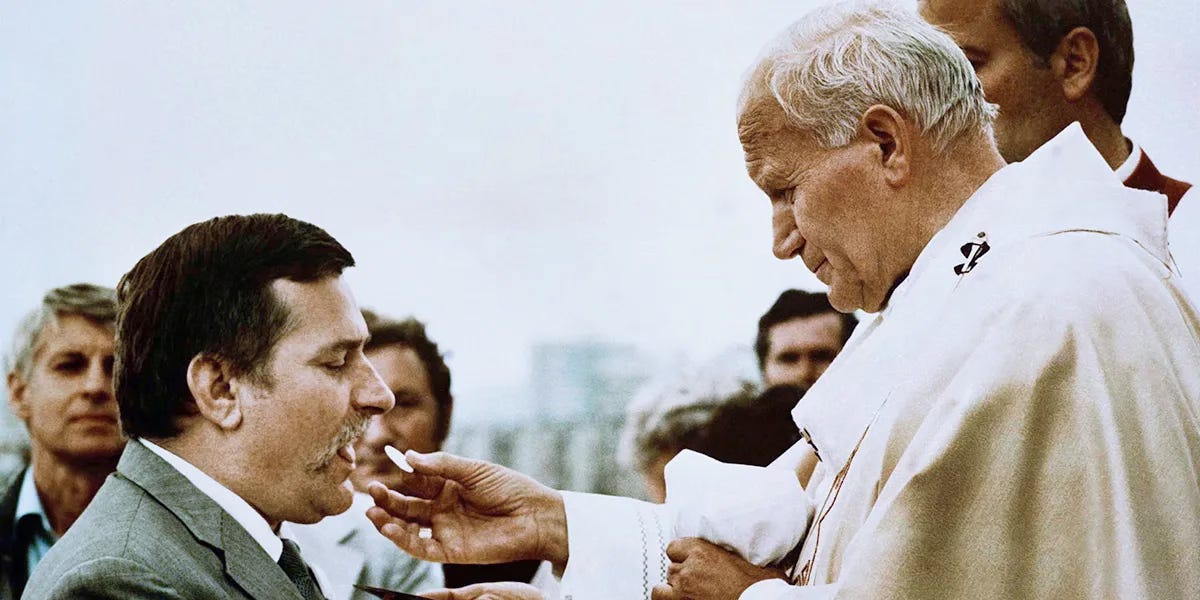
The Solidarność (Solidarity) movement was led by an electrician, Lech Wałęsa. Soon, workers across Poland joined the first independent trade union in the Soviet bloc. The very name they chose, Solidarity, spoke to a truth that communism could imitate but never fully embrace. Our dignity does not come from the State or our class, but from the fact that we are brothers and sisters in Christ, created in God’s image.
The workers wanted freedom to organize themselves. They no longer wanted to have the communist state determining every aspect of economic life. Without necessarily using the word, they were practicing one of the central tenets of Catholic Social Teaching: subsidiarity.
Solidarity and Subsidiarity
Within Catholic Social Teaching, solidarity helps us see we all belong to one human family. Subsidiarity means that decisions should be made at the lowest competent level. Subsidiarity teaches that higher authorities should support the initiative of families, workers, and civic organizations; not replace them.
While shipyard workers in Gdansk were challenging Communist rule from below, another Pole was challenging Communist ideology from Rome. Pope John Paul II drew on his experience under Soviet rule as he articulated a vision of the human person that contradicted the philosophical foundations of Marxism.
Rejecting Marxist claims
John Paul II rejected the Marxist reduction of the human person to economics. Poverty is a real evil, but Marxism is wrong when it assumes that every human problem has a material solution. As he wrote in Laborem Exercens:
In dialectical materialism too, man is not first and foremost the subject of work and the efficient cause of the production process, but continues to be understood and treated, in dependence on what is material, as a kind of “resultant” of the economic or production relations prevailing at a given period (Pope St. John Paul II, Laborem Exercens, 13).
While critical of materialism in Marxism, he was also critical of the consumer society.
It seeks to defeat Marxism on the level of pure materialism by showing how a free-market society can achieve a greater satisfaction of material human needs than Communism, while equally excluding spiritual values (Pope St. John Paul II, Centesimus Annus, 19).
Economic freedom is only one aspect of human freedom. While he supported Solidarity’s efforts to gain freedom for Polish workers, indeed for the Polish nation, he served as the moral conscience of the Movement. His contribution to Catholic Social Teaching helps all of us to be more human in the way we view economics and the world. Communism is not the way forward, but neither is unbridled capitalism exercised in a soulless way.
The Marxist system was very much State-centered, with decisions being centralized. The virtue of subsidiarity opposes this directly, moving decisions to a more local level.
Wojtyla’s Experience of Catholic Social Teaching
Throughout his life, Karol Wojtyla lived the principles of solidarity and subsidiarity. He called for solidarity movements to dialogue with others and never to become closed unto themselves. Reflecting on Catholic Social Teaching, he reminds us that the State should be concerned with wage levels, humane working conditions, and the dignity of work and of each worker.
The State must contribute to the achievement of these goals both directly and indirectly. Indirectly and according to the principle of subsidiarity, by creating favorable conditions for the free exercise of economic activity, which will lead to abundant opportunities for employment and sources of wealth. Directly and according to the principle of solidarity, by defending the weakest, by placing certain limits on the autonomy of the parties who determine working conditions, and by ensuring in every case the necessary minimum support for the unemployed worker (Pope St. John Paul II, Centesimus Annus, 15).
Understanding that we are all part of one human family changes the way we look at one another. In the world, there is always the temptation to give in to a mentality of conquest. Pope John Paul II proposed rather a civilization of love. When the state works with intermediate autonomous bodies to promote the good of all, they all work together to promote this civilization of love. This is the principle of subsidiarity at work.
The principle of solidarity has become even more present since Pope John Paul II, notably in the teaching of Pope Francis in Fratelli Tutti, quoted also by Pope Leo XIV in Magnifica Humanitas. Pope Benedict XVI refers to the term in Caritas in Veritate. What began as a workers’ movement had a tremendous influence on Catholic Social Teaching, helping to craft a response to the proposal of Communism to the world. While there can be debate on different economic systems, the Church can never cave to the desire to lose respect for the dignity of each human being. This is at the core of Wojtyla’s thought and teaching as well.
Subsidiarity and the Family
Pope St. John Paul II was known for his love of marriage and family. Respecting the family as the most basic unit of society, he saw in it additionally the best way to promote human dignity and the progress of humanity. Subsidiarity takes on special importance in his reflection on the family in his Letter to Families.
The mission of education must always be carried out in accordance with a proper application of the principle of subsidiarity. This implies the legitimacy and indeed the need of giving assistance to the parents, but finds its intrinsic and absolute limit in their prevailing right and their actual capabilities (Pope St. John Paul II, Gratissimam Sane, 16)
When families fall apart, societies fail. Parents have the ultimate responsibility of the education of their children. Other institutions, whether this be the state, the Church, or others, must give parents their place in the education of their children. A just society involves the parents; it does not exclude them.
Importance of Economic Freedom
Economic freedom was important for Pope John Paul II, but not because he was promoting consumerism or the market economy. Economic freedom is a means to an end, since it allows the individual to choose what is good. Freedom is not without its limits, and ideally, we should use our freedom to choose what furthers the common good. The risk of the market economy and capitalism is that there can be a strong tendency towards individualism. The rise of selfishness and greed is unchristian and does not promote the common good. Economic freedom is good when we use it so that all can grow and flourish.
Conclusion
When the workers reacted so strongly to the firing of Anna Walentynowicz, they were looking out for one of their own. Self-interest might have suggested ignoring the problem. But they knew they had to stand up for what was right. The Soviet empire eventually collapsed. But the Kingdom of Christ still needs to be built up. The mission of Christians remains the same: to build the civilization of love by defending the dignity of every human person.