

Do you believe in miracles?
In our context, perhaps it is not such a surprising question. We deal with the supernatural, as we are men and women of faith. But if we look at American sports history, the phrase came up in a context that was momentous, but not supernatural.
Which is the best sports movie ever? The other day, someone was trying to convince me that the best sports movie of all time is Hoosiers. I feel pretty confident that I can classify that simply as a wrong answer. There are several football movies that could make the claim. Remember the Titans could make a good run for it, and the fact that Denzel Washington is in it speaks well in its favor. Personally, I would argue for Field of Dreams, but that is because it caught the spirit of baseball and America in a very specific way, and I am biased in its favor.
You could also make a strong argument for the movie Miracle, which chronicles the amazing story of the 1980 USA Olympic hockey team that pulled off one of the greatest upsets in sports history. The 1980 Winter Olympics in Lake Placid, New York, were the world stage not just for the best athletes of the world, but also for the Cold War. In fact, the US would lead a boycott of the Summer Olympics in Moscow, reacting to the Soviet invasion of Afghanistan. The USSR responded by boycotting the 1984 Summer Olympics in Los Angeles.
For decades, the Olympics were not only a show of athletic performance, but also of the basic struggle between East and West. Could a free society prevail in the face of an ideology that urged the sacrifice of personal liberties in favor of the State? Since only amateurs were technically allowed to participate in the Olympics, it felt like the Soviet Union had an unfair advantage. In their collectivist society, they prioritized athletes, and so they would train year-round, benefiting from State support.
The 1980 US hockey team was made up of college kids cobbled together by University of Minnesota coach Herb Brooks. They would face a Soviet juggernaut that had won four consecutive gold medals. Yet, in the semi-finals, the US overcame all odds and won 4-3. As time ran out, Al Michaels delivered his immortal line: “Do you believe in miracles? Yes!”
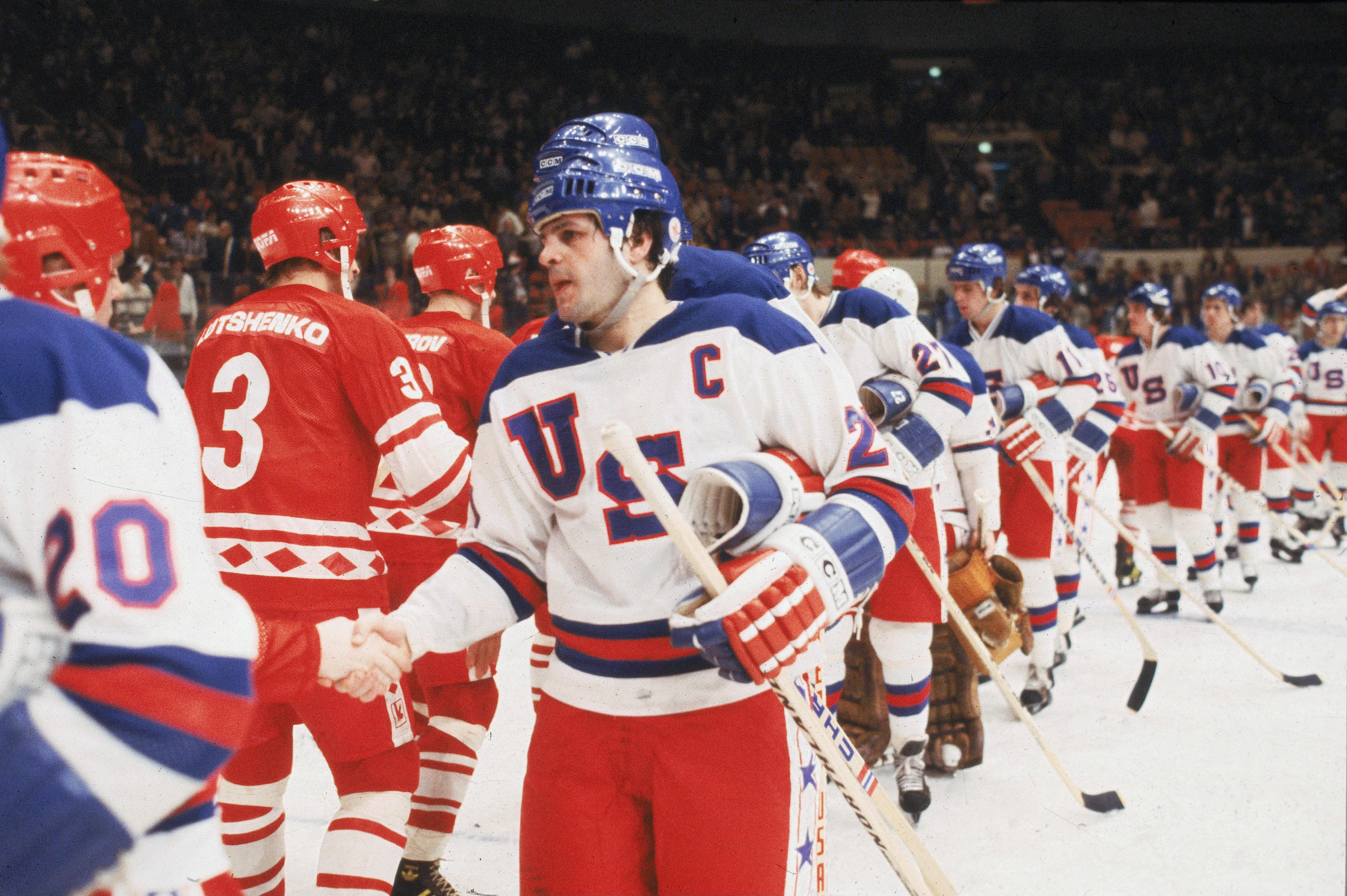
What those amateur players did for Herb Brooks, we are called to do for Jesus Christ. Today’s Gospel is one of the most challenging for those of us who want to follow Christ. Both Brooks and Jesus ask their players and disciples to stop living for themselves, but Christ asks for something infinitely greater because he has first given himself entirely for us. Jesus gives a simple sequence that is not so simple to carry out. Deny yourself. Take up your cross. Follow me.
Deny Yourself
One of Herb Brooks’ greatest challenges was to get his players to overcome their college rivals and play for Team USA. We run into many of the same challenges. Do we play for Team Jesus in our ordinary day-to-day life, or are we more set on our personal goals? It is so easy to sacrifice Jesus in favor of personal comfort and glory.
Pope St. John Paul II reflected on the radicality of this call from Jesus that does not allow for hesitation or second thoughts.
It is a demanding requirement that unsettled even the disciples and that, through the ages, has held back many men and women from following Christ (Pope St. John Paul II, 14 February 2001).
While the world often celebrates radical commitment to ideologies and causes, the Gospel calls for a deeper radicality, being rooted in the Word of God and in Christ. This has produced:
Admirable examples of sanctity and martyrdom that strengthened and confirmed the way of the Church (Pope St. John Paul II, 14 February 2001).
To deny ourselves does not mean denying that God has given us desires, gifts, and a personality. It means refusing to make ourselves the center of the story.
Take Up Your Cross
There are so many false prophets today who try to promise a following of Jesus that does not include the cross. But we will always have to suffer, because we are imitating the one who suffered and died for our sake. We cannot expect to forego what our Master himself lived out for us.
The path outlined by God for his Son is the path to be undertaken by the disciple who has decided to follow Jesus. There are not two paths, but only one: the one trodden by the Master. The disciple cannot invent a different way (Pope St. John Paul II, 14 February 2001).
We take up our cross every time that we accept the small annoyances and the big challenges that we have in our lives. We do this when we carry these burdens with acceptance and even embrace them instead of grumbling and complaining. We don’t merely tolerate suffering because we have no choice. We unite what we cannot avoid to Christ.
Follow Me
If we are going to follow Jesus, we have to understand that our discipleship means we will have to be like him. We are not following an influencer who chronicles his exotic vacations to get likes and follows.
Jesus is not a Messiah of triumph and power. In fact, he did not free Israel from Roman rule and he never assured it of political glory. As a true Servant of the Lord, he carried out his mission in solidarity, in service, and in the humiliation of death. He is the Messiah who did not fit into any mold and who came without fanfare, and who cannot be “understood” with the logic of success and power, the kind of logic often used by the world to verify its projects and actions (Pope St. John Paul II, 14 February 2001).
What in your life is keeping you from following Christ in a more radical way? Each day, take ten minutes to pray with the liturgy of the day. Ask Jesus, Lord, how do you want me to live today? If you spend more time following Jesus and less time following influencers, you begin to live in a way that is deeply satisfying and purposeful. Let’s work together to build a community where we deny ourselves, take up our cross, and follow Jesus.
What are you playing for?
Great article! I remember watching the American hockey team win over the Soviets and then beat Finland for the gold. We were in the midst of the Carter years of malaise and depression. Iranian mullahs had taken Americans hostage less than four months earlier, in November 1979, making America appear weak. The Soviets quickly attacked and took Kabul in a December 1979 invasion, making them appear even stronger. Carter's failed rescue attempt of the hostages in April 1980 dampened the good feelings from our Olympic hockey victory. I served with the 1-1 Cav on what was then the Czech border during the summer of 1980 (along with a short stint on the West German border). It was depressing to experience the Iron Curtain and what, by all appearances, was an overpowering Soviet force. I remember a Catholic priest, an Army chaplain, giving a homily about a man who had successfully escaped across the wall. But after celebrating his freedom, the man soon overwhelmed by the contrast of his new existence: Coming from material impoverishment caused him to recoil at the moral license around him, saying, "Had I grown up in the West, I would have died from temptation in a day." That priest was reminding us physically tough U.S. soldiers that the enemy we faced was far greater than the Soviets—it was our weak moral disposition and understanding of real freedom, that was keeping us from being true followers of Jesus.