

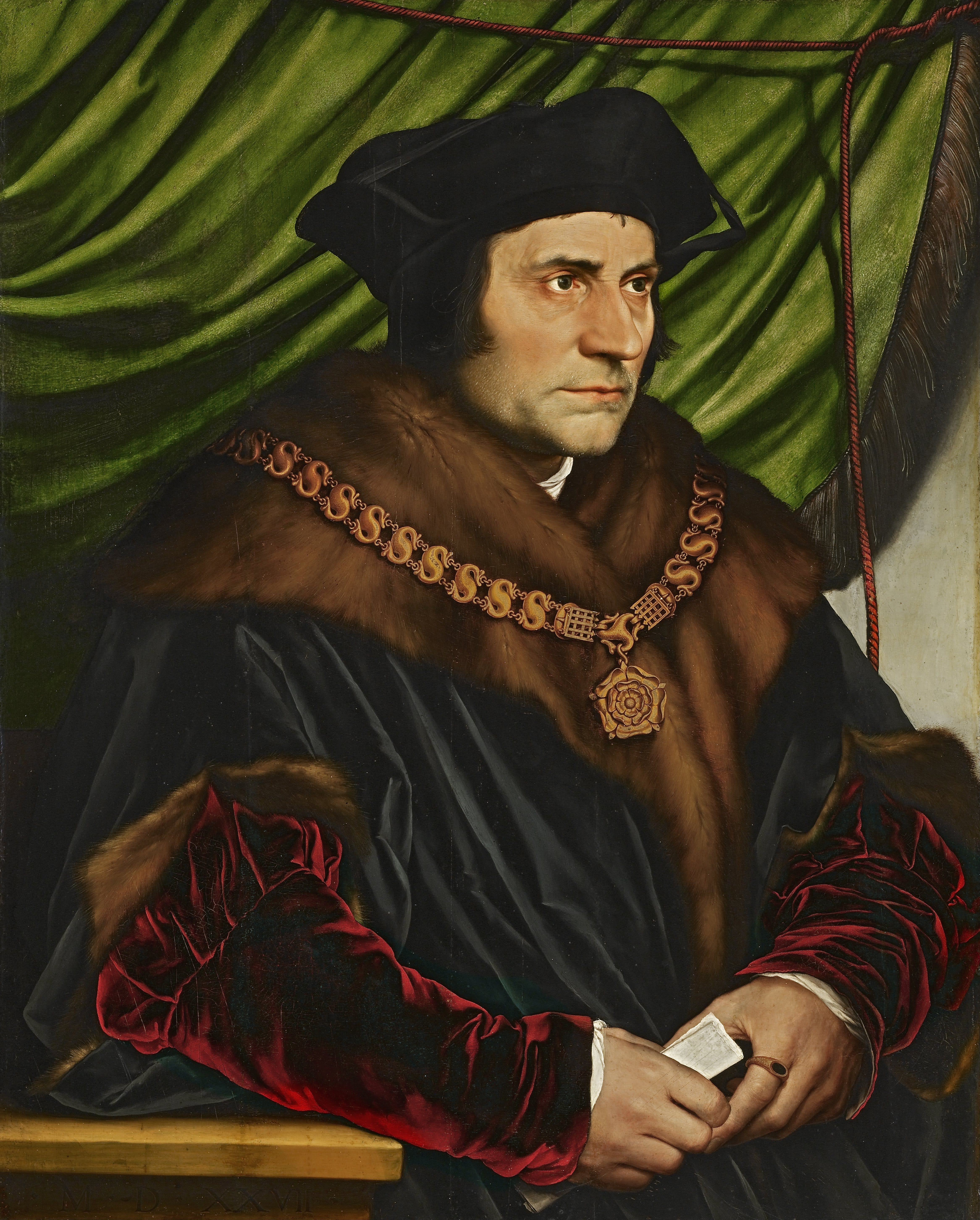
St. Thomas More showed what it meant to have a great love for country, but he loved his God and his Church more. After the Protestant Reformation, England stood out for being one of the great defenders of the Catholic Church. Pope Leo X gave King Henry VIII the title “Defender of the Faith” in 1521 when the king wrote in defense of the Catholic Church against the attacks of Luther. Of course, the story did not end there.
When Henry VIII demanded an annulment of his marriage to Catherine of Aragon, the Pope refused. Henry responded by asserting royal authority over the Church of England. In 1534, he ordered all bishops and everyone holding public office to take the Oath of Supremacy, recognizing him as the head of the Anglican Church.
Seeing the changing landscape, Thomas More, previously his Lord Chancellor and always his faithful servant, refused to take the oath. Although he loved his country, he loved God more and was martyred at the Tower of London. We are called to be good citizens of our country, but first we are called to be sons and daughters of God.
In today’s Gospel (Mt. 22:15-21), the crowd tries to get Jesus to do something seditious against the occupying government of Rome. Jesus comes up with a clever response, affirming the duty we all have to God and country, in that order.
Duties of the Government
Before affirming the duty of citizens towards the country, it is good to remember the purpose of government. Pope Leo XIII reflected on the duties of a citizen in his encyclical Sapientiae Christianae. He began by reflecting on how society does not grow out of nature seeking its own end, but to help its citizens attain their own perfection.
Nature did not form society in order that man should seek in it his last end, but in order that in it and through it he should find suitable aids whereby to attain to his own perfection (Pope Leo XIII, Sapientiae Christianae, 2).
A government should be looking for more than mere external advantages. We cannot reduce the role of government to merely offering economic advantages. The government of a just society must be interested in the moral welfare of its citizens as well. When a society loses sight of its moral grounding, it becomes increasingly difficult for the law to maintain social order. Law can never completely take the place of ethics.
Sometimes, it can feel like the State and religion are asking for two opposed things from believers. It is impossible to serve two masters (cf. Mt. 6:24).
No better citizen is there, whether in time of peace or war, than the Christian who is mindful of his duty; but such a one should be ready to suffer all things, even death itself, rather than abandon the cause of God or of the Church (Pope Leo XIII, Sapientiae Christianae, 7).
Pope Leo points to a principle that was carried out in its fullest expression by St. Thomas More.
Duties of the Citizen who is a Christian
Hopefully, we will not be called upon to lay down our lives to stand up for our faith. But we should perhaps reflect more on what it means to be Christian in a world that does not always agree with our values. If we are perhaps not called upon immediately to die for our beliefs, are we willing to at least suffer some discomfort?
There are many ways that we might suffer for being Christian. Perhaps we stand up for our beliefs in a situation where that is uncomfortable. Others are mocking the Church, but we stand up to defend her. Or maybe it means extra sacrifice to go to Mass on a holy day of obligation, because it is not a recognized holiday. Nevertheless, we make the sacrifice and go. It is far less than giving up our lives, but it is making sure that we give first to God what is God’s and then to Caesar what is Caesar. We might have the image of a ruler or our heroes from the past on our coins, but the image of God is impressed in each of our souls.
Standing Up for God in our Country
If we are going to be faithful citizens, we need to make sure to bring into the public square the values that we learn in our relationship with God. We recognize the value of the state, but we also recognize what we contribute by digging deep into our own intellectual treasure chest to share with the world the truth that is revealed through Jesus Christ.
Perhaps one of the greatest contributions we can make as Christians comes precisely from our awareness of human dignity. In a world that becomes increasingly polarized, we can continue to respect people we disagree with, because we know their dignity does not come from their ideas or their actions, but from the reality that they are created in the image and likeness of God.
We are called to be honest and fulfill our civic obligations. We should stand by our convictions and treat people with charity even when we disagree with them.
We can often get tied up in what the government owes us. Let us think a little more about how we can serve our country and our fellow citizens, not in spite of being Christian, but precisely because of it.