

We often hear that faith belongs to the realm of private belief while reason belongs to the realm of facts. One is considered subjective, the other objective. Many people assume that choosing one requires abandoning the other. Karol Wojtyła spent much of his intellectual life challenging this false dilemma. Are faith and reason two competing paths to truth, or do they ultimately lead to the same destination?
Luther
While the tension has many historical causes, the Protestant Reformation marked an important moment in the growing separation between faith and reason. In the spiritual realm, Luther was critical of reason. We could look at this superficially and assume that he is opting for a fideistic understanding of truth. God becomes arbitrary when we take faith on its own, divorced from reason. Is this what Luther wanted?
No, rather he was reacting to some tendencies within Scholastic philosophy and theology that wanted to apply logical methods without discernment to the Bible. Logical syllogisms could seem to take precedence over the gift of faith that comes through Revelation.
Although Luther did not intend a complete separation of faith and reason, some trajectories unleashed by the Reformation contributed to a growing distinction between the domains of faith and rational inquiry. The Enlightenment would deepen this divide. Reason increasingly sought autonomy from faith, while faith was often relegated to the sphere of personal conviction. It was into this intellectual climate that Karol Wojtyla was born.
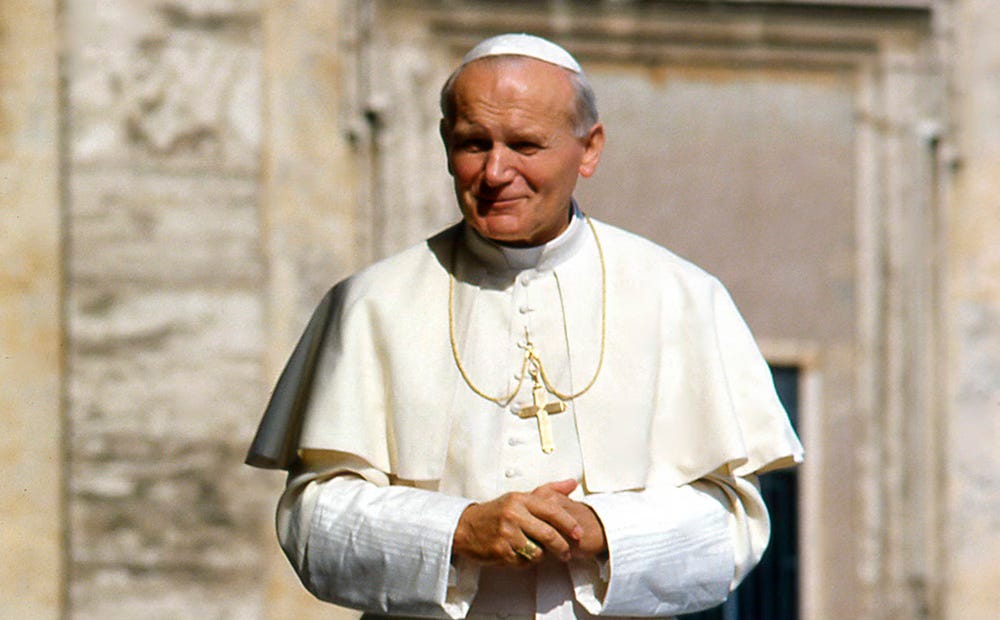
As a man of deep faith and at the same time a champion of reason, his pontificate would be a stronghold for truth in a world sliding towards relativism.
Tensions Between Faith and Reason
He saw that modern culture often forced people to choose between faith and reason, as if one had to be sacrificed for the other. His response was not to diminish either, but to show how each depends upon the other in the search for truth. This is why he wrote the encyclical Fides et Ratio, exploring the relationship between faith and reason, always with the important mission of achieving the truth. The opening paragraph makes a bold claim, which he develops throughout the encyclical.
Faith and reason are like two wings on which the human spirit rises to the contemplation of truth; and God has placed in the human heart a desire to know the truth – in a word, to know himself – so that, by knowing and loving God, men and women may also come to the fullness of truth about themselves (Pope St. John Paul II, Fides et Ratio, introduction).
The quest for truth is an important element of the human experience. There are many paths that help arrive at the truth.
Men and women have at their disposal an array of resources for generating greater knowledge of truth so that their lives may be ever more human (Pope St. John Paul II, Fides et Ratio, 3)
Importance of Philosophy
This search for truth corresponds to something we desire naturally, as we learn through philosophy, the love of wisdom.
Born and nurtured when the human being first asked questions about the reason for things and their purpose, philosophy shows in different modes and forms that the desire for truth is part of human nature itself. It is an innate property of human reason to ask why things are as they are, even though the answers which gradually emerge are set within a horizon which reveals how the different human cultures are complementary (Pope St. John Paul II, Fides et Ratio, 3).
Philosophy serves as a help for understanding truths of the faith. Some of the same behaviors of the Scholastics that bothered Luther were actually a route for a genuine deepening of the faith. Although his criticism of simply applying syllogisms indiscriminately to the truths of faith may have been warranted, the use of rigorous philosophical and theological methods to go deeper into revealed truth has borne great fruit in the succeeding centuries.
Splintering of the Truth
Karol Wojtyła was aware of a certain splintering of the truth with the rise of the modern age. With the impressive and noteworthy expansion of human knowledge, there is a tendency to neglect the search for ultimate truth. This is regrettable, and through this encyclical, Pope John Paul II helps to remedy the situation.
Already the First Vatican Council taught that “the truth attained by philosophy and the truth of Revelation are neither identical nor mutually exclusive” (Pope St. John Paul II, Fides et Ratio, 9). There is a twofold order regarding the object of knowledge, not their source. All truth comes ultimately from God, but some of this truth can be attained only by him revealing it to us. This is the truth that we know primarily through faith, although it is never contrary to reason.
The truth made known to us by Revelation is neither the product nor the consummation of an argument devised by human reason (Pope St. John Paul II, Fides et Ratio, 15).
Avoiding an Over-Rationalization of the Faith
This helps to avoid a rationalization of faith, reducing the faith to a series of principles from which all of its truths can be logically deduced. The relationship between faith and reason is important, and can be threatened by some modern ways of thought, particularly nihilism.
As a philosophy of nothingness, it has a certain attraction for people of our time. Its adherents claim that the search is an end in itself, without any hope or possibility of ever attaining the goal of truth (Pope St. John Paul II, Fides et Ratio, 46).
For John Paul II, nihilism emerges when reason loses confidence in its ability to know objective truth. The result is not greater freedom but skepticism about whether truth can be known at all. Having a strong trust in reason, Pope John Paul II argued that faith and reason can achieve a proper harmony. He suggested
that faith and philosophy recover the profound unity which allows them to stand in harmony with their nature without compromising their mutual autonomy. The parrhesia of faith must be matched with the boldness of reason (Pope John Paul II, Fides et Ratio, 48).
The question of faith and reason is not merely academic. Every person seeks meaning, purpose, and truth. Wojtyla believed that we were made for this search. Faith without reason risks becoming superstition; reason without faith risks becoming trapped within its own limits. Together, they are the two wings by which the human spirit rises toward the fullness of truth.