

I was in Rome during the final years of Pope John Paul II. I saw his strength fade. I remember the Stations of the Cross at the Colosseum when he was too weak to come, and Cardinal Ratzinger led in his place. But what I will never forget is standing in St. Peter’s Square when it was announced: he had gone to the house of the Father. He gave everything.
As powerful as his witness was, it is only a shadow. Because even the greatest saint gives his life once, but Christ gives himself completely, and he continues to give himself every time we gather to celebrate the Eucharist.
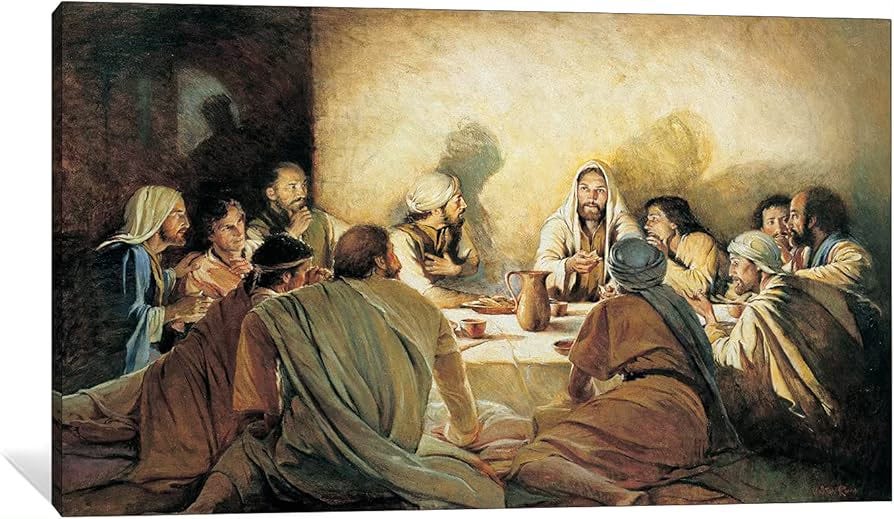
Jesus loved his own in the world, and he loved them to the end (Jn. 13:1).
Jesus loved them to the end: by washing their feet, by giving them his body and blood, and by dying on the cross to save us from our sins.
Washing somebody’s feet is not necessarily an attractive proposition. For the Passover meal, people needed to be ritually clean. Part of this was to wash off the grime from walking the streets of Jerusalem. Normally, this was the work of a servant. At times, even the host himself would do it. Jesus shows the depth of his love by washing the feet of his disciples. The Lord kneels before his disciples. God kneels before man. We commemorate this act by having the priest wash the feet of twelve members of the community at this Mass. It is a reminder that in the Church, every vocation is always a vocation to service.
Jesus goes further in his giving of himself to his disciples by instituting the Eucharist. Although not recorded in the Gospel of John, we remember the words of the Institution: Take and eat: this is my body, this is my blood. The words of Institution are at the heart of every Eucharistic Celebration. Jesus gives himself fully, even to the point of giving his body and blood. As Pope John Paul II taught, the Eucharist both forms the Church and builds her up (cf. St. John Paul II, Dominicae Cenae, 4)
The Eucharist makes us what we are as a Church, because it unites us with Jesus, who came to give his life for us.
Nowhere is this reality more present than in his ultimate sacrifice of dying on the cross at Golgotha. We can never understand the Eucharistic miracle without contemplating the mystery of his Passion and Death. The Last Supper and his sacrifice at Golgotha are mysteriously united and come down to us through the centuries in our own celebration at every Mass.
Jesus loved his own to the end through washing their feet, giving himself in the Eucharist and dying on the Cross. If we truly contemplate these mysteries, we should grow in our desire to give ourselves to him. Each year, the washing of the feet is a powerful reminder to priests of their duty to serve the faithful. But these three mysteries should command us to imitate him in self-giving. In his recent audience, Pope Leo reminded us that we are called to bring Christ to the workplace, civil society, and all human relationships. We do this when we seek first to serve and not to be served. By doing this, we “show the beauty of Christian life, which foretells here and now the justice and peace that will be accomplished in the Kingdom of God” (Pope Leo XIV, 1 April 2026). If this is how Christ has loved us, how can we not love in the same way? It means choosing to serve when it is inconvenient. It means lowering ourselves when we would rather be recognized. It means loving to the end, in our homes, in our schools, and in every relationship.