

Pope John Paul II was a man often lost in prayer before a tabernacle and a crucifix. His teaching did not come from raw reflection, but from the lived experience of prayer. The Paschal Mystery: the suffering, death, and resurrection from the dead of Jesus represents the central mystery of our Christian faith. His centering on the Paschal Mystery helped him understand the importance of the Eucharist and of Penance in our everyday lives. The precious blood of Jesus Christ our Savior has paid our redemption.
The “price” of our redemption is likewise a further proof of the value that God himself sets on man and of our dignity in Christ (Pope St. John Paul II, Redemptor Hominis, 20).
The Eucharist presents this mystery to us powerfully. What was bread and wine becomes the Body and Blood, Soul and Divinity, of Jesus Christ our Lord.
Summit and Fullness
Rather than beginning with norms, Karol Wojtyła liked to begin with a reflection on Jesus Christ. In this paragraph of Redemptor Hominis, he will get to liturgical norms that are important to follow. However, first it is important to establish the central character of the Eucharist within Christian worship.
The entire sacramental life of the Church and of each Christian reaches its summit and fullness in the Eucharist (Pope St. John Paul II, Redemptor Hominis, 20).
This recalls the words of Vatican II referring to the Eucharist as “source and summit” of holiness within the Christian life. How is it this summit? What gives it this fullness? John Paul II examines this, as the Eucharist is the fullest expression of the presence of Jesus Christ in his Church.
By celebrating and also partaking of the Eucharist we unite ourselves with Christ on earth and in heaven who intercedes for us with the Father (Pope St. John Paul II, Redemptor Hominis, 20).
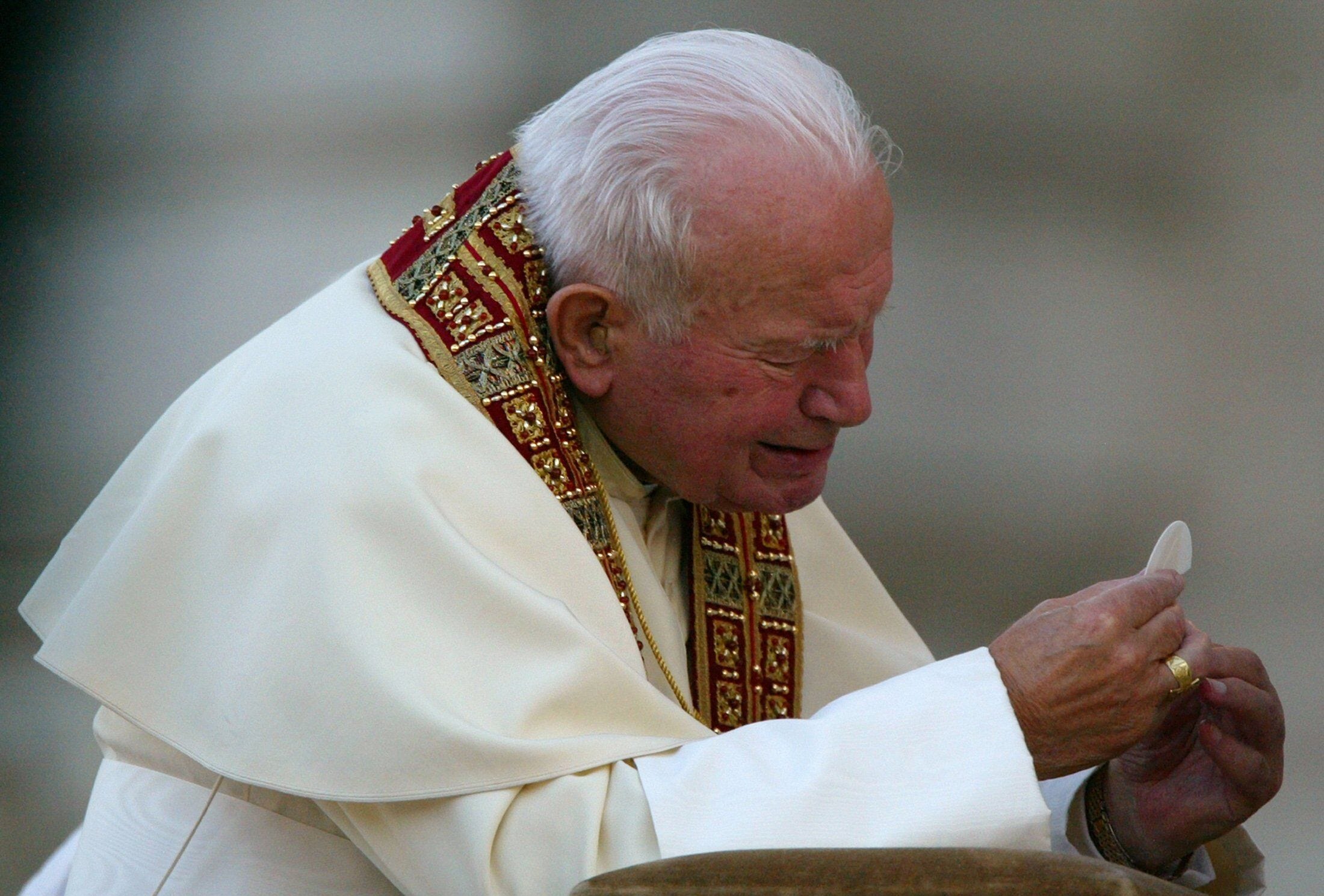
If you ever witnessed John Paul II celebrating Mass, you understand that these words were not just poetic beauty, but lived doctrine. One thing is to teach something, but another thing entirely is to live it. Pope John Paul II lived out his love for the Eucharist before writing out his doctrine. Paragraph 20 of Redemptor Hominis echoes his teaching throughout his pontificate, which often centered on the Eucharist.
Called to Newness
The Eucharist is not just one sacrament out of the seven instituted by Christ. It gives us so much grace and power and calls us to live in this world a foretaste of eternity. The Gospel does not just point to the next world, but calls us to a new existence during this earthly life. Christians are not called to simply “wait for eternity” but rather to live in a way that shows we are graced individuals.
The Eucharist is the Sacrament in which our new being is most completely expressed and in which Christ himself unceasingly and in an ever new manner “bears witness” in the Holy Spirit to our spirit (Pope St. John Paul II, Redemptor Hominis, 20).
Christ does not call us to be holy in the next life exclusively, but already in this life. Our holiness exists to the extent that we allow the Holy Spirit to work in our lives. The Holy Spirit descended upon Mary at the Annunciation, and she became the Mother of God. He descended upon the Apostles at Pentecost, and they became great preachers, fearless in the face of constant danger.
The Holy Spirit continues to be present in the Church, drawing us into deeper communion with Christ. Through the Eucharist, Christ’s Body and Blood nourish us and strengthen us in the life of grace. Baptism introduces us to divine life and sacramental grace, while the Eucharist builds on that life and helps us grow in holiness.
Living By the Eucharist
John Paul II asserts that “the Church lives by the Eucharist.” This is an assertion, at the same time that it serves as an exhortation for all of us. Teaching about the Eucharist should always be a focus for theologians, so the men and women engaged with the intellectual life of the Church should always see the Eucharist as a focal point. Mystics and ascetics, men and women who dedicate themselves to prayer and to penance, will always do well to make the Eucharist a focus of their time of meditation and contemplation.
Catholics have the obligation to attend Mass on Sundays and holy days of obligation. Hopefully, the motivation is never principally the obligation but becomes an inner urgency to come into contact with the Eucharistic Lord. When Catholics prepare for Mass, they are more open to receive the actual graces that come through the sacramental grace of receiving Communion.
Priests and bishops are called to have special reverence before the Eucharistic Lord. This should come out clearly in the way they celebrate Mass. Hopefully, the Mass is never rushed. The priest is not an owner of the mystery, but rather a steward to whom it has been entrusted.
Attention to Liturgical Norms
Pope John Paul II was very aware of the need to attend to liturgical norms. He knew, at the same time, that mere exhortation to follow rules was not going to convince his audience. His yearly letter to priests was always an exhortation to go deeper into the meaning of the priesthood. He reminded priests of the exalted nature of their vocation, touching the mysteries of God in a real way. A priest who approaches the Eucharist carelessly does harm to the faithful by making it seem something unimportant.
The liturgical norms help make sure that the priest and other ministers approach the altar respectfully and in a way that communicates love for the Eucharist to the faithful.
This is the source of the duty to carry out rigorously the liturgical rules (Pope St. John Paul II, Redemptor Hominis, 20).
The Pope’s call to reflection helped many priests celebrate the mysteries more reverently and with greater reflection. This self-examination echoes the words of St. Paul:
Let a man examine himself, and so eat of the bread and drink of the cup (1 Cor. 11:28).
This self-examination in relation to the Eucharist introduced the importance of the other sacrament that is received frequently in Christian life, the Sacrament of Penance.
Link Between Eucharist and Penance
Paul exhorted the early Christians to test their consciences before approaching the heavenly banquet that comes down in the form of the Eucharistic celebration. To approach the Eucharist is to seek conversion.
The Christ who calls to the Eucharistic banquet is always the same Christ who exhorts us to penance and repeats his “Repent” (Pope St. John Paul II, Redemptor Hominis, 20).
Penance would be another theme of the pontificate of John Paul II. Pope St. Paul VI noticed after the Second Vatican Council a “loss of the sense of sin.” This led to a precipitous decline in the Catholic practice of the Sacrament of Penance. Some people even taught that Penance was in contradiction to the loving Communion achieved through common reception of the Sacrament of the Eucharist.
This thinking is faulty, however, because Communion in the sacrament of the Eucharist without communion that comes through common penance builds on a false hope. We are unable to become one with one another if our sinful actions have separated us from the Body of Christ. The words of the Holy Father are not meant to shame us, but they are a call to conscience that we are meant for more.
When we truly live out the Sacraments of Eucharist and Penance, we grow in our spiritual lives, a gift from the time of our Baptism. As Catholics, we should give witness to this intimate relationship and pray each day to grow in our love for Jesus Christ, expressed especially in our love for the Eucharist. When we recognize the price that has been paid, the Suffering and Death of Jesus Christ on the cross, we begin to recognize our own dignity and begin to do our best to live accordingly. The more deeply we understand what Christ has done for us, the more deeply we want to live for him.