

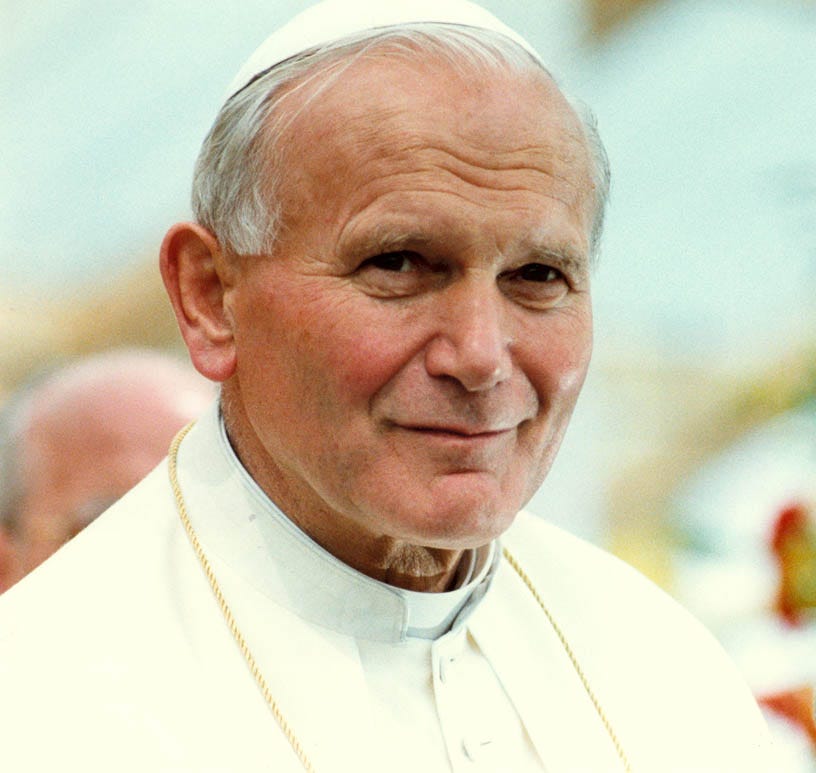
Young Karol Wojtyła could never have imagined the suffering his life would entail. One thing that is amazing about him is that he never shied away from suffering. Rather, he allowed it to transform him and to bring him closer to Christ. The mission that he would receive as Universal Pastor was directly tied to his experience of the redeeming love of Jesus, revealed also through the mystery of suffering.
A Church for All
The Church exists for all of humanity, not merely for its visible members. Pope St. John Paul II saw the Church as interested in and concerned for all of humanity, not just those baptized as Catholics. While the Mystical Body is made up of those who have received the sacrament of Baptism, the mission of the Church is to all men and women.
The Church, then, both contains and communicates the invisible grace she signifies. It is in this analogical sense that the Church is called a “sacrament” (Catechism of the Catholic Church, 775).
The Church is the universal sacrament of salvation, meant to be a witness to all humankind, not just its visible members. There is often debate in the Church about who is Catholic, who is not, and what this all means in relation to salvation. The Church does not presume to judge the eternal destiny of those outside her visible boundaries. At the same time, she proclaims that salvation comes through Jesus Christ. The sacraments he instituted are privileged means to communicate grace. Their power comes from Christ’s redemptive love.
Christ’s Redemptive Love
Jesus is rightly remembered for the power of his love. Unfortunately, this love is often presented as something merely sentimental, and the strength and power of his love becomes obscure. This is a disservice to the truth, since Christ lived out his love through his sacrifice on the Cross, not through a series of pious feelings expressed carelessly.
As Pope John Paul II writes:
Christ united himself with [the Church] in his mystery of Redemption, the Church must be strongly united with each man (Pope St. John Paul II, Redemptor Hominis, 18).
The Church does not merely exist in the world. She is called to bring the witness of Christ to the forefront in powerful ways. Through the life of grace, we are all called to communion with Jesus Christ. How exactly this communion works is a mystery, a truth of faith that surpasses our understanding. It is the way we allow Christ’s redemptive love to touch our hearts and transform us.
This mystery of Christ’s union with the soul makes him a new man (cf. Col. 3:1). Sometimes life’s experiences crush us, but God’s grace waits to rebuild us. Karol Wojtyła knew well the pain of profound loss. We remember the successes, but we don’t always remember the pain he suffered through the loss of his family. The war interrupted his studies, just as war still does for so many people today.
One of the reasons we do not appreciate the full horror of war is that we are often isolated from its effects. For some of us, the greatest pain we experience from war is paying more for gas at the pump. This does not compare with people who are afraid of their homes being blown up or losing loved ones. Karol Wojtyła suffered Nazi occupation during the Second World War. The end of the war brought but brief relief, as the Soviet Union dominated Poland until 1989. Pope John Paul II advocated so effectively against war because he had felt its consequences firsthand. Wisdom does not always flow from age and the experience of suffering, but it did in the case of this great man.
Called to Share in Christ’s Life
This means that we partake in Christ’s life. What does it mean to share in the divine life? (Cf. 2 P. 1:4). It is a hard concept. I like thinking of the image of pericoresis used in the East to describe the Trinity. We know that there is one God and three Persons. One way to imagine this is to think of the three dancers spinning around together at a very fast rate, until you could nearly not tell them apart. This does not mean that the Divine Persons are indistinguishable from one another. That would be heresy. But their union is far greater than anything we can imagine or experience. We could also think of a small child who gets caught up in a group hug with both his parents. Although certainly imperfect, these are some ways I think of participating in God’s divine life.
We share in Christ’s life when we allow the life of grace to take root in us. By penning the encyclical Redemptor Hominis, Pope John Paul II reminded the Church that the function of the Church does not consist in bingo halls and church raffles, but rather in bringing people into communion with Jesus Christ. Christ came to redeem man, not to entertain him.
We can engage in various community-building events as a way of fostering communion, but we can never let the means make us lose sight of the end. We are here to preach the name of Jesus Christ. We are called to give the world the good news that Jesus Christ came to save us from our sins.
Transforming Suffering into Apostolic Strength
Through grace, we are “newly created in Christ for the fulness of grace and truth” (cf. Eph. 2:10). We are created in Jesus Christ for good works. His union with us is a source of power. John Paul II found power in the midst of his own weakness. At the time of writing the encyclical, he was still a young Pope, vibrant and participating in sports, especially skiing and hiking. A few years later, he would suffer an assassination attempt that nearly took his life and limited his physical activities for years afterwards. Although his physical strength declined gravely, his spiritual strength never wavered.
Although the physical suffering aged him, he still found the inner strength to travel the world and to begin the marvelous papal initiative of the World Youth Day. He would meet the young people in places far and near, like Rome, Santiago, Denver, and Paris. His encounter with Christ animated each apostolic journey.
Through our relationship with Jesus Christ, we are transformed and empowered to grow in our love of God and to engage with the world effectively. This transformation does not mean that we are exempt from suffering. Nor does it mean that our spiritual life will come easily. Often, when somebody starts off in the spiritual life, he or she is blessed with many spiritual consolations. These tend to diminish with time. Likewise, physical strength and health may decline. John Paul II’s witness to hope bears this truth. Although his physical energies were spent, he became more spiritual and gave even greater evangelical witness to the world.
The life of grace that Christ offers us can grow throughout this life until reaching its completion in eternal life. Let’s look at suffering in our own life and see how we can grow in our apostolic strength. We want to evangelize the world, bringing Christ into every corner of society.
Father, well said! I have always struggled with explaining the Blessed Trinity. Pope Saint John Paul II's teaching in Dec 1985 helps but I still find it difficult to explain: https://www.vatican.va/content/john-paul-ii/it/audiences/1985/documents/hf_jp-ii_aud_19851204.html