

“We are not afraid of the truth.” When Pope John Paul II visited the Institut Catholique in Paris on June 1, 1980, he identified the principle that lies at the heart of every authentic university. A university exists because men and women desire to know the truth. This love for truth gives rise to genuine intellectual freedom, the freedom to follow reality wherever it leads.
Visiting the Church’s Eldest Daughter
His first pastoral visit to France marked the first time a Roman Pontiff had visited France since 1814. The Enlightenment had shaped French intellectual life profoundly, and many modern currents questioned whether objective truth could be known at all. Pope John Paul II would choose the setting of a Catholic university in France to remind academia of its fundamental need to pursue the truth.
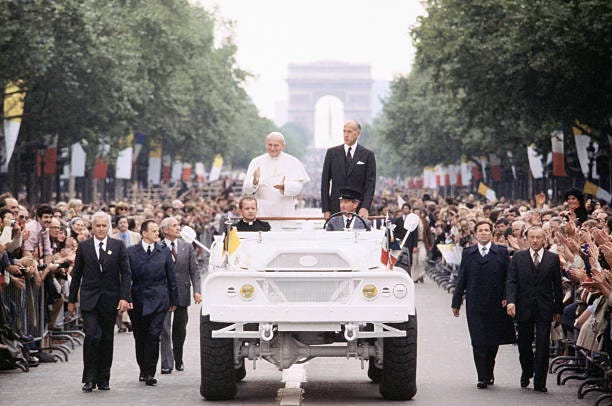
The French Revolution and subsequent secularization of society seemed to wrest France from the bosom of the Church. Pope John Paul II’s visit showed the Church’s maternal concern and France’s desire to remain connected. Love for truth characterized Karol Wojtyła, and throughout his life, he sought to share this love with others.
Against this backdrop, he summarized the university’s mission in a single sentence:
Love for truth is the foundation of intellectual freedom without which there cannot be a university worthy of the name (Pope St. John Paul II, Discourse to the Students and Professors of Institut Catholique de Paris).
This affirmation may surprise those who assume that the Church is hostile to intellectual freedom. Catholic teaching is often caricatured as an obstacle to scientific progress or independent thought. Yet John Paul II emerged as one of the twentieth century’s most vigorous defenders of the university and of the freedom necessary for authentic inquiry.
He noted the value of human knowledge but also pointed out a potential weakness. The sciences provide remarkable knowledge about the world, while the humanities illuminate the richness of human experience. Yet neither automatically answers the deepest questions: What is the human person? What is the purpose of life? How should we live? Knowledge alone does not guarantee wisdom.
Self-knowledge
Yet knowledge of the world is not enough. The deeper question is whether we understand ourselves. A university fulfills its mission not merely by producing experts but by helping men and women discover who they are and what their lives are for. The specific mission of these institutions is to introduce students to intellectual pursuits, answering the thirst for truth and certainty. We seek truths about the world, but we also seek the ultimate truth that gives coherence and meaning to all particular truths. We seek not only particular truths but also the source and unity of truth itself.
From St. Paul of Tarsus to Einstein, the greatest minds have shared a conviction that reality is intelligible and worth exploring. It is not enough to simply gather data. We have to learn the meaning of the data. A Catholic university has a privileged position within the larger panorama of higher education, as faculties of theology and philosophy can foster a deeper learning for their students. A Catholic university offers lay men and women the opportunity to pursue intellectual excellence while remaining rooted in the truths of the faith.
Problem of Splintering Disciplines
The Jesuit theologian Jean Danielou identified a tendency toward intellectual fragmentation within the modern university. The positive sciences have increasingly come to dominate university life, often at the expense of philosophy, theology, and the humanities. When this is the case, there is no true intellectual freedom, since there is no pursuit of a higher truth.
When universities abandon the search for transcendent truth, they become vulnerable to ideological capture. Intellectual life narrows, and education risks becoming an instrument of power rather than a pursuit of wisdom. “To forget God is the perversion of intelligence, if to be intelligent is to know reality.” Intellectual sloth risks cultural death.
Faith Seeks Understanding
As Augustine observed, “faith should think.” Faith is not meant to bypass reason but to engage it. A Catholic university provides a privileged setting where faith and reason can challenge, purify, and enrich one another. This is why the Church never has to fear the advances of science that come as a result of intellectual research and study. There will never be a newly discovered truth that disproves the truths of the Catholic faith. We may have to revisit assumptions we have made, but truth cannot contradict itself.
The conviction that truth is one and that faith has nothing to fear from reason shaped Karol Wojtyła’s entire intellectual life. It also explains his deep interest in fostering dialogue among theologians, philosophers, and scientists. Because truth is one, the university cannot isolate disciplines from one another. Philosophy, theology, and the sciences must remain in conversation. This conviction led John Paul II to invest significant energy in fostering dialogue among scholars from other fields.
Intellectual Freedom
The Catholic faith has never been afraid of true science. The Church’s understanding of the world has often developed alongside advances in human knowledge. While Christians have sometimes embraced incomplete explanations of reality, the Church has remained open to deeper insights into creation. For this reason, the Catholic Church defends intellectual freedom vigorously.
This is one of the problems for fundamentalist interpreters of Scripture and of the Church. Intellectual freedom is not the same as intellectual isolation. Errors often arise when individuals or groups become convinced that they alone possess the whole truth and no longer remain open to correction. Genuine inquiry requires both conviction and humility.
John Paul II rejected the false choice between Catholic identity and intellectual rigor. A Catholic university should form men and women who love the truth enough to follow it wherever it leads. Intellectual rigor and Catholic identity are not competing goods; each strengthens the other when both are ordered toward truth. In the end, the university remains worthy of its name only when it can say, with confidence and humility: “We are not afraid of the truth.”