

During the Second World War, a quiet Polish tailor named Jan Tyranowski changed the life of a young factory worker named Karol Wojtyla. Years earlier, Jan’s own life had been transformed by an equally unlikely event. A priest had once preached a simple homily with a striking message: “It is not difficult to be a saint.” This led to his realization that holiness was not reserved for extraordinary people. As the Second World War broke out, he was living his spiritual life in a more demanding way than many religious orders. He came up with the idea of the Living Rosary, a group that promoted devotion to Mary while also establishing practical community among young people. Karol Wojtyla would get to know him through this apostolic initiative. The influence of this prayerful tailor on the future Pope cannot be overstated.
Jan introduced Karol to mental prayer and to Carmelite spirituality. This was incredibly important for his lifelong devotion to St. John of the Cross, and he would write his doctoral thesis on the act of faith in the writings of the great Spanish mystic. The influence of these Carmelite masters would remain with him throughout his life. Even in his mature personalist philosophy, one can recognize themes first encountered in St. John of the Cross.
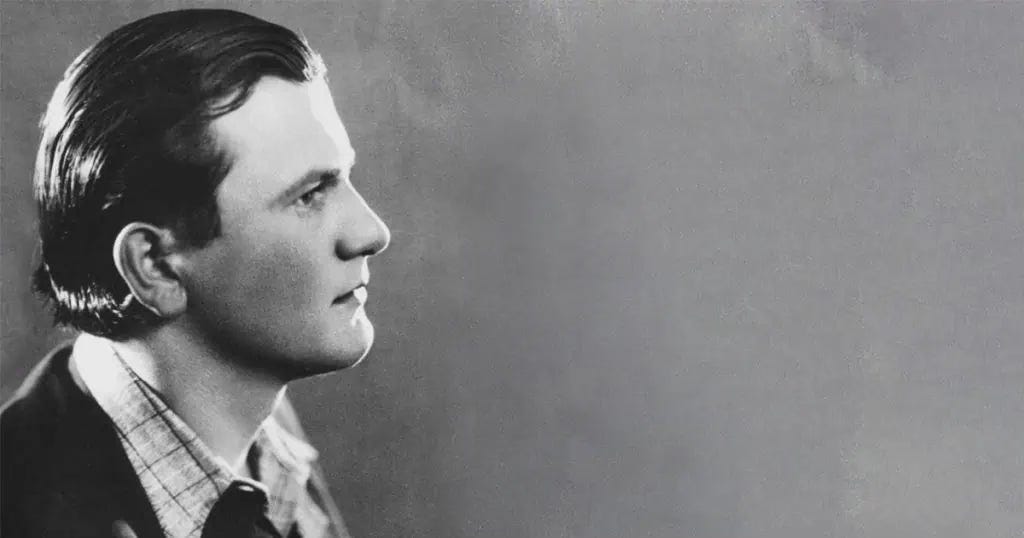
Jan did more than encourage Karol to pray. He introduced him to an entire spiritual tradition. Through the writings of the Carmelite masters, especially St. John of the Cross, Wojtyla discovered a rich account of the soul’s journey toward union with God. Prayer was not simply saying words or fulfilling religious duties. It was the gradual transformation of the whole person. This mystical vision would eventually shape not only Wojtyla’s spirituality but also his philosophy.
Many of the themes that later became central to his personalism can already be found in the Carmelite tradition he absorbed under Tyranowski’s influence.
To describe the dynamics of the spiritual life philosophically, Wojtyla developed several concepts that became central to his personalism: consciousness, personal freedom, and self-determination.
Wojtyla would never leave these insights behind. As a priest, bishop, philosopher, and eventually pope, he insisted that every person is called to communion with God. The ideas he would later articulate philosophically had first been lived in prayer under Jan Tyranowski’s guidance.
Consciousness
When Karol Wojtyla wrote his great philosophical work, Person and Act, he paid a lot of attention to consciousness. One of the distinct features of the human person is consciousness. He is able not only to act but also to be aware of his own actions. Further, man can be aware of his own human action. This is at the source of freedom and morality in man. This core thought is present in the writings of St. John of the Cross.
The soul, then, conscious of the abundance of its enrichment, at the time of these glorious encounters feels to be almost at the point of departing for complete and perfect possession of its kingdom, for it knows that it is pure, rich, full of virtues, and prepared for such a kingdom (St. John of the Cross, The Living Flame of Love, 31).
Part of the greatness of the human soul is its capacity to become aware of the blessings it receives from God. St. John is saying that the soul not only receives grace but also becomes conscious of God’s transforming work within it. This interior awareness fascinated Wojtyla because it showed that the spiritual life does not bypass human experience; it elevates and perfects it.
Wojtyla was open to the world because he was convinced that nothing genuinely human fails to find an echo in his heart. The experiential dimension of St. John’s mystical theology would later find a philosophical expression in Wojtyla’s personalism. As he writes in Person and Act, “Man not only acts consciously but also is conscious of his action” (Wojtyla, Person and Act, p. 121). This capacity for self-awareness is one of the defining characteristics of the human person. What St. John of the Cross explored within the life of prayer, Wojtyla examined through phenomenological analysis, showing that conscious subjectivity is fundamental to every human act. Once Wojtyla understood the person as a conscious subject, the next question naturally followed: How does that conscious subject become free?
Personal freedom
The interior experience of prayer naturally led Wojtyla to reflect more deeply on personal freedom. In the writings of St. John of the Cross, he discovered that freedom was not simply the absence of external constraints but the soul’s interior liberation for union with God. He expresses the paradox beautifully:
All who are free tell me a thousand graceful things of you; all wound me more and leave me dying of, ah, I-don’t-know-what behind their stammering (St. John of the Cross, Spiritual Canticle, 7).
Freedom is at the source of every true human experience. The rise of democratic societies and totalitarian regimes marked the twentieth century. Freedom of choice in some parts of the world stood in stark contrast with extreme limits on freedom of thought, expression, and action in other regions.
Wojtyla was always clear that freedom needed to be rooted in truth. Although he loved participating in the Second Vatican Council, he nevertheless criticized the draft of the document promoting religious freedom. He believed that religious freedom could never be understood apart from the human person’s obligation to seek and embrace the truth.
He would rectify this in his own magisterium as Pope St. John Paul II. From the beginning of his pontificate, he proclaimed the freeing aspect of the truth, quoting Jesus, “The truth will set you free” (Jn. 8:32) in his first encyclical, Redemptor Hominis (1979).
Seeking to renew Catholic moral theology, he wrote the encyclical Veritatis Splendor (1993), presenting truth and freedom as inseparable foundations of the moral life.
After the fall of the Berlin Wall in 1989, John Paul II watched Western consumerism and moral relativism spread rapidly through the former Communist countries. Even the Polish people, who had struggled so heroically for political freedom, could mistake freedom for the pursuit of unlimited personal choice rather than the pursuit of the good. He found that the error lay always in divorcing freedom from truth.
The life of St. John of the Cross shows how freedom cannot be reduced to external circumstances. Although imprisoned and persecuted by his own Carmelite brothers, his interior freedom continued to grow because it rested in God. Wojtyla embodied the same conviction. When the Communists built Nowa Huta, the model city of the future without a church, he refused to accept that a society could be truly free while excluding God. Each Christmas he celebrated Mass with the workers until they were finally permitted to build a church.
There is no freedom without God.
Freedom, however, is never merely the ability to choose. It is exercised concretely through action. This led Wojtyla to one of the defining ideas of his philosophy: self-determination through the human act.
Self-determination through the human act
Freedom is key to grasping how Karol Wojtyla understood moral action and what it means to be human. When St. John of the Cross reflected on the human will and its role within the spiritual life, he set up much of what Karol Wojtyla would understand as freedom, especially self-determination through the human act. John’s reflection on desire comes out in the way he understands the spiritual life.
It is not the things of this world that either occupy the soul or cause its harm since they enter it not, but rather the will and desire for them, for it is these that dwell within it (St. John of the Cross, Ascent of Mount Carmel, I.3.4).
For Wojtyla, every freely chosen action does more than change the world; it changes the person acting. By choosing the good, we become good. By choosing evil, we diminish ourselves. Human action is therefore self-determining: through our freely chosen acts, we gradually become the kind of person we choose to be.
Pope St. John Paul II used this philosophical reflection as the basis of his critique of fundamental option theory in his encyclical, Veritatis Splendor:
By his fundamental choice, man is capable of giving his life direction and of progressing, with the help of grace, towards his end, following God’s call. But this capacity is actually exercised in the particular choices of specific actions, through which man deliberately conforms himself to God’s will, wisdom and law. It thus needs to be stated that the so-called fundamental option, to the extent that it is distinct from a generic intention and hence one not yet determined in such a way that freedom is obligated, is always brought into play through conscious and free decisions (Pope St. John Paul II, Veritatis Splendor, 67).
He resisted those who stated that we could basically choose God, but not act accordingly. What we do determines who we are. We can’t make a theoretical choice that contradicts our practical behavior.
All of the thought of Pope St. John Paul II shows a great unity between his interior life springing from his union with God and his philosophical reflections. It is challenging to live the way we proclaim is best. Wojtyla is someone who did this, and this is part of why he became a saint. Jan Tyranowski began by teaching a young man to pray and unlocked a world of mystery that led Wojtyla to become one of the most influential Christian philosophers of the twentieth century.