

Little Li is the child martyr of the Eucharist in China. Archbishop Fulton Sheen would famously tell her story as he traveled the world, promoting devotion to the Blessed Sacrament. He talked about her entering the parish church after Communist soldiers had occupied the town and closed the church. She knew there were still consecrated hosts in the tabernacle. When she first entered the church, she witnessed that the soldiers had burst open the tabernacle, and the sacred hosts lay scattered on the ground.
Each night, she would enter the church clandestinely, kneeling to the ground to consume one host by lowering her head to the ground and picking up the host with her tongue, as it was customary in the pre-Vatican II Church for the laity never to touch the host with their hands. Her heroic mission ended when she consumed the last host, was caught and executed by the guards, becoming a little girl martyr of the Eucharist.
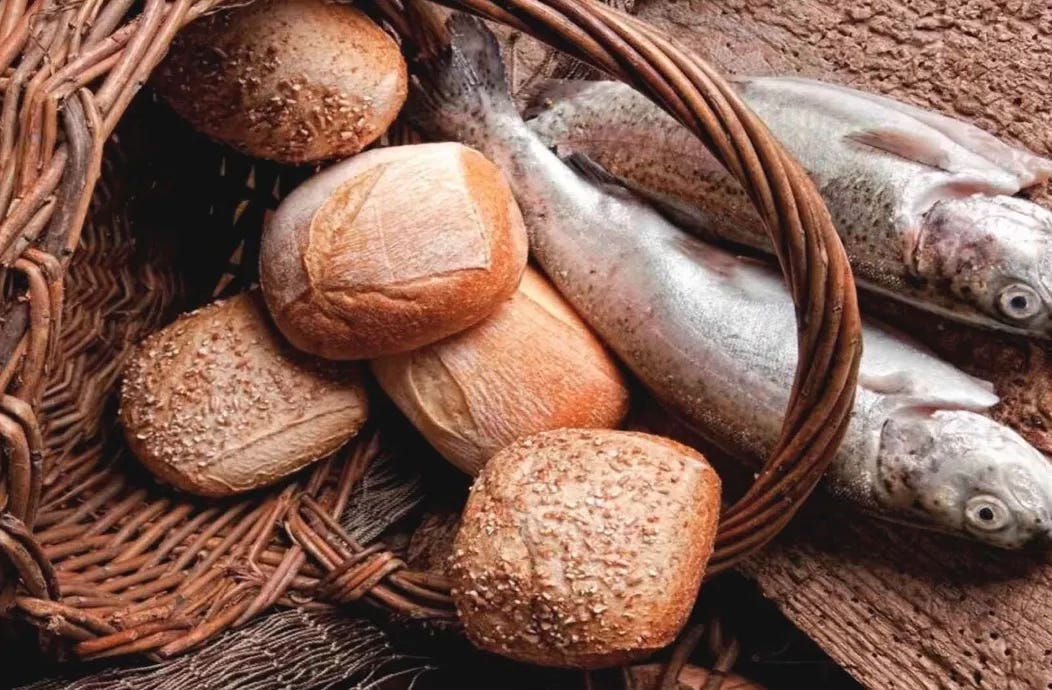
When she was learning her catechism, she asked why the Eucharist had to be bread. She would have preferred rice cakes, something more familiar to her cultural background. Her catechists explained that the hosts had to be bread before consecration, so that they could be the Body of Christ afterwards. The fact that we use bread and wine for the Mass reflects that Jesus became man in a concrete cultural context, in Palestine of the first century. What we eat and how we eat it speaks to our culture. The multiplication of the loaves in today’s Gospel does more than satisfy a hungry crowd. It points toward the New Covenant that Jesus will establish through the Eucharist.
Covenant
The word “covenant” lies at the heart of salvation history. Covenants could be sealed with a sacrifice, but they were also often sealed with a meal. A covenant should not be reduced to the establishment of a law or set of norms. Rather, it establishes bonds of kinship. A new family is formed. Our Bibles speak of the Old and New Testaments because the Latin translation used the word testamentum. But the biblical idea is richer than a legal document. God is establishing a covenant relationship with his people.
In this sense, we can look at the Feeding of the Five Thousand as a preview of the New Covenant that will be established at the Last Supper. There, Jesus pronounces these words over the chalice. “This chalice which is poured out for you is the new covenant in my blood” (Lk. 22:20).
Becoming a Family
A covenant has familial, legal, and liturgical dimensions. The sharing of the Passover meal, the setting for Jesus celebrating his Last Supper, implied a certain familial intimacy. Rather than being a public feast, it was a common holiday celebrated in the privacy of each family home. To invite a stranger to Passover was to establish a bond of friendship that seemed more like a family relation.
Not Just the Law
There are also legal implications of entering into a covenant. In the Bible, the covenants are primarily between God and his people. To enter a covenant implies having a shared understanding of each party’s obligations. When we approach the Eucharistic banquet at a Catholic Mass, we recognize certain obligations. Love always requires sacrifice. Marriage vows create rights and responsibilities because they establish a family.
Similarly, approaching Holy Communion is a public profession that we belong to Christ and to his Church. Because Holy Communion expresses an already existing communion of faith and life, the Church asks that those who receive it already be united with her in faith and be spiritually prepared. When we say “Amen,” we proclaim that we accept what the Church teaches and we believe that it is truly the Body of Christ, not merely a symbol.
Liturgical Aspects
Finally, we see the liturgical dimension of the covenant. At the Mass, there are liturgical norms that we respect so that we can participate in the Lord’s Eucharistic banquet worthily. The word “liturgy” means the “work of the people,” and our work is to praise God. When we receive Communion, our communion with the household of God is deepened. The covenant established in Baptism is renewed and strengthened as we share in the sacrifice of Christ. Every covenant has its ritual expression. In the Old Testament it was the Passover. In the New Covenant, it is the Mass. The liturgy is not a collection of arbitrary rules but the way God’s family worships together.
The Eucharist is not simply food from God; it is the covenant meal through which Christ makes us members of his family. Little Li understood this instinctively. She knew that the Eucharist was not simply sacred bread but the living presence of Christ, the meal of God’s family, and the treasure worth giving everything to protect.
Every time we come forward for Holy Communion, we enter again into that New Covenant. We come not as isolated individuals but as sons and daughters gathered around the table of our Father. May we receive the Body of Christ with the same love, reverence, and faith that led Little Li to risk and ultimately give her life for the Bread of Heaven.