

We often think freedom means choosing whatever we want. But as Karol Wojtyla reminds us, freedom is only real when it is rooted in truth. Reality has a way of asserting itself, especially when we try to deny it. And in today’s Gospel, Thomas shows us what happens when freedom is separated from truth.
I remember one time when my brother was lifting weights very near my face. He was sure it was safe and that nothing would happen. I still have a chipped tooth to prove that it was not as safe as he imagined.
Reality is what hits you in the head when you deny it.
Or maybe you lose a piece of a tooth. Freedom is not unlimited, and we have to learn to respect its limits if we are going to be truly happy.
What does it mean to be free? Thomas, the Apostle, used his freedom to withdraw: to separate himself from the community that had encountered Christ. They were all gathered together after the Crucifixion, and the Risen Jesus appeared to all of them. Thomas could not find it within himself to believe. The testimony of his fellow apostles was not enough to convince him.
Like Thomas, we have just contemplated the reality of Christ’s suffering. On Good Friday, we venerated the Cross: we know that Jesus truly died.
Thomas knew something we all know from experience: the dead do not return. Once death has claimed someone, that person is gone forever. Perhaps holding on to his own grief, he avoided the other apostles and missed the Appearance of the Risen Jesus.
“Freedom is real and inescapable” (A. Reimers, Karol Wojtyla’s Personalist Philosophy, p. 56). Thomas might have wanted to feel trapped. It would have taken away his personal responsibility. But instead of that, he had to face the reality of his own actions. When he heard the news of the Resurrection, it had to make him at least doubt his own conclusions drawn from experience. But the decisive moment came when he saw the Risen Jesus.
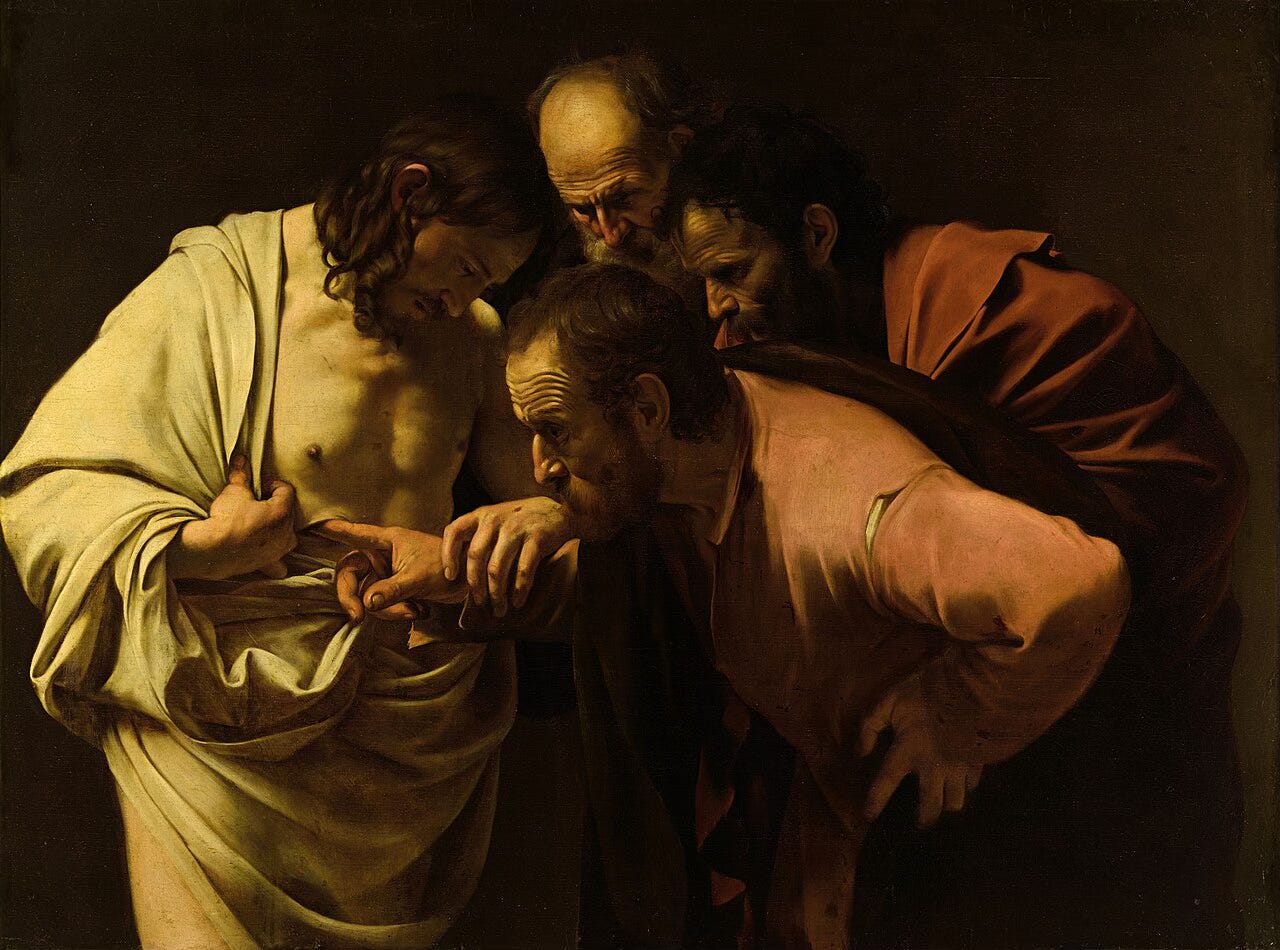
Jesus had appeared a week before to all the disciples. This encounter is deeply personal for Thomas. Jesus does not reject Thomas’s doubt. He enters into it. He invites him:
Put your finger here and see my hands, and bring your hand and put it into my side, and do not be unbelieving, but believe (Jn. 20:27).
After allowing himself to be wrapped up in doubt, he followed the prescription of Jesus. As he touched the wounds in the hands and feet of Jesus, he was able to overcome his own preconceived notions. As he reached his hands into the open side of Jesus, he was able to see the depth of the love of Jesus. We are no different from Thomas. We are free, but that freedom can lead us away from the truth. We can fall into isolation and doubt, or it can lead us to Christ. True freedom is not the ability to choose anything. It is the courage to choose what is true, even when it challenges us. And ultimately, it is the courage to believe.
Will we use our freedom to resist the truth… or will we fall on our knees before Jesus and declare “My Lord and my God”?
Buenísimo, gracias Padre.
Hi Fr. Nicholas. Thank you for this gift. I really need to spend more time on the Thomas story. So many lessons there I want to learn. Thanks again.