

Sometimes, I see someone who posts something saying that anxiety and faith cannot coexist. The claim makes me a little nervous, because I feel like it puts too much pressure on people of faith. The idea is that the more you believe and trust in God, the less you will worry, and therefore you will not experience anxiety. I suppose that is true in a way, but I am concerned that it downplays the reality of mental disturbances that people have to deal with.
Trust in God can bring profound peace, but anxiety is not always simply a failure to trust God. Even saints have struggled with fear, scrupulosity, or other forms of emotional and psychological distress. These experiences should lead us to prayer, yes, but also to seek support in family, friends, pastors, and qualified mental health professionals.
Paul’s Trials
In the second reading, Paul seems to be going through it. I love St. Paul. He is such a passionate figure from the New Testament. He was a man who was always all-in. When he thought the Christians were a menace to the Jewish religion, he got letters from the authorities so that he could go out and arrest them. After his conversion, he was more than willing to suffer for the Gospel. His willingness did not make it any easier, however. Describing his interior state of affairs, Paul expresses himself in his letter to the Romans in a way that I think resonates with all of us.
I have great sorrow and unceasing anguish in my heart (Rm. 9:2)
It sounds like something many of us could say any day of the week. We all have things that make us sad, and that makes sense. During this earthly life, we constantly face challenges that push us to our limits. Paul feels anguish because many of his people reject Christ. The beautiful thing is that if we look at the Gospel, we can find many moments when Jesus shows us how to deal with wild challenges. The philosopher Karl Jaspers came up with a term to describe such experiences. He called it a Grenzsituation, a limit situation, moments when we discover that we are not in control. It is never comfortable, but it is always a growth opportunity.
Faith does not always remove anxiety, and there can be people of deep faith who suffer from anxiety or other forms of mental illness and psychological suffering. So telling anxious people that they simply need more faith seems counterproductive. First, we should accompany them with compassion, then encourage them to deepen their relationship with Christ.
Apostles Facing Fear
The apostles were facing a limit situation in today’s Gospel (Mt. 14:22-33). They are out on the water, and for some reason, Jesus seems to be a bad passenger. One priest friend of mine complains about traveling by plane with me. He thinks that only when he travels with me does he ever run into the delays and discomfort of air travel. I think they are more ubiquitous, but that’s not the point. It seems like when Jesus is in the boat, their faith is always going to be challenged. In this passage, they have strong winds and powerful waves. Even worse, they see a mysterious figure walking on the waves and are afraid that it’s a ghost.
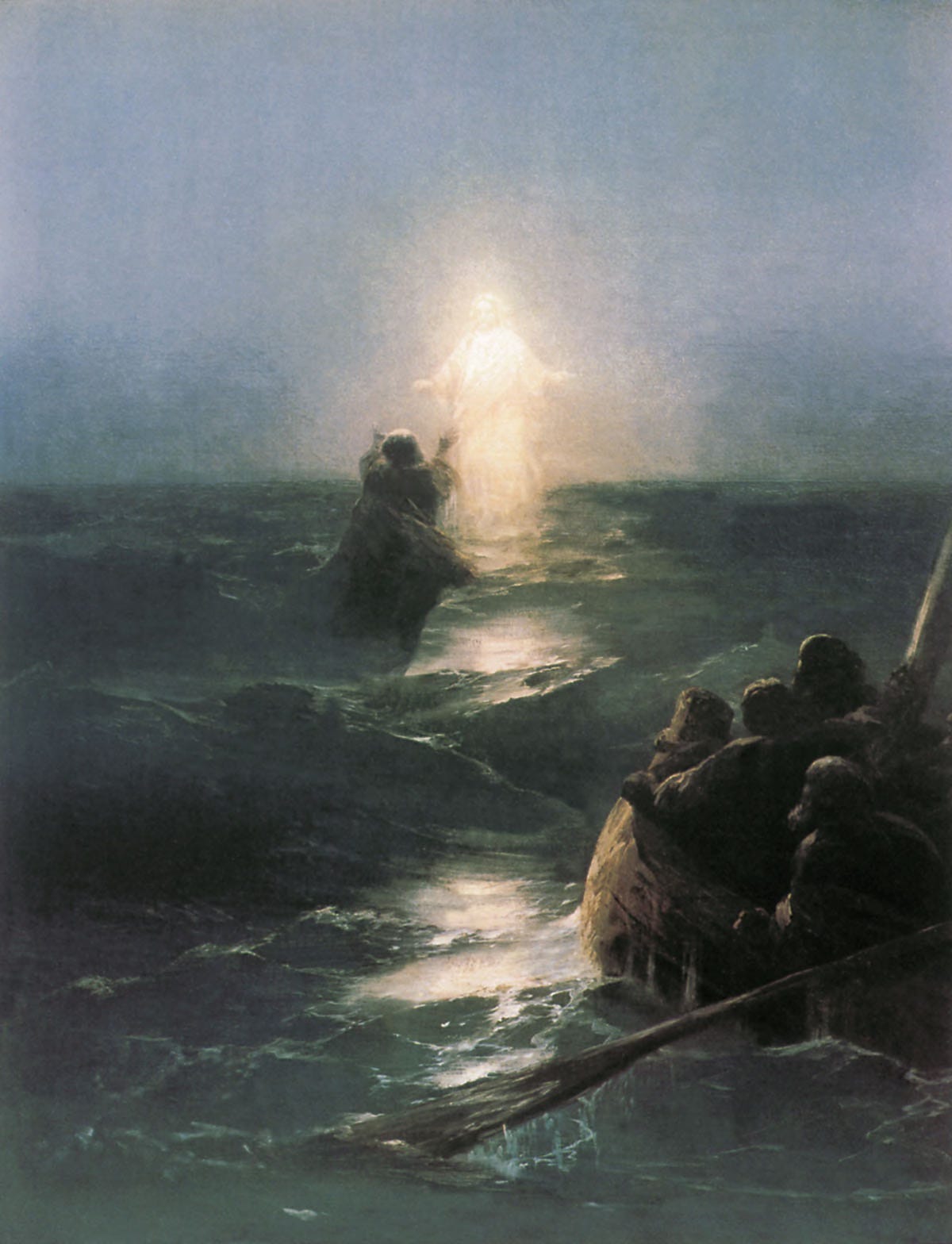
A limit situation is one that we can’t change, solve, or safely avoid. It forces us to choose truth and self-awareness. Death, suffering, guilt, and struggle are all examples of limit situations. As the apostles are losing their minds, Jesus speaks to them calmly:
Take heart, it is I; have no fear (Mt. 14:27).
This seems a lot easier said than done. When we are afraid, we don’t feel like “Don’t be afraid” is very good advice. But Jesus does give us a key about how to get through moments of fear and anxiety. We need to look for Jesus in these crisis moments.
Good Therapy
This should not take away from the very good help that therapists can give, helping to understand what strategies we can use to deal with irrational fear and anxiety.
The other day, I heard what sounds like a helpful remedy for many people experiencing anxiety. “Do it for fun.” In other words, don’t convince yourself that one interview, one exam, or one conversation determines your entire future. Take it easy. Shifting our perspective helps reduce anxiety and gives greater freedom.
I think this can be very freeing for many people. The point of the Gospel is not that the storm immediately disappears. It is that Jesus appears in the storm. His first gift is not calm seas, but his presence.
His presence changes everything, but at the same time, we need to be careful not to reduce real mental health problems to spiritual roadblocks. We need to take all of our problems to Jesus. What can you do this week to trust more in Jesus and walk out to him on the water?
You may have to pray like Peter, “Lord, save me” (Mt. 14:30). And even better, he may pluck you out of the water, and you can respond with the disciples in the boat: “Truly you are the Son of God” (Mt. 14:33).
Sunday’s homily is going to 🔥
Thank you Fr., for writing this, today. I needed to hear this.