

First reports suggest that the Fort Hood shooter will be executed and that his execution will be livestreamed. Secretary of War Pete Hegseth shared this in a Thursday, October 8 interview. Vice President Vance later that day cast some doubt on that, but the very concept is repellent. It strengthens the argument that the death penalty is out of place in modern society. Turning the deliberate killing of an individual into a public spectacle risks normalizing violence. Some Catholic pundits get up in arms when the Pope speaks out against capital punishment, but our streak of anti-capital punishment Popes seems to grow at each papal election.
What do you think about capital punishment?
Karol Wojtyła opposed the death penalty, and this is in line with the way he looked at the human person. In his first encyclical, Redemptor Hominis, “On the Redeemer of Man,” he argues that everything about humanity is affected by the reality of redemption. We cannot escape the reality of personal guilt, but it can be forgiven through the sacrifice of our Savior.
No Escape from Redemption
The situation of man in the modern world is affected by redemption. It is impossible to imagine a world in which redemption has not happened. Jesus, the truly innocent one, died in the place of the guilty. In a world that often denies the capacity to be guilty, Christianity acknowledges the guilt, but also preaches mercy.
As we speak in public, it is often difficult to hold two truths together. People can commit genuinely evil acts. No person ever ceases to possess human dignity. Sometimes, we excuse the actions of those we favor while condemning others as irredeemable. Christianity avoids both errors. We condemn evil for what it is but still make an effort to love the sinner.
Against a background of the ever-increasing historical processes, which seem at the present time to have results especially within the spheres of various systems, ideological concepts of the world and regimes, Jesus Christ becomes, in a way, newly present, in spite of all his apparent absences, in spite of all the limitations of the presence and of the institutional activity of the Church (Pope St. John Paul II, Redemptor Hominis, 13).
Jesus is truly present in the world, and he is a real person, not an ideological construct. No political or social system can claim to have Jesus as the only inspiration, because he is larger than any of those categories. Just as Jesus Christ truly entered history over 2,000 years ago, his intervention in the world is real. We have a God who gets his hands dirty.
Forgiveness
Christianity is dealing with concrete man, not an abstraction. No one can accuse Karol Wojtyła of being removed from the reality he is speaking about here. Still a young Pope, he had to practice forgiveness towards Ali Agca, the Turkish gunman who attempted to assassinate him in 1981. In 1983, he went to visit Ali Agca in prison and extended his heartfelt forgiveness.
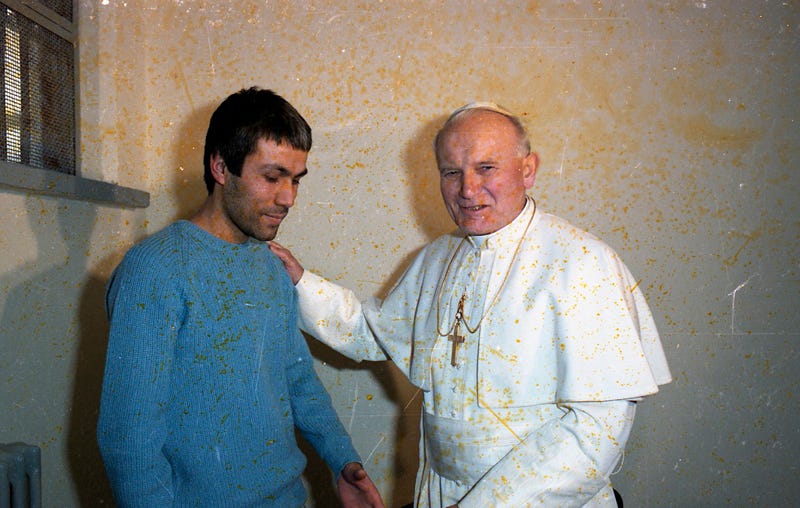
Doctrine becomes real when it is lived out. If Pope John Paul II had merely preached forgiveness, but not had the gesture of forgiveness with Ali Agca, his words would have seemed hollow. As it is, however, his words carry an immense weight. He truly desired the salvation of all people, even those who wished and did him ill. His meditation on the Person of Jesus Christ always led him back to the human person.
For the Church, all ways lead to man
For the Church, all ways lead to man. The Polish Pope looked at man as:
the primary and fundamental way for the Church, the way traced out by Christ himself, the way that leads invariably through the mystery of the Incarnation and the Redemption (Pope St. John Paul II, Redemptor Hominis, 14).
Christ’s coming into the world has transformed what it means to be human. It takes time for us to unpack the full meaning of the Incarnation. Perhaps there were strong arguments for the State to protect its citizens through capital punishment. However, the Christian imperative to protect human dignity and seek the conversion of sinners gives us compelling reasons to reject it today.
However, in the 21st century, with all that we know and our technological advances, it is no longer necessary. We should not execute criminals, first because of who they are, but second, because of who we are. All human beings are created in God’s image, wounded by sin, and still loved by Christ, who desires their redemption. Who are we? We are called to imitate Christ, upholding justice, protecting the innocent, but also refusing to reduce any human being to his or her worst act.
Just because someone else has violated the dignity of human beings does not mean that we have to repeat that same mistake. Especially as Christians, we are called to have a capacity for forgiveness that is not of this world but is of the world to come.
A Society Afraid of Violence
Modern man is afraid. We shudder at the rise in mass shootings and violence. We fear for ourselves and for those close to us. At the same time, each act of violence should also serve as an examination of conscience for us as a society.
The man of today seems ever to be under threat from what he produces, that is to say from the result of the work of his hands and, even more so, of the work of his intellect and the tendencies of his will (Pope St. John Paul II, Redemptor Hominis, 15).
We should look at the increase in men and women who perpetrate such crimes and question why society is producing more violence and less peace in a world that would seem to have plenty of resources for everybody. Our technological sophistication has grown enormously, but technological progress does not mean we grow automatically in moral wisdom or respect for human dignity. The problem is that we have very little grasp of the inherent dignity of every human person. If we permit the perpetuation of a culture of death, we cannot be surprised when we see a rise in violence.
Culture of Death
Pope John Paul II spoke out frequently against what he termed a culture of death. His understanding of our absolute duty to defend life comes from his understanding of Jesus Christ as the center and goal of all history. The human story is one of a creature who has come from God, has fallen into sin, and has been redeemed by the sacrifice of a Savior.
Our lives do not belong to us absolutely. As creatures, we depend on God, and our behavior should reflect that. Not even the government can stand above the duty that we all have to defend life.
Even worse than perpetuating capital punishment, there is talk about making it into a show. This desire for vengeance is understandable, but it responds to the basest of human desires. As Christians, we are called to look toward Heaven rather than indulge our thirst for vengeance. We must resist the temptation to become like the ones who do evil to us.
Christian opposition to capital punishment reveals what we believe about the human person. No one can be reduced to the worst thing he or she has ever done. This does not diminish the horror of murder, the suffering of victims, or the state’s duty to protect the innocent. It does mean that justice must never lose sight of the dignity of every person who stands before it. Even murderers can be redeemed.
Well said. Ağca was a trained assassin and the Pope's forgiveness led to his conversion to Catholicism although accounts are unclear as to when/how. Hegseth’s execution of Nidal Malik Hasan under the UCMJ is problematic on many levels not to mention that filming it would be macabre, even if some consider the execution justified by the depravity of Hasan’s actions—in addition to his many victims he also killed a pregnant woman who was pleading for the life of her unborn child. President Obama deepened the misery of the victims’ families by describing the rampage as “workplace violence” rather than as a terrorist attack. I admit that I struggle with the question of capital punishment. The current Catechism of the Catholic Church, §2267 sees it as inadmissible but this is a change from prior teachings which said execution could be justified only when it was the sole practicable way to defend human lives, a situation considered “very rare, if not practically non-existent.” The earlier version makes sense to me and the latter makes me wonder how the Church will respond to societal breakdown and widespread anarchy (like Plato predicts is the result of democracy devolving into...) St. Thomas Aquinas explicitly defended the death penalty in principle, arguing that, in some cases, legitimate public authority may execute a dangerous criminal to protect the common good. He compared this to removing a diseased limb to save the body, while maintaining that such action could be justified only when necessary for society’s protection. In my view, although I accept the Church’s teaching against the culture of death, I do not see capital punishment in certain cases as contributing to that culture; rather, I see it as a means of protecting society in those exceptional cases where necessary which do not exist in our time but may in a later time. In other words, I may be mistaken, but it seems to me that, whereas abortion is intrinsically evil, capital punishment is not, even if it is now inadmissible. So, my tortured comment reflects my obedience to the teaching and my doubts--perhaps lack of hope--that it is sustainable in the future.
It shocks and surprises me how people are reacting in social media comments to the case of Christa Pike and how there is this immense desire to see criminals die. For Catholics, I think it is critical we remember the story of Saint Maria Goretti and Alessandro Serenelli.