

Yuval Noah Harari represents a growing conviction in contemporary culture: as science advances, religion and philosophy become increasingly unnecessary. Looking at religion through the lens of evolution and history, he sees it primarily as a collection of shared stories that enable large-scale human cooperation. From a sociological perspective, this is a compelling account of how religions function. Humanism, nationalism, and capitalism might function just as well as the world’s major religions in enabling and encouraging large-scale human collaboration. But does explaining religion’s social role exhaust its meaning? Or does it overlook the deeper questions religion has always sought to answer?
Is Religion Pragmatic or Metaphysical?
This understanding of religion treats its value as primarily pragmatic rather than metaphysical. This view sees religion as important for what it does and does not concern itself with the value of its truth claims. This stands in marked contrast to Pope John Paul II’s vision. For John Paul II, the real question is not whether science can replace religion or philosophy, but whether all three seek the same truth by different methods. Science investigates the natural world, philosophy reflects on reason and being, and religion asks about humanity’s ultimate origin and destiny. Scientific inquiry can itself become a path by which the scientist encounters God.
In his book, Miracles, C.S. Lewis reflected that “Men became scientific because they expected Law in Nature, and they expected Law in Nature because they believed in a Legislator.” This goes along well with Karol Wojtyła’s basic intuition that truth is objective and goes beyond what we can make up ourselves. There can be no contradiction between true faith and reason, as they work together to attain the truth. John Paul II famously described faith and reason as “two wings on which the human spirit rises to the contemplation of truth” (Pope St. John Paul II, Fides et Ratio, introduction).
His respect for faith and reason motivated his continuous dialogue with science throughout his priesthood and papacy.
He spoke to the Pontifical Academy of Sciences, encouraging scientists to use their scientific inquiry to complete their own humanity. “Every scientist, through personal study and research, completes himself and his own humanity” (Pope St. John Paul II, “Address to the members of the Pontifical Academy of Sciences”, 13 November 2000). For Karol Wojtyla, the question always returns to what it means to be human.
Tool To Understand Our Place in the Cosmos
He saw science as an important tool to understand man and his place in the universe. Scientific discoveries continually expand our understanding of the universe. Science may tell us how stars form or how life develops, but it cannot determine why there is something rather than nothing, whether human dignity possesses objective value, or what constitutes a good life. These are philosophical and religious questions because they concern meaning rather than mechanism.
No matter how large our body of scientific knowledge grows, there will always be questions that are beyond the realm of science to adequately answer. The number of particles contained within the observable Universe is finite; the amount of information encoded in all the Universe is finite; no matter how much we learn, the amount that we know will always be finite. Beyond all definite knowledge, there will always be room for philosophy (Ethan Siegel, “No, Science Will Never Make Philosophy Or Religion Obsolete”, 30 June 2020).
The issue is not how much scientific knowledge humanity eventually acquires. Even if the natural sciences one day explained every physical process in the universe, they would still leave unanswered questions that belong to philosophy and theology: Why is there something rather than nothing? Is there objective moral truth? What determines the dignity of a person? What is the ultimate meaning of life? Even if scientific knowledge continued to expand indefinitely, the fundamental questions of meaning, purpose, and morality would remain.
A Different Role for Religion
John Paul II proposes a different role for religion than what many secular thinkers assume. It is not meant to be a tool for collaboration, but a vehicle to arrive at the truth.
Science can purify religion from error and superstition; religion can purify science from idolatry and false absolutes. Each can draw the other into a wider world, a world in which both can flourish (Pope St. John Paul II, “Letter to Reverend George Coyne, SJ”, 1 June 1988).
Religion cannot be reduced to superstition, but it risks becoming so when there is not a rigorous confrontation with objective truth. Scientific inquiry offers an important dialogue that helps religion distinguish authentic faith from superstition and continually purify its understanding of the created world.
Boldness and Confidence
Sometimes, it feels like believers approach new scientific discoveries defensively, as if every advance were a threat to faith. This was not the case with Pope John Paul II. His confidence in objective truth, certainly bolstered by his philosophical background, made it so that he could never view scientific truth as an obstacle or a threat to his way of looking at the world.
If anything, new scientific discoveries can force us to rethink the way we look at certain realities of the world. Authentic faith has nothing to fear from genuine scientific discovery. Sometimes, these discoveries require believers to rethink longstanding assumptions about the natural world. But they never change the world as such. A true scientific method is more concerned with discovering the truth that is already there rather than reinterpreting the facts to fit a preconceived theory or ideology.
A New Spin on the Enlightenment
The Enlightenment period ushered in a new appreciation for knowledge and intellectual growth. It fostered much of scientific development and seemed at times to be at odds with religion. However, this exaltation of reason is not inherently threatening to religion. At its best, the Enlightenment challenged only forms of religion that were unwilling to submit their claims to the demands of reason and truth.
When some scientists during the 19th and 20th centuries tried to move from their scientific discoveries to make metaphysical claims, they naturally made some churchmen nervous. This was, however, never the case for Karol Wojtyła. For him, these scientific discoveries were only pushing the envelope of human knowledge and could ultimately only help us to understand humanity better and especially our place in the cosmos.
The Heavens Sing the Glory of God
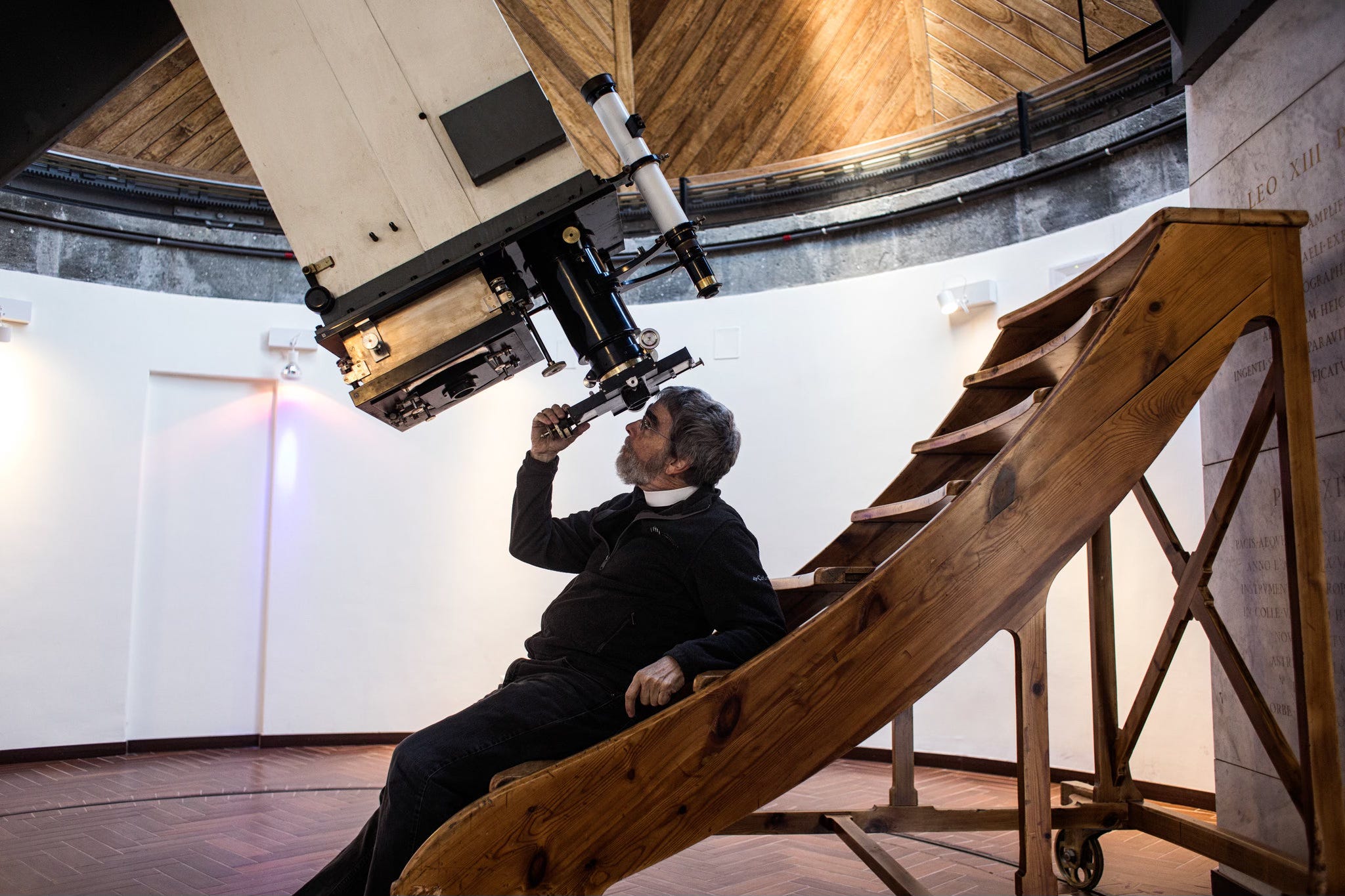
Remembering Psalm 19, “the heavens declare the glory of God,” Pope John Paul II viewed scientific inquiry as an incredible ally for religion and theology.
Can theological method fruitfully appropriate insights from scientific methodology and the philosophy of science? (Pope St. John Paul II, “Letter to Reverend George Coyne, SJ”, 1 June 1988).
What does evolution mean for theological anthropology? How does astronomy deepen our understanding of creation? How might advances in neuroscience illuminate the mystery of the human person? These are not questions to be feared but welcomed. Every genuine scientific discovery enlarges our understanding of creation and therefore offers new opportunities to contemplate our Creator. When we approach the world with curiosity rather than fear, we become better able to hear what the Psalmist proclaimed long ago: “The heavens declare the glory of God.” (cf. Ps. 19)
Scientific advancements do not shrink the areas proper to faith. Rather, they widen the horizon, opening up new spaces to truth. Every genuine discovery in the natural sciences allows us to know more about the created world, and through that, the Creator. Science can explain how the world works, but philosophy seeks wisdom and religion directs the human person to the One who is the source of all truth. For Christianity, truth is not merely an abstract principle but rather a Person. The search for truth reaches its highest accomplishment in encountering Jesus Christ, who reveals both God and the human person to himself. Rather than rendering religion obsolete, scientific advances increase the reasons for wonder.