

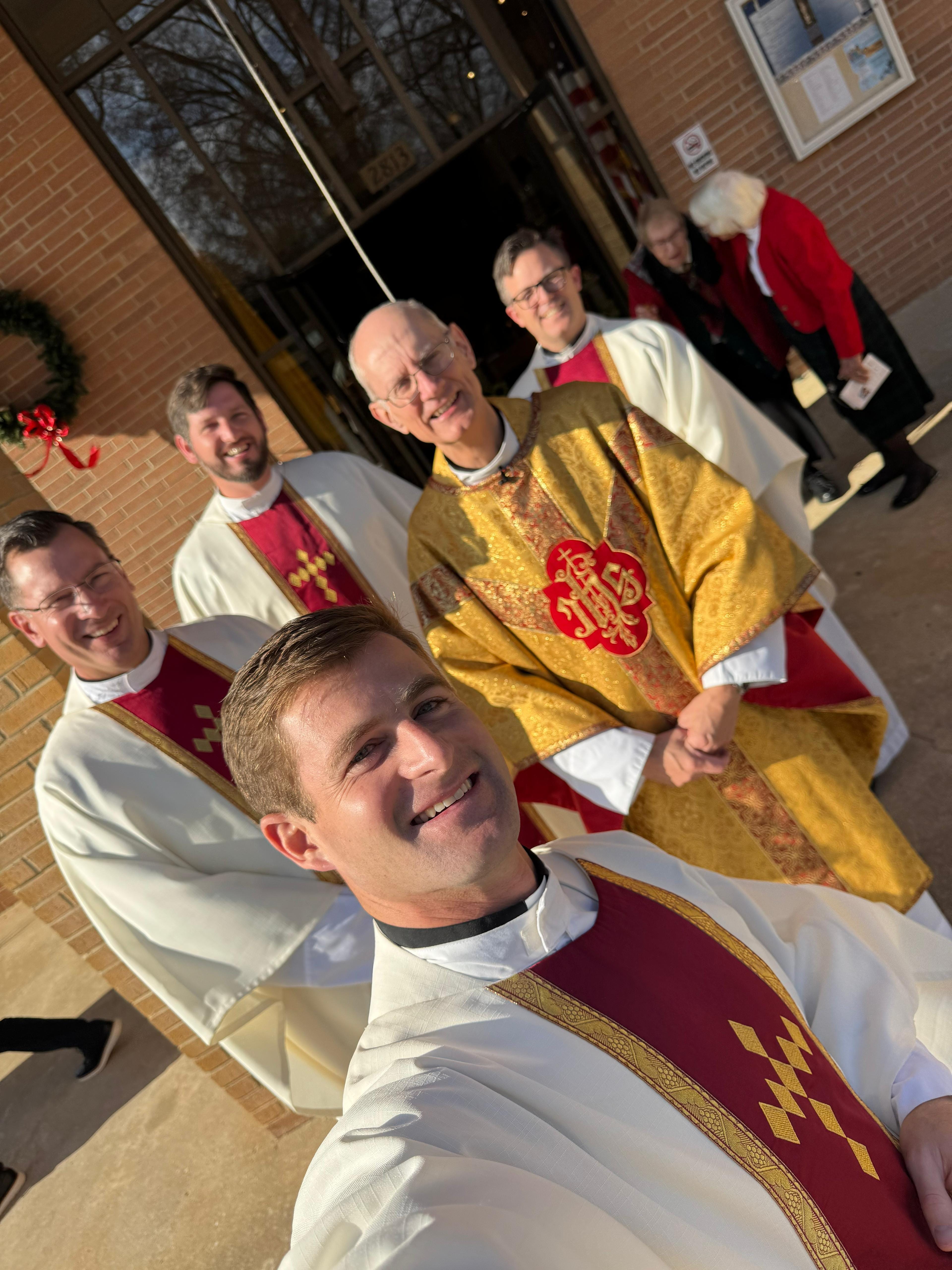
We had our last Mass of 2025 at Duke on Christmas Eve. The five priests who live in my house in Durham were there for the Mass. Then, for Christmas Day, we joined the priests in Raleigh for Mass. I was able to preach the homily, The Gift God Wants.
In the news:
My thoughts on the Sunday Gospel: We get to celebrate the Holy Family this Sunday. Check out my homily here at A Battle of Images: Herod, Culture, and the Holy Family.
What I’m reading: I had one of my hardest reads in a while. As I try to get into the thought of Pope John Paul II, I read a book by a philosopher who has studied his thought.
At the Center of the Human Drama, Kenneth Schmitz
At the Center of the Human Drama can be read as a five-act play. Schmitz traces Karol Wojtyla’s intellectual development from literature, through philosophy, and into theology, highlighting his genius in adopting the language and concerns of modern philosophy while remaining rooted in the deep truth of perennial philosophy.
The first chapter shows how Wojtyla initially approaches existential questions through literary means. His plays portray human beings as actors within a drama, revealing that personal meaning emerges through action, voice, and participation in a larger narrative.
Chapter Two examines Wojtyla’s dialogue with modern philosophy. He is responding to the question “why be good?” recognizing that he can no longer use the traditional answers. Kant abstracts moral obligation from lived experience, putting all moral value in the will. Scheler looks at values but lacks a sufficiently strong account of personal agency and moral responsibility. Wojtyla discovers that the acting person becomes good or bad through his actions. He explores this throughout his Lublin Lectures.
The third chapter shows a maturing of thought in The Acting Person, even though the first translation into English was problematic. Although it is dense, it is worth reading.
In the fourth chapter, he looks at the catecheses as Pope. His theological insights on original solitude and original unity complete his earlier philosophical reflections. He moves from Scripture to understand man.
In the fifth chapter, he looks at how his philosophy carries through into his teaching as Pope. He proposes five truths to be held to understand the philosophical contribution of Wojtyla to the understanding of the person and the metaphysical grounding of moral living.
Overall, Schmitz argues that Wojtyla offers a renewed metaphysical account of the person that integrates subjectivity without collapsing into modern immanentism.
Youtube Video of the Week: Fr. Mark-Mary Ames, CFR, talks about how the Church is too divided when he visits the Pints with Aquinas Podcast.
Merry Christmas, Father! So cool that you had mass at Duke, that’s where my mom went to school! So great to find so many amazing Catholic priests on here :)