

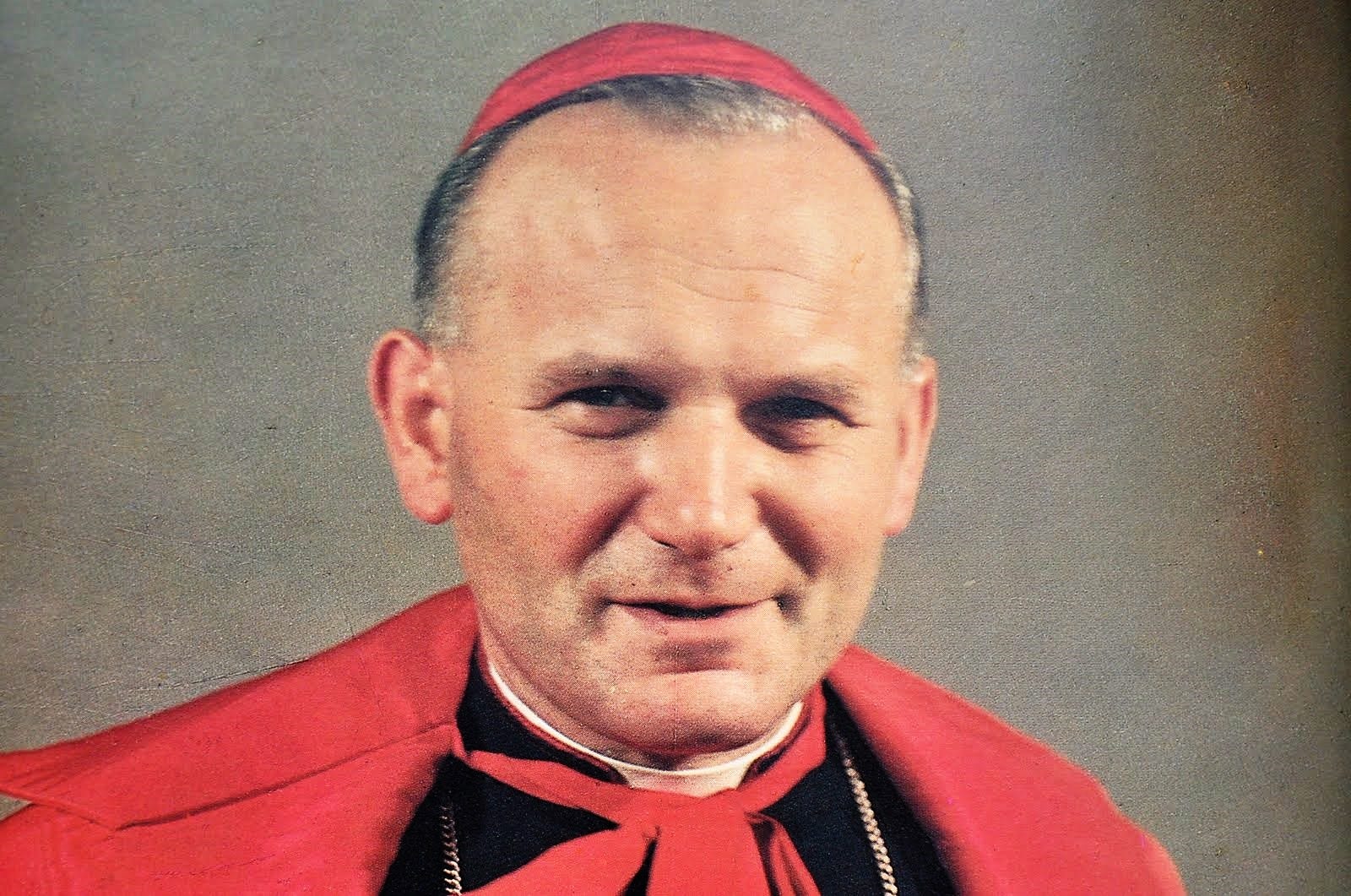
In 1964, Karol Wojtyła was appointed Archbishop of Kraków. After serving as auxiliary bishop for six years, he would finally assume leadership of the Archdiocese. Three years later, in 1967, Pope Paul VI created him a cardinal. In 1969, he began writing Sources of Renewal, a theological reflection on the Second Vatican Council by a firsthand witness. Published in 1972, it offered his interpretation of the Council and a vision for its implementation in the life of the Church. Pope St. John Paul II was a man of piercing vision, both forwards and backwards. It is hard to characterize his life as anything other than looking forward to the dawn of the Third Millennium. At the same time, he was always a man deeply steeped in history. In his theological thought, this meant especially a look back to the monumental event in recent Church history, the Second Vatican Council.
Central Document from the Second Vatican Council
Among all the documents, Gaudium et Spes always held a special place in the heart of Karol Wojtyła. The 1965 Pastoral Constitution would serve as his inspiration for how to guide the Catholic Church into the third millennium. His visit to the United States and Canada in 1969 gave him another opportunity to encounter Western society and appreciate the possibilities offered by political and religious freedom. He desired such freedom to be present in his homeland of Poland as well and would work for that through his own role as archbishop and later as Pope of the Universal Church.
Joys and Hopes
Young Father Karol had been part of the commission that worked on Gaudium et Spes. While he did not pen number 22, which would be his favorite text to quote throughout his papacy, he did propose a text to the commission. In 1964, he sent to the commission a text known as the “Polish text,” emphasizing the importance of religious freedom. This reflects a Polish understanding of the episcopate, particularly in Kraków, where he spent forty years of his life.
The Kraków episcopate had a distinct historical character in matters of religious freedom. To be the successor of St. Stanisław was to be the heir of an ancient tradition in which the bishop was the defensor populi, the “defender of the people,” and the defensor civitatis, the “defender of the city” of last resort (George Weigel, Witness to Hope, p. 189).
His love for his Polish homeland made him into a natural candidate to help rally support for Poland during the decades of Soviet domination. His experience of political persecution helped him to see the value of religious freedom, built into the structure of the Vatican II document.
In his commentary on the Second Vatican Council, he focuses at one point on redemption as a reality constantly directed towards man in the world.
The redemptive work of Jesus Christ which determines the inmost nature of the Church is in fact the work of the redemption of the world (Karol Wojtyła, Sources of Renewal, p. 69).
Linked to the Redemption
He would eventually link his entire pontificate to the mystery of the Redemption worked through the sacrifice of Christ on the Cross. Rather than embracing a secular humanism, the Christian humanism proposed by Wojtyła flows from the Christian mystery itself.
The mystery of redemption, closely linked with Jesus Christ, his life, death and resurrection, is the central reality of our faith. Here Vatican II offers a great contribution to the enrichment of faith from the point of view of consciousness of redemption (Karol Wojtyła, Sources of Renewal, p. 75).
Putting man at the center comes from recognizing the centrality of Christ in his work of redemption.
This central Christian reality is presented to man in such a way that, following the expression of Gaudium et Spes, we can perceive a specific kind of anthropocentrism emerging through the Christocentrism which the Constitution reflects so clearly (Karol Wojtyła, Sources of Renewal, p. 75).
He looks first at Jesus Christ and then at the human person. This is how he discovers the infinite dignity of every human person. His personalist philosophy would contribute to the modern understanding of human dignity, particularly in the Western world.
Christian Humanism
Fully aware of the developments in modern philosophy, particularly the Marxist expression of Hegelian thought, Wojtyła recognized the limitations of an understanding of humanity detached from its transcendent vocation. Marxism has a way of celebrating “humanity” in the abstract, whereas Pope St. John Paul II was much better at celebrating each human being as a person. By placing Christ at the center, rather than man, he actually gives a greater metaphysical foundation for the need to treat humans respectfully, according to their inherent dignity.
In reality it is only in the mystery of the Word made flesh that the mystery of man truly becomes clear. For Adam, the first man, was a type of him who was to come, Christ the Lord. Christ the new Adam, in the very revelation of the mystery of the Father and of his love, fully reveals man to himself and brings to light his most high calling (Gaudium et Spes, 22).
Well Worth Quoting
Pope St. John Paul II would go on to quote this passage more than 200 times in his papal teaching. His reverence for the mystery of redemption led him to reflect repeatedly on the dignity of the human person. His reflections would bear fruit in his reflection on the Theology of the Body, his personalist philosophy, and his consistent support of religious freedom.
Already reading through the Vatican documents as the Cardinal Archbishop of Kraków, Wojtyła was aware of what for him was the central paragraph of the entire Council.
We seem here to have reached a key point in the Council’s thought. The revelation of the mystery of the Father and his love in Jesus Christ reveals man to man, and gives the ultimate answer to the question, “What is man?” This answer cannot be separated from the problem of man’s vocation: man confirms his identity by accepting that vocation and making it a reality (Karol Wojtyła, Sources of Renewal, p. 75).
What he recognized in 1970 as the key point would continue to shape his thought throughout his time as Universal Pastor.
Vocation and Redemption
The vocation of every man and woman in the world runs through the mystery of redemption. This is the great insight that Wojtyła discovered through his meditation on Gaudium et Spes 22. Christ does not merely serve as the face of the Father, revealing God to humanity. Rather, Christ reveals humanity to itself. We can only arrive at the true sense of what it means to be human by coming to understand the great gift that is Jesus Christ. We are all called to participate in God’s divine life offered through Jesus Christ.
This is not simply some abstract theological principle. It helps us understand the mission of the Church in the modern world. The Church defends human dignity because Christ has revealed the extraordinary vocation of every human being. We stand up for religious freedom, not because all religions have the same value, but because all humans do. The Church’s mission is inseparable from the mystery of redemption.