

All around the world, people are looking to Pope Leo XIV for guidance on the ethical use of artificial intelligence. His papacy has already shown a deep concern for technology and human dignity through the creation of an Interdicasterial Commission on Artificial Intelligence and the anticipated encyclical Magnifica Humanitas. To understand the foundations of this conversation, it is helpful to look back at Pope Benedict XVI’s social encyclical, Caritas in Veritate.
Pope Benedict reflected extensively on the theological virtue in his major writings on hope, faith, and love. His social encyclical Caritas in Veritate applies Christian charity to questions of economics, development, and technology.
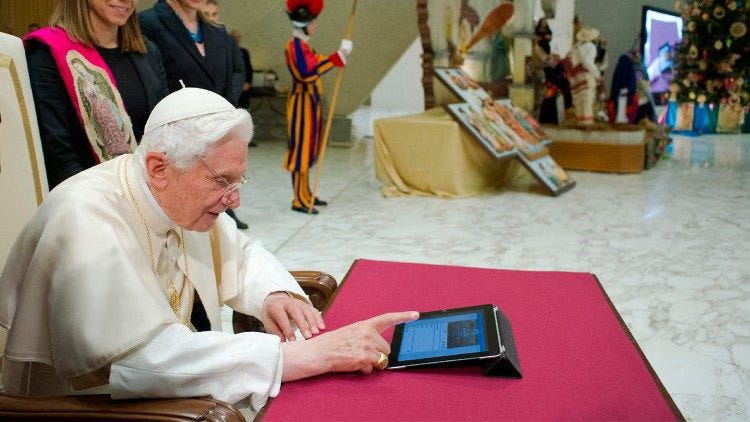
In Chapter Six, he reflects on “The Development of Peoples and Technology.” His reflection on technology is striking. Technology “is a profoundly human reality, linked to the autonomy and freedom of man” (Pope Benedict XVI, Caritas in Veritate, 69). Technology is one of the signs that anthropologists look for to distinguish early humans from other primates. It is human to use technology. Pope Benedict gives an important criterion here, that it should still respect the autonomy and freedom of man.
No longer slaves
We are not to be enslaved by technology. When we look at more recent technological advances, we can see a risk of falling into a certain servitude rather than using them for our purposes. Technology threatens our autonomy and freedom when we hand over our decision-making to it without further thought. Writing to the Galatians, Paul reminded them, “you are no longer a slave but a child” (Gal. 4:6). We must avoid turning to algorithms to determine truth. Rather than being slaves of technology, we are called to be children of God. I expect this to be a key theme in the upcoming encyclical to be published by Pope Leo.
Dominion over the earth
Using technology is human because it is an extension of the command from God at creation to have dominion over the earth (cf. Gn. 1:28). “Technology enables us to exercise dominion over matter, to reduce risks, to save labor, to improve our conditions of life” (Pope Benedict XVI, Caritas in Veritate, 69). Having artificial intelligence so much in the news and in our conversations, there is a certain risk of reducing the debate to the well-known and explicit AI chatbots, but the topic is already much broader. Features in newer cars, such as adaptive cruise control with automatic braking, smart refrigerators that order food automatically to maintain inventory, and updates to your navigation apps, are all part of the technological revolution as well. It is important to grasp the scope of artificial intelligence and technology in our lives. Are we using it in a way that makes our lives safer and improved, or is it invading our privacy and diminishing our quality of life?
More than just technology
“Technology is never merely technology. It reveals man and his aspirations towards development, it expresses the inner tension that impels him gradually to overcome material limitations” (Pope Benedict XVI, Caritas in Veritate, 69). As we witness the progress of technology, we see that the new features follow authentic consumer needs and desires. Even looking at our feed on social networks can be instructive. The algorithm often feeds us the sort of things we already consume regularly, while simultaneously shaping our habits and desires. A quick look at our feed can serve as an examination of conscience. Perhaps we experience what Paul described in his Letter to the Romans: “What I do, I do not understand. For I do not do what I want, but I do what I hate” (Rm. 7:15). When we experience this, we are being slaves, rather than masters.
Technology, and specifically, artificial intelligence, is more pervasive than ever. We allow it to be our master when it limits our freedom and autonomy. The challenge is to master it through discipline and virtue, so we can build up the Kingdom of God, seeking holiness, happiness, and connection in our own lives.
Technology should remain a tool that serves the human person, not a master that diminishes freedom. The Christian challenge is not to reject technological progress, but to cultivate the virtue necessary to use it wisely in the service of God and neighbor.