

If John the Baptist was preaching in the desert and your favorite music artist was performing in town, where would you go? John the Baptist helps us live hope actively, rather than passively, during Advent. We can get caught by the flashy and forget the foundational. With so much going on, it’s easy to overcommit to various social obligations and forget about Jesus.
We all know that there are many commercial aspects of Christmas. Christmas tree lots pop up all over the place. We decorate our houses, both inside and out. This feels very different from what we imagine Advent should be like. Meanwhile, the liturgy focuses on a call to repentance.
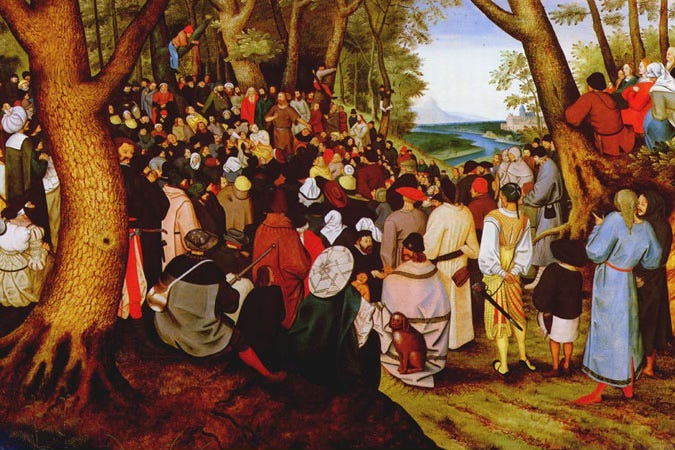
John the Baptist is the central figure from today’s Gospel (Mt. 3:1-12). The shock value of his clothes is exceeded only by the radicality of his message. And yet, people come from Jerusalem to hear him preach.
Repent, for the kingdom of heaven is at hand (Mt. 3:2).
Why did so many people go out into the desert to see John? It seems like he was always calling to repentance. He offered a baptism that signified repentance. He was not preaching a “health and wealth Gospel,” but rather preparing the way for Jesus. This is why he is so important to us. He helps us get ready for Christmas in a more real way than Advent calendars with chocolates or evergreen trees in living rooms. These externals can point us to what we are truly preparing to celebrate, the birth of Jesus, our Lord.
John the Baptist was a prophetic figure who worked through both words and gestures. St. Augustine reminds us how John the Baptist taught us the excellence of the Kingdom of Heaven. We should look forward to it as a wonderful city that we should desire to belong to as citizens. (cf. Augustine, “Sermon 16 on the New Testament”).
The way John dresses shows his hope. He wears camel’s hair and a leather belt. He lives in such a way that it is clear he is not looking for ultimate happiness in this world. By dressing so radically, he shows that his trust is in God alone. He must have seemed like a wild man, and it must have been an incredible sight to see the fine men and women of Jerusalem go out into the desert to listen to him preach.
And when they did arrive, what did they hear? John did not mince words and called them “brood of vipers” and recriminated them for reciting the Law but not living it in their hearts. John invites all of us to examine ourselves for the sin of hypocrisy.
This seems like a hard teaching as we are trying to open our hearts to the beautiful mystery of Christmas. It should inspire hope, however, because John was trying to free the men and women of Jerusalem from their greatest enemy. So often, what keeps us most from falling in love with Jesus and surrendering ourselves completely to him is our attachment to self. So, surprisingly, the figure of John invites us to hope as we move through this Advent season.
Hope is an active virtue, and one that challenges our basic attitudes. The problem is that we often think of hope as passive and wish we could just feel hopeful without doing anything. This is not how things work in real life.
Whenever we begin a new project, we have to overcome our initial laziness and internal resistance until we become an unstoppable force. John is spurring us to active hope at this stage of Advent. Christian hope “is a gift from God which fosters within us a deep and appropriate desire for Him, and fuels us on our journey towards Him” (Clement Harrold, “What is Hope and How is it Different from Faith?”). Hope is not a feeling, but a supernatural virtue that makes us desire God and helps our hearts recognize him as a magnet for good.
How are you going to live the time of Advent between now and Christmas? Live hope actively by setting aside time for Jesus. Spend less time worried about the concerns of this world and live a little more time focused on the coming of Christ. Take five minutes every morning to reflect on how you are going to live with hope that day. This is a great way to make sure that you are living hope actively instead of passively. Don’t just wait for Christmas – advance towards Christ.