

Are we human, or are we dancer? – The Killers, 2008
These lyrics from the 2008 song by the Killers prefigure Pope Leo XIV’s first encyclical, Magnifica Humanitas. The reaction has been fascinating to watch. While many have focused on its treatment of artificial intelligence, the document is fundamentally about the human person in an age increasingly shaped by AI.
Catholic social doctrine has a healthy legacy stretching back to Pope Leo XIII’s encyclical Rerum Novarum, which addressed the social upheaval of the Industrial Revolution and the competing ideologies that sprang up in response during the 19th century. Once again, the question becomes: who are we as human beings, and what does that mean in the face of technological advances that usher in great societal upheaval? In a world that values data, the Pope offers “wisdom, where we find principles for thought, criteria for discernment and judgment, and concrete guidelines for action” (Pope Leo XIV, Magnifica Humanitas, 3).
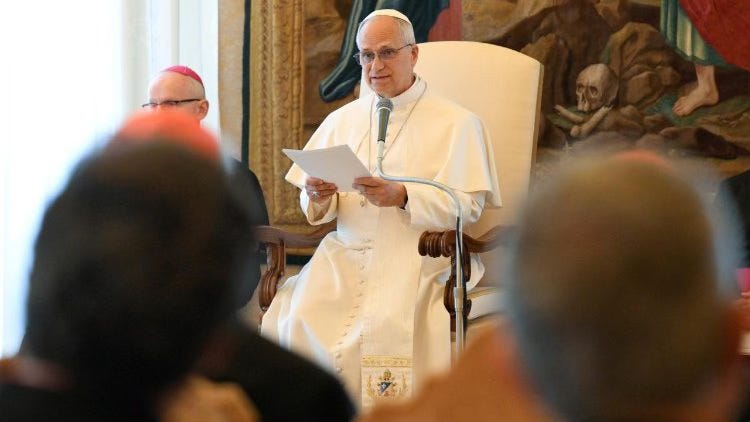
He proposes two biblical images: the Tower of Babel and Nehemiah rebuilding the walls of Jerusalem. Both images evoke a process of building. The Babel syndrome could be characterized as the attempt to achieve unity, progress, and power apart from God. This is expressed today through technological or economic ambition detached from moral truth and consequently idealizing profit. The actions of Nehemiah, however, herald Church teaching on the Common Good. This begins with a firm relationship to God while acknowledging human weakness. It recognizes our shared responsibility for one another and calls us to engage the world according to the values of the Gospel.
These two biblical images also illuminate the Church’s mission in moments of social transformation. What is the role of the Church in the world? It is a sign of unity and helps to interpret reality. The false unity sought by the builders of Babel can only be overcome when there is hope for true unity, fostered by Gospel values. Reality must not be interpreted merely through a geopolitical lens focusing on power, but above all through the evangelical values proclaimed by Jesus Christ in his words and witness.
Cardinal Czerny shared in an interview that while the Church’s teaching has political ramifications, the Church is not called to be partisan. The political and ecclesial spheres remain distinct, yet there are moments when both must grapple with the same moral questions.
Pope Leo brings to mind a phrase from Pope Francis: “time is greater than space” (cf. Pope Francis, Evangelii Gaudium, 222-237). Space hardens processes while time propels us towards the future and encourages us to go forward in hope. We need to foster long-term growth and avoid shortsighted grasping for power. Time opens new possibilities for growth and conversion. We need patience in the midst of tension.
After giving a review of Catholic social doctrine, he goes on to talk about technology and the dominance of artificial intelligence.
Current AI systems are more “cultivated” than “built,” for developers do not directly design every detail, but instead create a framework within which the intelligence “grows.” (Pope Leo XIV, Magnifica Humanitas, 98).
There are some pitfalls in this way of working, at least in how it relates to our humanity. The complexity of these systems can obscure who is responsible for their decisions and what assumptions are built into them. We can be deceived by the apparent ease of results, the false impression of objectivity, and the simulation of human communication. Accountability becomes difficult when we lose sight of the engineers behind these systems and instead attribute agency to machines.
In a time of technological transformation, it is important to remember the values of truth, work, and freedom. Truth is necessary for an authentic promotion of the Common Good. Much of what happens now in the media and public discourse leads us to the false impression that we can make up the truth. After decades of a prevailing narrative of relativization of truth, it is important to recover a rich understanding of truth as the way our minds correspond to objective reality.
Furthermore, it is important to remember the dignity of work. Humans are not to be treated as cogs in a machine directed by robots and artificial intelligence. The machine is to be at the service of humans, not the other way around. One curious aspect of AI is that it can actually de-skill workers when they perform simple tasks just to keep the machines running.
Finally, it is vital to protect freedom against dependencies and commercialization. Marketing seems to be the final frontier of human existence. But the addictions and hidden dangers that appear make it clear that we have to make a sincere push for authentic human freedom.
Are we human, or are we dancer? The song asks whether we possess true free will and individuality, or if we will simply conform to the societal expectations that arise with the advance of technology. The digital world is a new continent for evangelization, and it is important to turn to Christ in moments like these to reach our true human dignity.
As Pope John Paul II liked to recall from the Apostolic Constitution, Gaudium et Spes, “only in the mystery of the incarnate Word does the mystery of man take on light” (Vatican II, Gaudium et Spes, 22). By looking at Jesus, we come to understand ourselves for who we are.
Pope Leo XIV’s encyclical is not an incursion into geopolitics, but rather an encouragement and exhortation of hope in the face of a world that seems to be growing increasingly complex. No matter how complex the world becomes, it is Christ who is the King and Lord of history.