

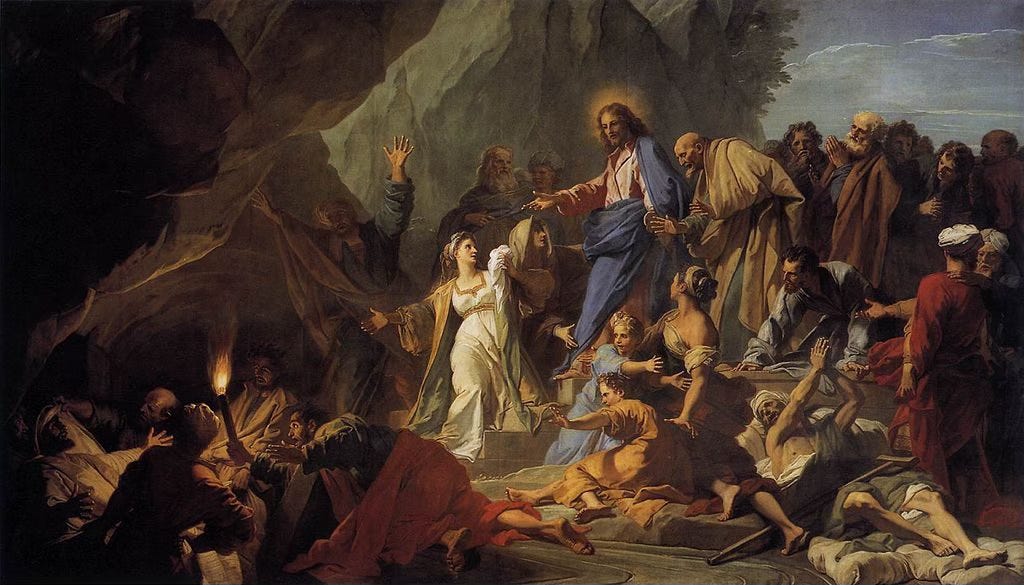
In June 2018, 12 boys from a soccer team and their coach were trapped inside a cave in Thailand. For 18 days, rising floodwaters threatened their survival before being rescued in a complex international operation. When I hear their story, I can’t help but ask: if I were trapped, who would I want coming for me? In today’s Gospel, Lazarus is in a cave too, a tomb. And the one who comes for him is Jesus.
One of the most important elements of our spiritual lives is recognizing and acknowledging that we need Jesus. We need the humility to admit that we cannot do it on our own. We cannot seek perfection apart from Christ. We have to learn to let him take over and guide us to our true home, which is Heaven. Apart from Christ, we can do nothing, and that is not bad news. Because with Christ, all things are possible.
The foundation of all interior life is the practice of deep humility. Humility is truth, knowing who we are before God and in relation to ourselves and others. Through original sin, our temptation is to live the lie that we are in control and that we don’t need God. Nothing is as freeing from this misconception as contemplating the reality of death. Lazarus could have no overestimations of his own power once he died. Jesus would use his death to show his own power and to teach others to rely completely on him.
The greatest obstacle to our spiritual growth is our pride. Pride distorts our relation to God, as well as with ourselves and with others. We can see this through the wounds we each carry. The important thing is not so much that we have suffered something, but rather how that affects us long-term. We hate having wounds. We wish we were completely healed. However, when we grow spiritually, we begin to realize that our wounds are the vehicle Christ uses to show us our poverty of spirit.
The place you most wish were different may be the place where Christ most wants to meet you.
Humility begins by becoming self-aware and realizing that everything good that we have comes from a good Father who loves us immensely. God is good, and it is good that he shares his gifts and blessings with us. What do you have that you have not received? (1Cor. 4:7) The more you can recognize that you have received everything from the hand of God, the more grateful you will be and the more you will grow in humility.
Paul exhorts us to esteem others more than ourselves (cf. Rm. 12:10). When we are humble, we are not enslaved to our image. Lazarus came out of the tomb wrapped in bandages. When Jesus frees him, he doesn’t stop to fix how he looks; he just walks out. That’s what humility does: it frees us from the obsession with how we appear. When we are humble, we say we are sorry when we offend others. We look to serve, rather than to be served (cf. Mt. 20:28).
Humility allows us to live before God, appreciating him joyfully and gratefully. This makes it so that we can taste God’s good fruits in prayer.
He who has God finds he lacks nothing. God alone suffices (St. Teresa of Avila).
Through the raising of Lazarus, Jesus shows us that he is in charge. The sisters of the dead man, Martha and Mary, are saddened by the event. Jesus himself is also sad. And yet, he arrives with authority and confidence in his own power. He is the best possible person to arrive on the scene. Death does not have the final word, because Jesus does.
Knowing that Christ is on our side gives us tremendous confidence and peace. So often, we feel anxious and nervous about the future. This always happens when we are trusting too much in our own efforts and have not truly given space to God to work in our lives. This week, name one place where you are still trying to be in control and invite Christ into it. Let him come into that “cave.” Because he is already on his way to you.