

Iconoclasts broke into churches and destroyed sacred images, claiming that they were idolatry. For them, vandalism was a way of guarding the faith. Eastern Emperor, Leo the Isaurian, decreed in the 8th century that Christians could not venerate images. The iconoclasts carried out his implicit wishes, pillaging churches and removing visual reminders of God and the saints. St. John Damascene defended the use of images, arguing that sacred art follows from the mystery of the Incarnation. In the Eastern Church, they celebrate the “Triumph of Orthodoxy” on the first Sunday of Lent, remembering when the Church definitively approved the veneration of images in 843, leaning heavily on the teachings of St. John Damascene. Since God became man, we can depict him – not guessing at divinity but portraying the humanity he truly assumed.
If a picture is worth a thousand words, why is there so much division over the use of images in Christianity? Christians disagree not because images are trivial, but because they are powerful.
Images shape imagination; imagination shapes culture; culture shapes how we treat the vulnerable. A Christianity devoid of images is a Christianity that has forgotten the reality of the Incarnation. Jesus has become man, and this is so real that he even has a human family.
Through God’s mysterious design, it was in that family that the Son of God spent long years of hidden life (Pope John Paul II, Familiaris Consortio, 86).
God chose to put Jesus in a human family, which was precisely the Holy Family. He grew up in a loving home and revealed from within what it means to live family life. Just as sacred images reveal the mystery of God made visible in Christ, so too the Holy Family reveals what God intends for every Christian family. The Holy Family shows what every Christian family should be. No pressure, right?
The Holy Family is an icon of the Christian family. The word “icon” means image and is important in Catholic theology. So much of what we believe and experience as Christians goes back to the foundational truth of the Incarnation. God became man and dwelt among us (cf. Jn. 1:14).
As we celebrate the Feast of the Holy Family, we should ask ourselves what image of family informs our imaginations. We live in confusing times, and this is all the more reason to know what we mean when we talk about family. We see a growing rejection of the traditional family – not always out of malice, but often out of confusion or pain. Yet we must continue to present the beauty of God’s design: the family of father, mother, and children.
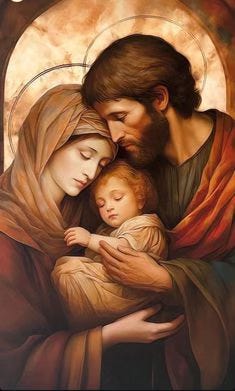
What are the images shaping our culture? We seem to have little knowledge of the Bible but a lot of awareness of pop culture. We know about the private lives of celebrities and experience a celebration of the fragmentation of families, without counting the cost for the most vulnerable: our children. In the context of the Nativity, we hear how Herod wanted to “destroy the child” (cf. Mt. 2:13). It seems that in our world, there are many Herods who are attempting the same thing. Herod’s violence is not simply a story from long ago; it reveals a perennial truth about the fragility of children in a fallen world.
I wonder which is a more powerful icon of modern times: the Holy Family of the Christian family or the desire to “destroy the child.” There are so many ways children are under attack from exploitation, neglect, and the pressures of a confused culture. It is our duty as a society to protect them. If we want to protect children, we need to invest our resources in building up Christian families. There is no better place for a child to be than in the center of a loving, Christian family.
Just as the Holy Family serves as an icon to understand the family, every child serves as an icon to reverence Jesus, the son of the Holy Family. This is part of why we should revere human life and protect it at all stages. God creates us in his own likeness and image, and so each one of us possesses inherent human dignity (cf. Catechism of the Catholic Church, 1702).
Too often, we judge our families by what they provide for us. Instead, we should consider how we can build up our family. Try praying the rosary together as a family, or if that seems like too much, start with a decade once a week. The more we allow God to sanctify our homes, the more our families become living icons – reflections of the Holy Family in a world starving for holy images.